

Introduction

What happens when an offshore Design support team completes the work, but the U.S. firm remains responsible for getting it right?
That is the key question U.S. firms should ask before using offshore Design support services.
Design support outsourcing will help companies increase capacity, acquire expertise and handle workloads. However, Design support outsourcing does not necessarily imply transfer of risk, responsibility for quality and customer demands on its own accord.
For U.S. engineering firms, , consultants, and AEC companies, the focus should be on building a clear delivery model with strong quality assurance, communication, documentation, review, and accountability.
This is especially important for projects with strict client, regulatory, contractual, or federal requirements.
So, how can U.S. firms use offshore Design support outsourcing while maintaining control and reducing risk?
It starts with clearly defining who is responsible, how work is reviewed, and how quality is controlled.
What Are Offshore Design support Services?
Offshore Design support services involve Design performed by professionals outside the country where the primary client or project is based.
For U.S. firms, this can include CAD drafting, BIM production, structural calculations, design documentation, quantity takeoffs, modeling, and technical production. For firms evaluating external production capacity, understanding how drafting outsourcing companies fit into an AEC workflow can also help define which tasks are suitable for external support.
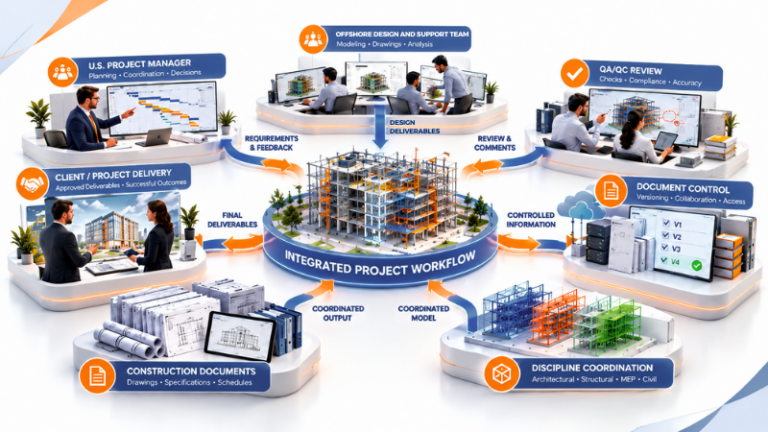
The offshore Design support team often works as an extension of the U.S. project team not a replacement for it.
Under a successful Design support outsourcing arrangement, the US Team side is responsible for requirement definition, coordination with customers, decision-making, and quality control. Offshore partners assist in technical manufacturing within their areas of responsibility.
Example of this can be found in situations where the US engineering consultant uses offshore Design support services to augment his CAD or BIM resources at high workloads.
This can add capacity without permanently expanding the workforce.
The key is ensuring that more capacity does not mean less control.
Why U.S. Projects Need a Different Offshore Design support Approach
Engineering projects are not simply production tasks. A drawing, model, calculation, or technical document can affect cost, schedule, constructability, safety, and contractual obligations.
That means Design support outsourcing services need to be managed differently from general administrative outsourcing.
A production team may be able to complete a task exactly as instructed. But Design work often requires context.
The team needs to understand:
- What standards apply?
- What does the client require?
- Which design assumptions are acceptable?
- What information is missing?
- Who has approval authority?
- Which changes require escalation?
- Who performs the final technical review?
Without these answers, even technically capable offshore Design support teams can produce work that requires significant rework.
The difference between production and responsibility
One of the most useful ways to structure offshore Design support is to separate production responsibility from approval responsibility.
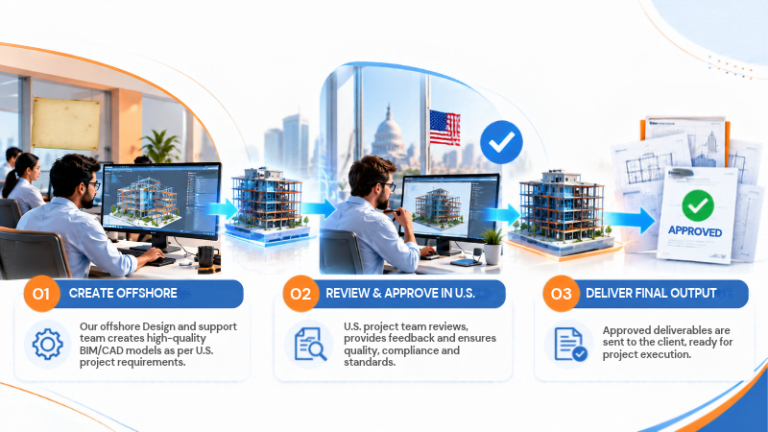
For example, an offshore Design support team may develop an BIM model according to a defined scope. However, the U.S. project team may still need to verify that the model meets the project’s requirements before it is issued to the client.
This does not mean every task must be duplicated by two teams.
Instead, the review process should be designed around project risk.
Routine production work may require standard checks. Higher-risk engineering decisions may require more detailed review by stateside qualified personnel.
This approach makes engineering project management more predictable because everyone understands where work is produced, where it is checked, and where decisions are made.
Managing Risk in Offshore Design support Teams
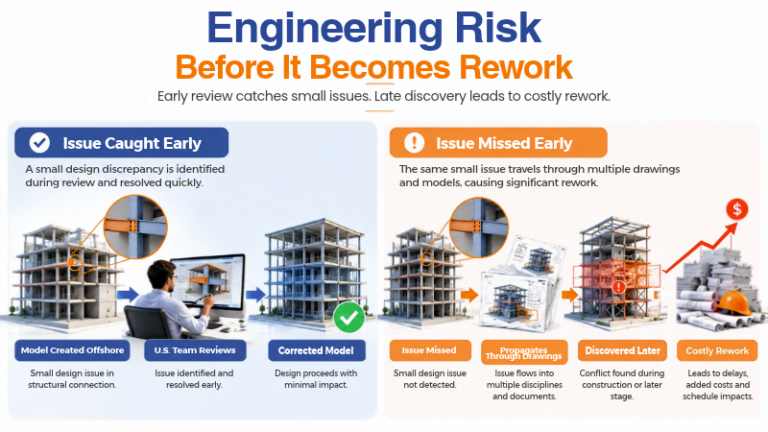
The biggest risk in offshore Design support is not necessarily the physical location of the team.
The bigger issue is whether the project has enough controls around that team.
Consider a simple example.
A U.S. consultant sends an incomplete set of project information to an offshore team. The team makes reasonable assumptions, completes the drawings, and submits them back. The drawings look technically polished, but the assumptions do not match the client’s expectations.
The problem is now larger than a drafting error.
The U.S. team may need to explain the issue to the client, revise the work, absorb additional hours, and potentially deal with schedule impacts.
This is why engineering project risk management should begin before production starts. Early-stage engineering decisions can also benefit from data-driven analysis and predictive workflows, helping teams identify potential design and performance issues before they become expensive downstream changes. Predictive design in early-stage engineering explores this approach in greater detail.
1.Risk starts with project definition
A clear scope gives the offshore team a defined target.
Instead of simply saying:
“Prepare the structural drawings.”
The project should establish the expected deliverables, applicable standards, available reference information, file formats, level of detail, review requirements, deadlines, and escalation process.
The more complex the project, the more important this becomes.
A strong scope also reduces the number of decisions that an offshore team has to make without adequate context.
2.Communication is part of risk control
Communication is often treated as a project-management issue, but in offshore Design support it is also a quality-control issue.
When teams work across different time zones, a question that could have been answered in an hour may remain unresolved for an entire workday.
Over time, these small delays can affect production schedules.
A structured communication process can help. The goal is not to create more meetings. It is to create a predictable way for teams to clarify technical questions, document decisions, and escalate issues.
That could include a shared project tracker, defined points of contact, regular coordination calls, and documented responses to design questions.
The important part is consistency.
Engineering Liability: Where Responsibility Must Stay Clear
Engineering liability is another area that U.S. firms need to consider carefully when using outsourcing.
Sending Design support work to an external or offshore team does not automatically mean that the U.S. firm has transferred all responsibility associated with that work.
The actual allocation of responsibility depends on the project contract, scope of services, professional requirements, applicable laws, and the specific relationship between the parties.
For federal contracts, this becomes particularly important. FAR Part 46 establishes quality-assurance responsibilities for Consultants/ contractors, while FAR provisions concerning sub-consultants / subcontractors make clear that prime consultants/ contractors have responsibilities relating to sub-consultant/ subcontractor performance and responsibility.
Therefore, companies should not treat Design support outsourcing simply to move work outside the organization.
Instead, the outsourcing arrangement should clearly establish:
- Who produces the work?
- Who reviews it?
- Who communicates with the client?
- Who approves changes?
- Who handles technical questions?
- Who maintains project records?
- Who is responsible for correcting errors?
These questions become especially important when the offshore team is working on deliverables that will eventually be reviewed, signed, sealed, submitted, or relied upon by a Licensed P.E./ U.S. client.
Since the specific requirements differ based on projects and jurisdiction, the contracts and professional obligations must be checked accordingly, not through a general outsourcing contract.
Design Quality Assurance and Quality Control
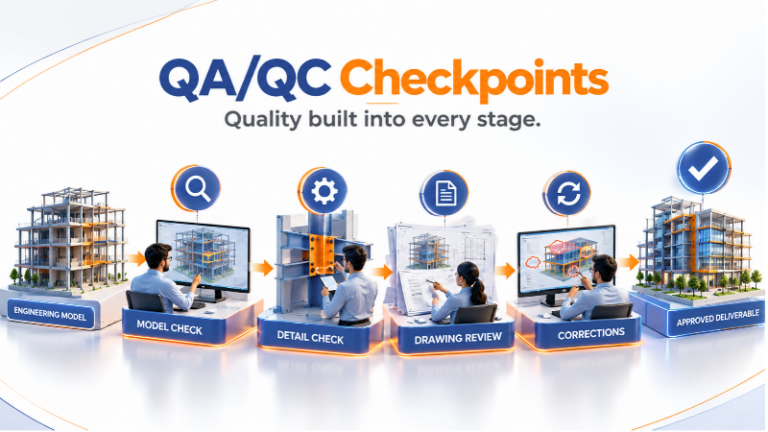
Quality should not be treated as the final step of outsourcing Design support services.
By the time an error reaches final review, correcting it can require changes across multiple drawings, models, calculations, and related documents.
This is why Design quality assurance should be built into the workflow from the beginning.
There is an important distinction between QA and QC.
Quality assurance focuses on the process used to produce consistent work.
Quality control focuses on checking the actual deliverable.
For an offshore Design support team, both are necessary.
What Design QA looks like in practice
A strong QA process may begin with standardized project templates and clearly defined production procedures.
The team must be aware of the data that need to be collected before the production process starts. They must also have knowledge of the standards, names, revisions, and format of the deliverable.
Then, during production, work can be checked at appropriate stages rather than waiting until the entire package is complete.
For example, a large BIM project may benefit from checking a representative portion of the model before the entire model is developed.
If a coordination problem is identified early, the team can correct the process before the same mistake appears throughout the project.
That is the practical value of Design QA/QC.
It is not simply about finding mistakes.
It is about preventing the same mistake from being repeated.
Measuring quality beyond “approved” or “rejected”
A project can also use measurable indicators to understand whether its quality process is working.
For example:
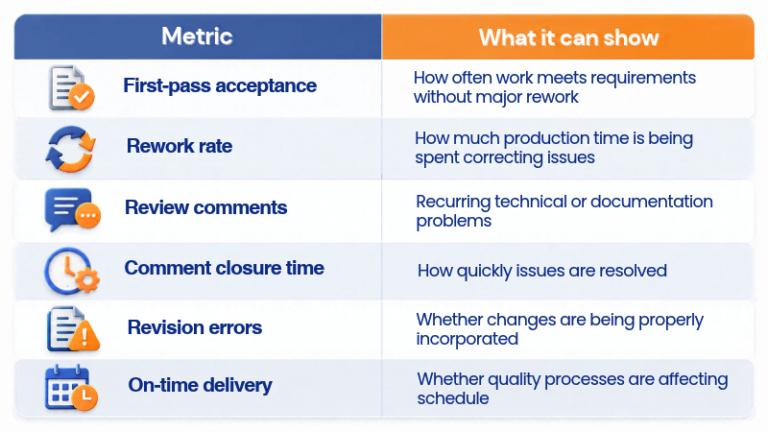
These metrics are more useful than simply asking whether an offshore team is “good” or “bad.”
They show where the process is working and where it needs improvement.
Managing Offshore Design Support Outsourcing Effectively
Successful offshore Design support outsourcing is usually less about geography and more about management structure.
A U.S. company may have access to a technically strong offshore team and still experience poor results if the project lacks clear ownership.
The reverse can also be true. A geographically distributed team can work effectively when responsibilities, communication, and review processes are well established.
1, Start with the right scope
The first step is determining what should actually be outsourced.
Not every engineering task has the same risk profile.
Production-heavy activities may be suitable for external support when the required inputs and outputs are clearly defined.
More sensitive activities may require greater involvement from the U.S. project team.
This means the question should not simply be:
“What work can we send offshore?”
A better question is:
“Which parts of this workflow can be performed externally while maintaining the required level of technical control?”
That small change in thinking can significantly improve an outsourcing strategy.
2.Create one source of project truth
Distributed teams can quickly create multiple versions of the same information.

One person may be working from an old drawing. Another may have a newer client comment. A third may be using a previous design assumption.
This creates avoidable rework.
A controlled document environment, clear revision procedures, and defined communication channels can reduce these problems.
The objective is simple: everyone should know which information is current.
3.Make escalation easy
An offshore Designer should not have to guess whether an issue is important enough to raise.
If project instructions conflict, information is missing, or a design condition appears unusual, the escalation path should be obvious.
A culture where teams are encouraged to raise questions early can prevent small uncertainties from becoming expensive corrections later.
Building a Reliable QA Framework for Offshore Teams
A practical Design quality assurance framework should connect project requirements with daily production.
The framework can begin before the first drawing or model is created.
- 1. Establish project requirements : The project team should define the scope, applicable standards, deliverables, deadlines, file requirements, review expectations, and communication process. This gives the offshore team enough context to perform the work correctly.
- 2. Confirm technical inputs : Production should not begin simply because a deadline exists. The team should have the information required to complete the assigned task. Missing or conflicting information should be identified early.
- 3. Define review points: Review does not always need to happen at the very end. For complex work, staged reviews can identify problems before they spread across the project.
- 4. Document changes: Engineering projects evolve. Client comments, revised dimensions, updated specifications, and design changes should be documented so that the team can understand what changed and why.
- 5. Track recurring problems : If the same error appears repeatedly, correcting each individual drawing may not solve the real problem. The process itself may need to change. This is where design project quality control becomes valuable. The goal is not only to correct individual mistakes but also to identify patterns that can be prevented in future work.
What U.S. Firms Should Evaluate Before Outsourcing Design Support Work
Before selecting a Design support outsourcing services provider, U.S. firms should look beyond hourly rates.
Cost is only one part of the equation.
A lower production rate may not provide savings if the work requires extensive review, repeated revisions, or additional project-management time.
Instead, firms should examine the provider’s ability to work within the project’s actual requirements.
- Technical capability: Does the team have experience with the relevant Design/ engineering discipline, software, standards, and project types?
- Quality process: How is work reviewed before it reaches the U.S. project team?
- Communication: Who will manage questions, updates, changes, and escalations?
- Documentation: Can the provider maintain consistent project records, revisions, and deliverables?
- Security and confidentiality :How will project information, intellectual property, and sensitive client data be handled?
- Scalability: Can the team support a small assignment and scale when project demand increases?
- Accountability: Most importantly, can responsibilities be clearly defined between the U.S. firm and the offshore provider?
These questions help shift the conversation from “How much does offshore Design support cost?” to “How will offshore Design support fit into our project delivery system?”
Common Offshore Design support Risks and How to Reduce Them
The risks associated with offshore Design support are often manageable when they are identified early.
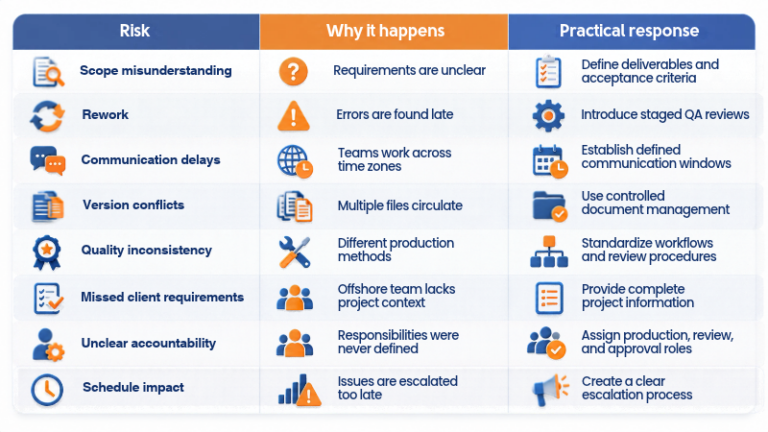
The objective is not to eliminate every possible risk.
No engineering project operates without risk.
The objective is to make risks visible early enough that the project team can manage them.
Extend Your Production Capacity Without Losing Project Control
Contragenix AEC Design & Support helps U.S. AEC firms extend their technical capacity with CAD, BIM, structural, civil, architectural, and Design support —backed by defined workflows, quality reviews, and clear project coordination.
Need additional Design support capacity? Explore Contragenix AEC Design & Support Services.
Conclusion
Offshore Design support services can give U.S. firms additional capacity, specialized skills, and production support but successful outsourcing requires more than sending work overseas.
What matters is how the offshore development team will integrate into the current process of working on the project.
Well-defined scope minimizes misunderstandings. Assigned roles maximize accountability. Effective communication eliminates bottlenecks. And quality assurance and quality control contribute to error detection.
The goal is not simply to outsource more work. It is to create a model where quality, responsibility, communication, and project control remain clear from start to finish.
When these elements are built into the workflow, offshore Design support can operate as a reliable extension of the U.S. project team.
Scale Your AEC Projects with Expert Design Support
Whether you’re managing multiple projects or facing resource constraints, our experienced engineering professionals seamlessly integrate with your team to provide accurate design, drafting, BIM coordination, and technical documentation, keeping your projects on schedule and within budget.