
Introduction
What if you could see how a building, bridge, or infrastructure asset would perform years before a single foundation was poured? That question is exactly what predictive design in early-stage engineering is built to answer. For decades, engineering teams have made critical early decisions, layout, materials, structural systems, based mostly on experience, assumptions, and static calculations. The problem? By the time a flaw shows up, it’s often deep into construction, where fixing it costs ten to twenty times more than it would have at the concept stage.
This is the gap predictive design closes. Instead of waiting for problems to surface after drawings are locked in, engineering teams now use data, simulation, and AI in engineering design to test outcomes before they commit. In this blog, we’ll break down what predictive design actually means, why early-stage decisions carry so much weight, how the AEC Design Technology supports predictive engineering, the challenges firms run into when adopting it, and a walkthrough of what it looks like in practice. Whether you’re an engineering firm owner, a project manager, or someone evaluating engineering design services for an upcoming project, this blog will give you a complete, practical picture of where the industry is heading and how to get ahead of it.
What Is Predictive Design in Early-Stage Engineering?
Predictive design in early-stage AEC design and engineering is the practice of using data-driven models, simulations, and forecasting tools to evaluate how a design will perform before it’s finalized, instead of discovering issues after the fact. during and after completion In simple terms, it flips engineering from reactive (“build it, test it, fix it”) to proactive (“model it, predict it, then build it right the first time”).
The Shift from Reactive to Predictive Engineering
Traditionally, engineering teams relied on:
- Manual calculations and static load assumptions
- Past project experience as a benchmark
- Physical prototypes or late-stage testing to catch design flaws
- Two-dimensional drawings that made it hard to visualize how systems interact
However, this approach leaves a lot of room for costly surprises. Predictive design, on the other hand, brings in real data, material behavior, environmental conditions, usage patterns, site-specific variables, early enough to influence the outcome, not just documenting it after the fact.
Core Components of Predictive Design
Most predictive design workflows lean on a mix of the following:
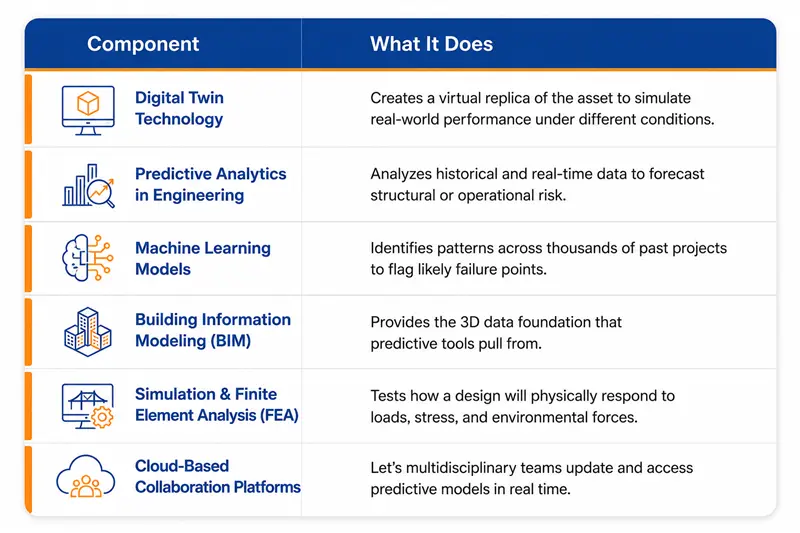
Together, these tools give engineering teams a much clearer picture of a project’s future — while there’s still time to change course cost-effectively.
Why Early-Stage Design Decisions Matter More Than You Think
Here’s a simple truth in AEC Design and Engineering: the earlier a decision is made, the cheaper it is to change, and the more expensive it becomes to ignore. Early-stage AEC Design decisions set the ceiling for a project’s entire cost, timeline, and performance, even though they’re often made with the least amount of information.
The Cost Curve of Change
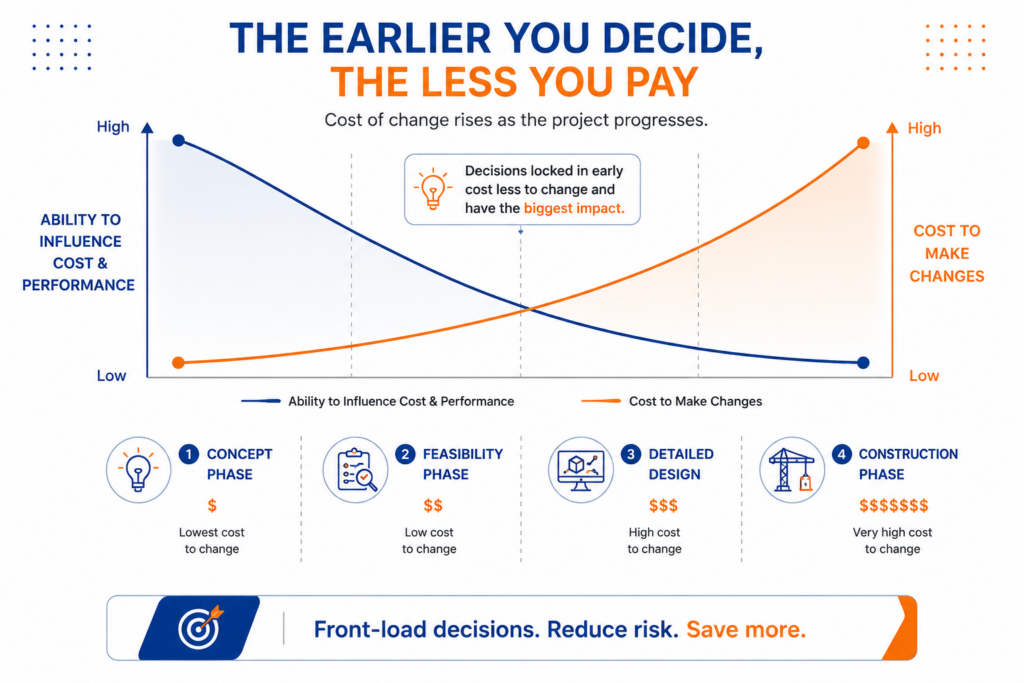
As a project moves forward, the cost of making a change grows sharply:
- Concept phase: A design change might cost a few hours of rework
- Feasibility phase: Changes still cost relatively good amount but start touching multiple disciplines
- Detailed design phase: Costs rise significantly as drawings, models, and specs are already interlinked
- Construction phase: The same change can cost 10–20x more, plus schedule delays and potential contract disputes
This is exactly why an AEC Design and Engineering feasibility study paired with predictive modeling is so valuable; it front-loads the insight instead of discovering problems when it’s too late to fix them cheaply.
Why Influence Drops as Design Progresses
There’s a well-known pattern in AEC Design and construction: your ability to influence a project’s cost and performance is highest at the very start, and it drops steadily as the project moves forward, while the cost of making changes moves in the opposite direction, rising the further along you get. Predictive design works by pulling more decision-quality data into that early window, precisely when your influence is greatest and your cost to act is lowest.
Early-Stage Decisions and Life-Cycle Costs
Beyond upfront cost, early decisions also shape long-term performance energy use, maintenance needs, and durability. In other words, getting the early-stage right isn’t just about avoiding rework; it’s about setting up a project to perform well for its entire lifespan, not just its construction phase.
Real-World Consequences of Skipping Predictive Analysis
When early-stage predictive analysis is skipped, a few patterns tend to show up later in an AEC Project:
- Structural or drainage issues discovered only after site work has already started
- Budget overruns traced back to assumptions made at concept stage that were never stress-tested
- Redesign cycles that push back permitting and construction schedules
- Disputes between stakeholders over "who should have caught this earlier"
None of these are unusual; they’re simply what happens when early decisions are made without enough visibility into how they’ll play downstream.
How Predictive Design Works: From Feasibility to Final Concept
So how does this actually play out on a real project? Predictive design typically threads through several early phases, each narrowing down the best path forward.
Engineering Feasibility Study Integration
An engineering feasibility study is usually the first checkpoint. Predictive tools here help teams answer: Is this even the right approach, site, or structural system before deeper resources are committed? Instead of a feasibility study being a purely narrative document, predictive tools let it include modeled comparisons, for example, how three different site layouts perform under the same load and drainage assumptions. This is the main purpose of due diligence.
Front End Engineering Design (FEED) and Predictive Modeling
Front end engineering design (FEED) is where scope, cost, and technical direction get locked in. Layering predictive analytics into FEED means teams can stress-test assumptions load capacity, material performance, site conditions, before detailed design work begins. This is often where the biggest cost savings show up, since FEED decisions directly shape the detailed design and construction phases that follow.
Conceptual Design Phase Engineering Tools
During the AEC design phase, engineering teams typically generate multiple design directions. Predictive tools allow rapid comparison of these directions using real data instead of gut instinct alone, which means more options can be explored in the same amount of time it used to take to fully develop just one or two.
Design Optioneering Explained
Design optioneering is the process of generating and comparing multiple design options side by side, cost, performance, constructability, so the best-fit option is chosen with evidence, not guesswork. It’s one of the most practical applications of predictive design, since it turns “we think this works” into “we can show this works.” Optioneering is especially valuable on projects with tight budgets or complex regulatory requirements, where a wrong early direction is costly to reverse.
The Technology Stack Behind Predictive Design
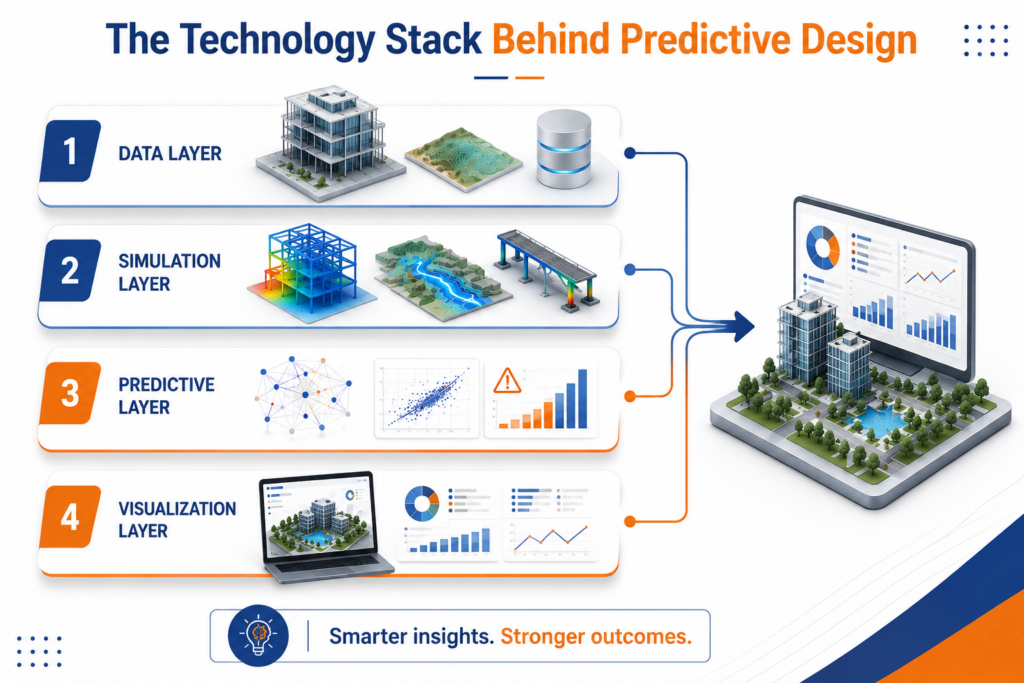
For teams evaluating how to implement this, it helps to think of predictive design as a stack of layered tools rather than a single piece of software:
- Data layer — BIM models, site survey data, historical project data
- Simulation layer — FEA, hydrology/hydraulic modeling, structural analysis software
- Predictive layer — machine learning models and analytics platforms that interpret simulation outputs and flag risk
- Visualization layer — digital twin dashboards and reporting tools that translate the analysis into decisions stakeholders can act on
Most firms don’t build all four layers from scratch; they integrate existing BIM, simulation, and analytics tools into a connected workflow.
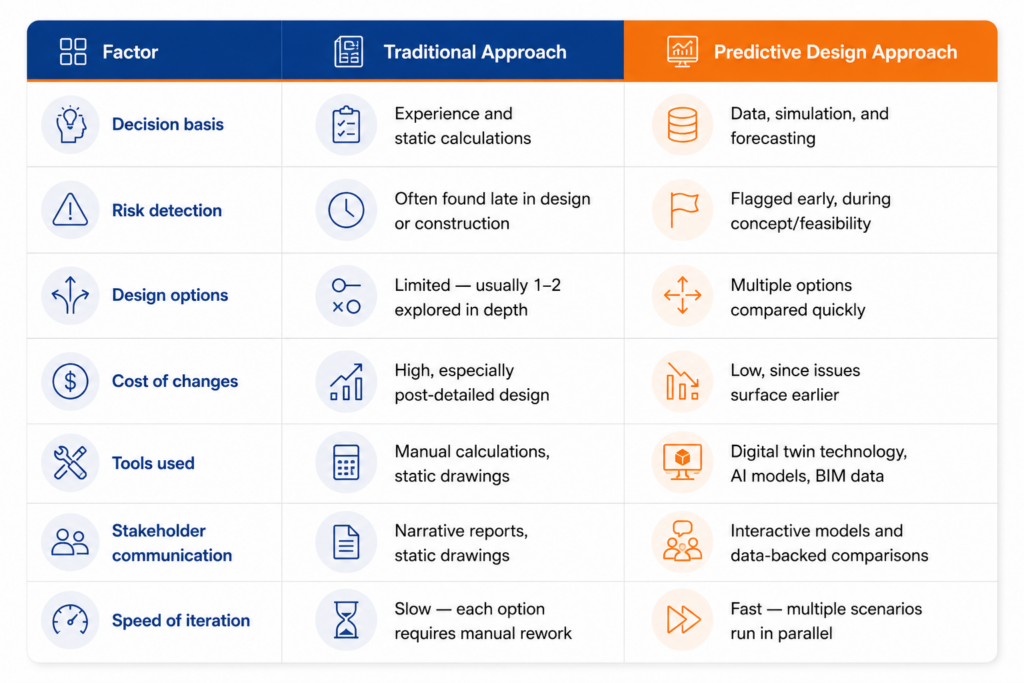
Predictive Design vs. Traditional Engineering Design Services
It helps to see the difference side by side. Traditional engineering design services and predictive-driven ones follow very different paths to the same goal:
When Traditional Methods Still Make Sense
To be fair, predictive design isn’t a replacement for engineering judgment, and it isn’t always necessary. Smaller, well-understood project types with low complexity and strong historical precedent may not need the same level of predictive modeling as a large, first-of-its-kind, or highly regulated project. The value of predictive design scales with project complexity and risk, the more variables and the higher the stakes, the more it pays off.
Key Benefits of Predictive Design for AEC Projects
AEC Firms adopting predictive design in construction and infrastructure work are seeing measurable gains. Here’s what tends to stand out most:
- Faster identification of design conflicts before they reach the field
- More design options evaluated in the same amount of time
- Reduced rework and change orders during construction
- Better-informed budgeting at the earliest, and cheapest, stage
- Stronger documentation to support client and stakeholder decisions
- Improved coordination across disciplines, since everyone works from the same data-backed model
How Predictive Design Reduces Project Risk
How predictive design reduces project risk comes down to timing. Instead of risk being discovered post-design during construction, where it’s costly and disruptive, predictive tools bring these to light during concept and feasibility, when adjusting course is still simple and inexpensive. This shifts risk management from a reactive, damage-control activity into a proactive part of the design process itself.
Benefits of Early-Stage Engineering Analysis
The benefits of early-stage engineering analysis go beyond cost control. Teams also gain:
- Clearer stakeholder alignment, since decisions are backed by data
- Fewer surprises during permitting and regulatory review
- A stronger foundation for downstream disciplines (structural, civil, MEP) to build on
- Better ability to justify design choices to clients, reviewers, and regulatory bodies
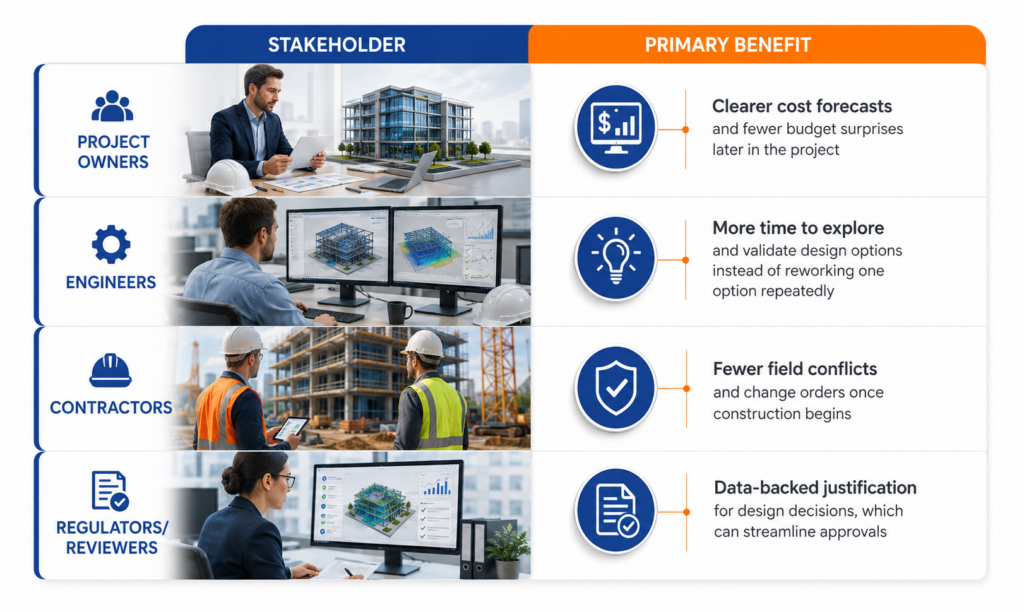
Benefits by Stakeholder
Predictive design doesn’t benefit every stakeholder in the same way. Here’s a quick breakdown:
Common Challenges When Adopting Predictive Design
Predictive design isn’t a plug-and-play upgrade, and it’s worth being realistic about where firms typically run into friction.
Data Quality Issues
Predictive tools are only as good as the data feeding them. If BIM models are incomplete, outdated, or inconsistent across disciplines, predictive outputs will reflect those gaps. Clean, well-structured data is a prerequisite, not an afterthought.
Overreliance on Models
A model is a forecast, not a guarantee. Teams that treat predictive outputs as absolute truth, rather than as one input among several, risk missing real-world nuances that data alone can’t capture. Engineering judgment still has to sit on top of the model, not be replaced by it.
Team Skill Gaps
A model is a forecast, not a guarantee. Teams that treat predictive outputs as absolute truth, rather than as one input among several, risk missing real-world nuances that data alone can’t capture. Engineering judgment still has to sit on top of the model, not be replaced by it.
How to Bring Predictive Design into Your AEC Workflow
If you’re considering adopting a predictive design, it doesn’t require an overnight overhaul. Most firms phase it in gradually:
- Start with data-driven engineering design on one project type. Pick a project category where past data is strong (e.g., water resources, structural, transportation) and pilot predictive tools first.
- Pair predictive tools with your existing feasibility process rather than replacing it outright; let predictive modeling supplement, not overhaul, what already works.
- Invest in digital twin and BIM-compatible workflows, so that models have clean data to draw from. This step alone resolves most of the data quality issues mentioned above.
- Train teams interpreting predictive outputs — the tools are only useful if engineers know how to act on what they show, not just how to generate a report.
- Set clear thresholds for when predictive results trigger a design change, so teams aren't second-guessing every output, but also aren't ignoring red flags.
- Document outcomes from each pilot project, so the ROI of predictive design is measurable, not anecdotal; this makes the case for wider adoption internally.
- Partner with experienced AEC design services providers who already have predictive workflows built into their process, rather than building everything from scratch in-house.
This last point matters. Firms offering established AEC design services spanning structural, civil, water resources, and transportation engineering, are increasingly building predictive capability directly into their early-stage deliverables, so clients get faster, better-informed options without adding overhead to their own teams.
Predictive Design in Action: A Walkthrough Example
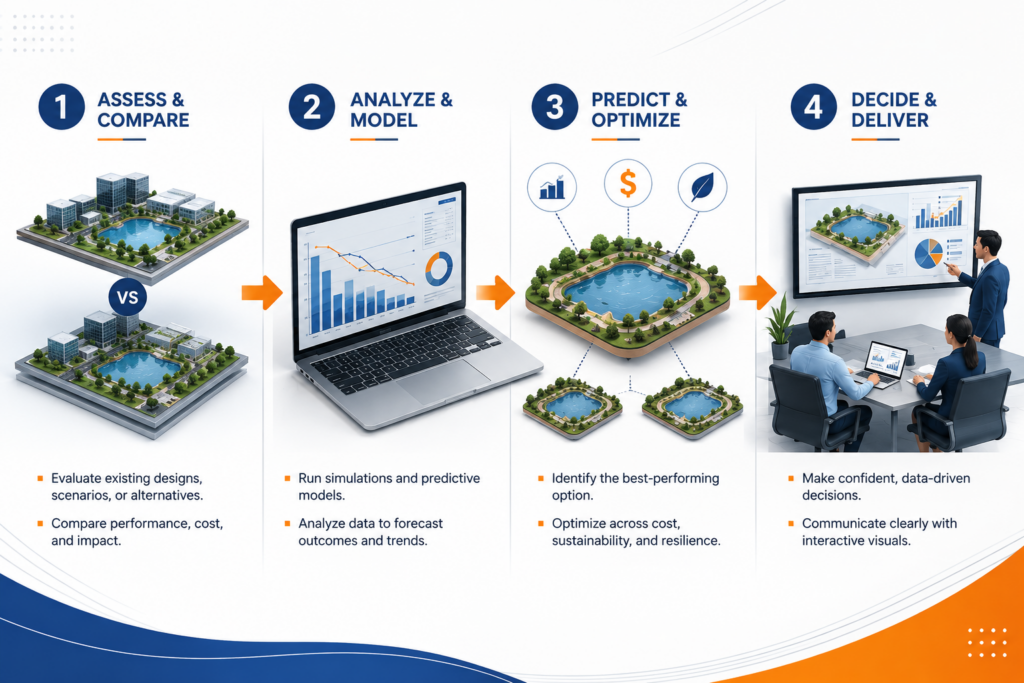
To make this concrete, here’s what a predictive design workflow might look like on a typical infrastructure project, for example, a commercial site requiring stormwater management design.
- Step 1 — Feasibility: Instead of a single proposed layout, the team models two or three site configurations against the same hydrology and drainage assumptions, comparing runoff and detention requirements side by side.
- Step 2 — FEED: The strongest-performing layout moves into front-end engineering design, where predictive modeling stress-tests against various rainfall events/ frequencies and downstream flood risk.
- Step 3 — Conceptual Design: Design optioneering narrows detention pond sizing and placement options, comparing cost, land use efficiency, and long-term maintenance needs.
- Step 4 — Decision: Stakeholders review a data-backed comparison, not just a narrative recommendation, and approve a direction with a clear understanding of the tradeoffs involved.
The result: a decision made in weeks, backed by modeled evidence, rather than a design that’s finalized on assumption and only tested for real once construction begins.
The Future of Predictive Design in AEC
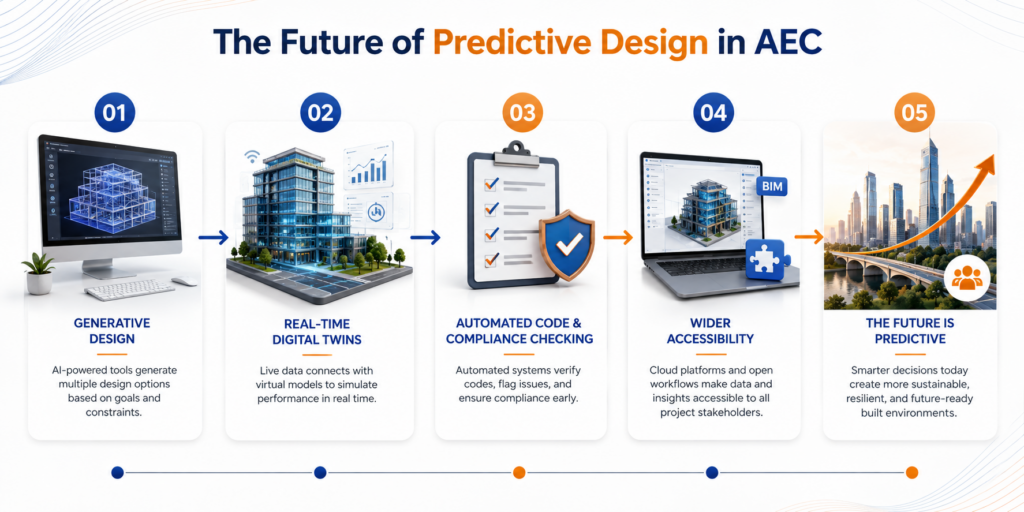
Looking ahead, a few trends are shaping where predictive design is headed next:
- Generative design tools that don't just evaluate options a team proposes, but generate new design options automatically based on set constraints
- Real-time digital twins that continue to update after construction, feeding performance data back into future project models
- Automated code and compliance checking, layered on top of predictive models to flag regulatory issues alongside performance risks
- Wider accessibility, as predictive tools become less specialized and more integrated into standard BIM and design software rather than requiring separate platforms
The direction is clear: predictive capability is moving from a competitive advantage held by a few firms to a baseline expectation across the AEC industry.
Conclusion
Predictive design in early-stage engineering isn’t about replacing engineering expertise, it’s about giving that expertise better information, earlier, when it’s cheapest to act on. From engineering feasibility studies to front end engineering design (FEED) and design optioneering, the common thread is simple: the earlier you can see a problem, the easier and cheaper it is to solve. As AI in engineering design and digital twin technology continue to mature, the firms that adopt predictive workflows early will consistently make faster, better-backed decisions than those still relying on assumptions alone. Whether you’re evaluating a new project or looking for a trusted engineering partner, Contragenix helps organizations make smarter, data-driven engineering decisions through advanced AEC design and support services.
FAQs
1. What is predictive design in early-stage engineering? It’s the use of data, simulation, and forecasting tools to evaluate how a design will perform before it’s finalized, allowing teams to catch issues and compare options during the due diligence, concept and feasibility stages rather than after construction begins.
2. How is predictive design different from a standard engineering feasibility study? A standard feasibility study typically relies on calculations and past experience. Predictive design adds data-driven modeling and simulation on top of that process, giving teams a more accurate forecast of performance and risk.
3. Does predictive design replace front end engineering design (FEED)? No. Predictive design enhances FEED by adding data-backed forecasting to the scope, cost, and technical decisions that are already part of that phase.
4. What industries benefit most from predictive design in construction? AEC firms into engineering, water resources, transportation, and municipal infrastructure projects tend to see the biggest gains, since these projects involve complex variables that are hard to predict with manual methods alone.
5. Is predictive design expensive to implement? Not necessarily. Many firms start small — piloting predictive tools on one project type — rather than overhauling their entire workflow at once. Partnering with an experienced AEC design services provider is often a lower-cost way to access these capabilities without building them in-house.
6. What’s the biggest risk of adopting predictive design tools? Overreliance on model outputs without engineering judgment, and poor data quality feeding the models — both of which can be managed with proper training and clean BIM data.
7. Do smaller engineering firms need predictive design tools? Not always. The value scales with project complexity and risk. Firms handling low-complexity, well-precedented projects may see limited benefit, while firms handling large or first-of-its-kind projects tend to see the biggest returns.
8. How does design optioneering fit into predictive design? Design optioneering is one of the most direct applications of predictive design — it uses predictive tools to generate and compare multiple design options quickly, replacing gut-instinct decisions with evidence-based ones.
Scale Your AEC Projects with Expert Design Support
Whether you’re managing multiple projects or facing resource constraints, our experienced engineering professionals seamlessly integrate with your team to provide accurate design, drafting, BIM coordination, and technical documentation, keeping your projects on schedule and within budget.