

Introduction
Are you confident you know which of the many types of government proposals your team is bidding on right now? Most contractors lose winnable work not because they lack the skill to write well, but because they treat every solicitation the same way. A sealed bid does not work like an RFP response. A task order does not work like a brand-new competitive bid. And if your team doesn’t know the difference, you are already behind before the first page is written.
This guide breaks down every major type of government proposal, walks through how the government procurement process actually moves, and shows you exactly what evaluators look for once your proposal lands in front of a source selection board. By the end, you will know which category your next opportunity falls into, what it demands, and how to position your company to win it.
What Is a Government Proposal?
A government proposal is the formal, written response a company submits after an agency issues a government solicitation. The solicitation spells out what the agency needs, how it wants the response formatted, and how it will judge every submission. Your proposal is your company’s structured answer to that request, showing the agency, you can deliver the work on time, within budget, and with acceptable risk.
Unlike a private-sector sales pitch, a government proposal isn’t persuasive in a loose, creative sense. It is judged against a fixed scorecard. That single difference is why understanding proposal types matters so much: each type changes the rules, the timeline, and the way you should approach the writing itself.
A Quick Look at the Government Procurement Process
Before diving into proposal types, it helps to see where proposals fit inside the broader government procurement process. At a high level, the process moves through five stages:
- Requirement identification – The agency defines what it needs and drafts a Statement of Work (SOW) or Performance Work Statement.
- Solicitation release – The agency publishes the opportunity, often as an RFP, RFQ, or Invitation for Bid (IFB).
- Proposal preparation and submission – Contractors write and submit responses by a fixed deadline.
- Evaluation – An evaluation team or source selection board scores each submission.
- Award and debrief – The agency selects a winner, and losing bidders may request a debrief to understand their score.
Every type of government proposal you’ll read about below fits somewhere inside this cycle. Some types skip stages entirely (sealed bids, for example, skip negotiation), while others repeat the cycle on a smaller scale within an existing contract (task orders). Knowing where you sit in this process tells you how much room you have to negotiate, clarify, or adjust your approach.
7 Types of Government Proposals You Need to Know
Here are the seven proposal types that cover almost every situation a federal, state, or local contractor will encounter.
1. Request for Proposal (RFP) Responses
The Request for Proposal (RFP) is the most common and most flexible solicitation type. An agency issues an RFP when it needs more than just a price; it wants to see your technical approach, your management plan, your past performance, and your pricing, all evaluated together. RFP responses usually require multiple volumes, and the agency weighs technical merit alongside cost rather than picking the lowest bidder automatically.
This is the proposal type most contractors think of first, and it forms the backbone of competitive federal work across every industry from IT to engineering services.
2. Sealed Bid Proposals (Invitation for Bid)
Sealed bid proposals, issued under an Invitation for Bid (IFB), work very differently from an RFP. The agency already knows exactly what it wants; there’s no need to evaluate technical approach or management style. Bidders submit a sealed price, the bids are opened publicly at a set date and time, and the contract typically goes to the lowest responsive and responsible bidder.
Sealed bidding is common for straightforward requirements such as construction, supplies, or maintenance services where the specifications are clear-cut and pricing is the deciding factor.
3. Unsolicited Proposals
Not every proposal starts with an agency request. An unsolicited proposal is one your company initiates, offering a unique capability, innovation, or solution the government hasn’t formally asked for. These are far less common, governed by specific federal acquisition rules, and require you to clearly demonstrate why your idea is innovative enough to justify a non-competitive look.
Unsolicited proposals work best when your company has genuine, hard-to-replicate expertise that solves a problem an agency hasn’t fully recognized yet.
4. Task Order Proposals
Once your company holds a spot on a multi-award contract vehicle, such as an IDIQ or GWAC, individual pieces of work are competed among the existing contract holders through task order proposals. These are typically smaller in scope, faster-turnaround responses, often due within days rather than weeks, which raises a question a lot of contractors underestimate: how long does it take to prepare a government proposal when the runway is this short. Task orders reward contractors who already have strong templates and fast internal review processes.
5. Recompete Proposals
A recompete proposal is submitted when a contract you currently hold is coming up for renewal, and the agency reopens it to competition. Recompetes are uniquely difficult: you have to defend your incumbent position while avoiding complacency, since competitors will be studying your weak points and underbidding wherever they can. Strong recompete strategy depends heavily on capturing lessons learned and performance data throughout the life of the current contract.
6. Technical Proposals
Most RFPs require a separate technical proposal volume that explains how, specifically, you will perform the work. This section covers your methodology, staffing plan, technical approach, risk mitigation, and relevant past performance. Evaluators read the technical proposal to judge feasibility and quality, completely separate from price, which is why a strong technical narrative often carries more weight than being the cheapest option.
7. Cost Proposals
The cost proposal is the pricing volume submitted alongside (but usually evaluated independently from) the technical proposal. It must be fully compliant with the solicitation’s pricing format, often broken down by labor category, period of performance, or contract line item. Pricing this volume correctly is its own discipline, and teams who underestimate government proposal writing cost often end up either underbidding the effort or padding it so much they price themselves out. For certain contract types, the cost proposal must also include detailed cost justification or be cost-certified, so accuracy here is non-negotiable; pricing errors can disqualify an otherwise winning bid.
How the Source Selection Process Scores Your Proposal
Once proposals are submitted, they move into the source selection process, where an evaluation team scores each submission against published criteria. Two common methods dominate federal evaluations:
- Lowest Price, Technically Acceptable (LPTA) – The agency sets a minimum technical bar, and among everyone who clears it, the lowest price wins.
- Best Value Tradeoff – The agency weighs technical quality, past performance, and price together, sometimes awarding to a higher-priced bidder if the added value justifies the cost.
Proposal Evaluation Criteria That Matter Most
Regardless of method, most agencies score against a consistent set of proposal evaluation criteria:
- Technical approach and soundness of methodology
- Management plan and staffing qualifications
- Past performance and relevant experience
- Cost realism and overall price reasonableness
- Compliance with every instruction in the solicitation
Missing even one instruction, a missing page, an unaddressed requirement, a wrong font size, can knock an otherwise strong proposal out of consideration entirely. Compliance is the floor; competitiveness only starts once you’ve cleared it.
Proposal Components Every Contractor Must Get Right
No matter which proposal type you’re working on, a few components show up again and again.
- Statement of Work (SOW): This document, written by the agency, defines exactly what work is required, the deliverables expected, and the timeline. Your entire proposal should map directly back to the SOW, line by line.
- Compliance matrix: A simple table cross-referencing every solicitation requirement against the section of your proposal that answers it. If you've never built one, this proposal compliance matrix explained guide walks through exactly how to put one together. This single document prevents the most common, and most costly, proposal mistakes.
- Past performance references: Recent, relevant contracts that prove you can do what you're promising.
- Pricing volume: Built to match the solicitation's exact pricing structure, not your own internal format.
Where to Find Government Contracting Opportunities
Knowing the proposal types is only useful once you have opportunities to bid on. The most reliable sources of government contracting opportunities include:
- SAM.gov – The primary federal procurement portal for nearly all open solicitations.
- Agency-specific procurement portals – Many agencies post forecasts and solicitations on their own sites ahead of formal release.
- State and local procurement portals – Useful if your company also targets state, county, or municipal work.
- Existing contract vehicles – If you already hold a position on an IDIQ or GWAC, task order opportunities often arrive through direct agency outreach rather than public posting.
Setting up daily or weekly searches on these platforms, matched to your NAICS codes and capabilities, keeps your pipeline full and gives your capture team enough lead time to prepare before a deadline lands.
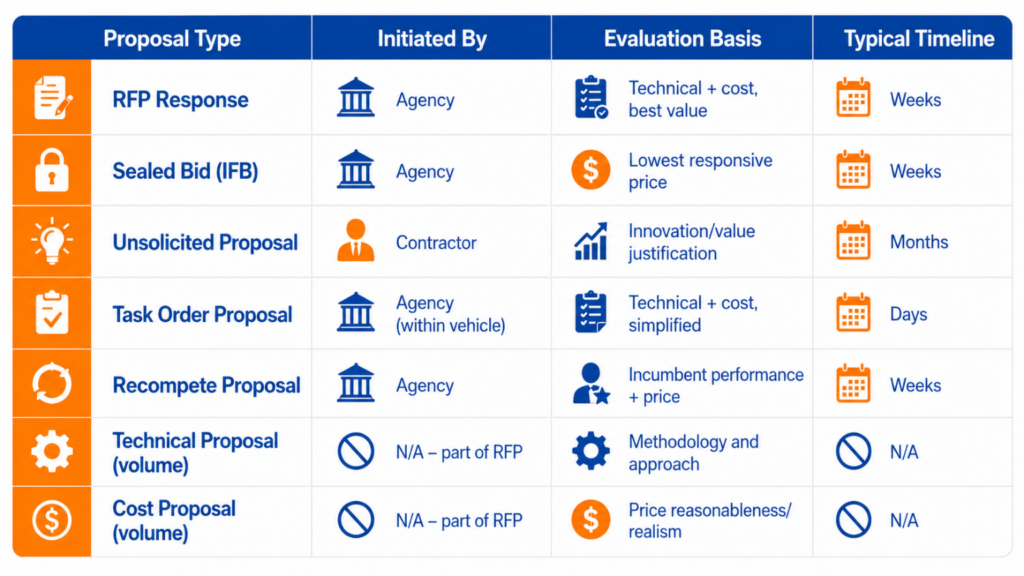
Quick Comparison Table: Government Proposal Types
Conclusion
Every type of government proposal carries its own rulebook and treating them all the same is one of the fastest ways to leave a winnable bid on the table. Once you can clearly tell a sealed bid apart from an RFP, or a task order apart from a full recompete, you can build the right strategy, assign the right team, and budget the right amount of time for each pursuit. Pair that understanding with a disciplined approach to the source selection process and proposal evaluation criteria, and your win rate will climb steadily, opportunity by opportunity.
If your team is actively pursuing government contracting opportunities and needs support turning a solicitation into a compliant, competitive proposal, working with experienced GovCon proposal specialists like Contragenix can make the difference between a near-miss and an award. Take a look at our proposal support services to see how we help federal contractors at every stage of the process.
Need Help Winning Government Contracts?
Navigating federal procurement, FAR compliance, and proposal development can be complex. Contragenix supports businesses with expert bid assistance, proposal development, and government contracting strategy to improve win rates.