

How Long Does It Take to Prepare a Government Proposal?
One of the most common questions government contractors ask is:
“How long does it take to prepare a government proposal?”
The answer depends on the complexity of the solicitation, contract value, proposal requirements, teaming arrangements, and the maturity of your capture process.
Some proposals can be completed in a matter of days. Others require months of planning, writing, reviews, pricing development, and compliance checks before submission.
Understanding proposal timelines is critical because rushed submissions often lead to compliance issues, weak technical responses, and missed opportunities.
In this guide, we’ll break down realistic government proposal timelines, factors that impact proposal development, and proven ways to reduce turnaround times while improving win probability.
Section L — formally titled Instructions, Conditions, and Notices to Offerors — is the government’s official guide to how your proposal must be structured, formatted, and submitted. Think of it as the exam instructions before the test.
Why Proposal Timelines Matter in Government Contracting
Government proposals are not ordinary business proposals.
A federal, state, or local government solicitation may require:
- Technical volumes
- Management plans
- Staffing plans
- Past performance references
- Resumes and key personnel
- Pricing narratives
- Past performance references you are required to provide
- Certifications and representations
- Compliance matrices
Missing even one requirement can make an otherwise strong proposal non-responsive.
This is why successful contractors build structured proposal processes long before the submission deadline arrives.
If you’re new to proposal development, our guide on the Government RFP Response Process: A Step-by-Step Guide to Winning More Contracts explains how a complete proposal moves from opportunity identification to final submission.
Average Government Proposal Preparation Timelines
While every opportunity is different, most proposals fall into the following timeline ranges.
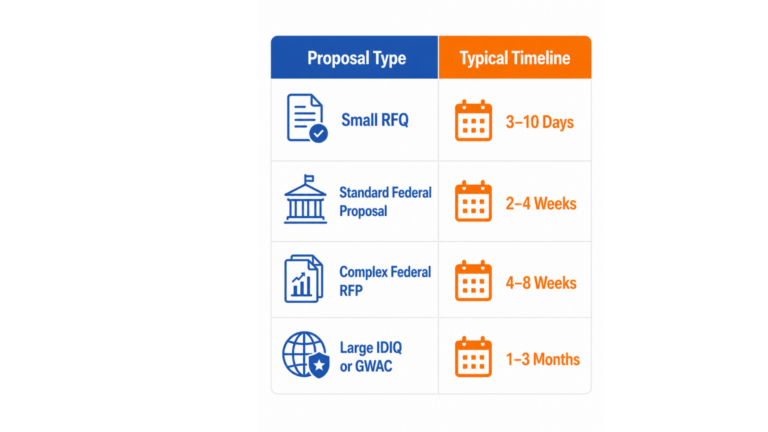
Small Government Proposals (3–10 Days)
These opportunities typically include:
- Simplified acquisitions
- Small business set-asides
- State and local government bids
- Requests with limited narrative requirements
Common deliverables include:
- Capability statement
- Pricing sheet
- Basic technical response
- Certifications
For contractors with existing templates and past performance examples, these proposals can often be completed within one week.
Mid-Sized Government Proposals (2–4 Weeks)
These opportunities generally require:
- Detailed technical narratives
- Staffing plans
- Past performance writeups
- Management approaches
- Compliance reviews
Most federal opportunities under this category require coordination between operations, proposal writers, pricing teams, and leadership.
This is where dedicated proposal resources become valuable.
Organizations that rely on internal staff often struggle to balance proposal work with contract performance responsibilities.
Large Federal Proposals (1–3 Months)
Large IDIQs, GWACs, BPA opportunities, and enterprise-level contracts often require extensive preparation.
Requirements may include:
- Multiple proposal volumes
- Detailed management approaches
- Complex pricing structures
- Key personnel commitments
- Subcontractor coordination
- Compliance matrices
- Several review cycles
In many cases, capture activities begin months before the solicitation is officially released.
For example, contractors pursuing major vehicles often prepare long before release by analyzing qualifications and evaluation criteria. A recent example is our analysis of OASIS+ Domain Qualification Matrices and Scorecards, where early preparation can significantly improve competitiveness.
Factors That Impact Government Proposal Timelines
Several variables determine how long proposal development will take.
Solicitation Complexity
The biggest factor is the complexity of the solicitation itself.
A 20-page RFQ requires far less effort than a 300-page RFP containing multiple volumes and extensive compliance requirements.
Proposal teams must carefully review:
- The Statement of Work (SOW) or Performance Work Statement (PWS)
- Evaluation criteria
- Submission instructions
- Contract clauses
The more requirements involved, the longer preparation will take.
Proposal Volume Requirements
Many agencies request multiple proposal volumes, including:
Technical Volume
Explain how work will be performed.
Management Volume
Describes staffing, oversight, reporting, and risk management.
Past Performance Volume
Demonstrates relevant experience and contract success.
Price Volume
Provides pricing methodology and cost justification.
Each volume often requires separate development and review cycles.
Teaming and Subcontractor Participation
When multiple organizations are involved, timelines increase.
Proposal managers must collect:
- Partner information
- Past performance references
- Resumes
- Pricing inputs
- Letters of commitment
Availability of Existing Content
Organizations with mature proposal libraries move much faster.
Reusable content may include:
- Technical approaches
- Corporate experience
- Management plans
- Quality control procedures
- Resumes
Contractors without proposal repositories often start from scratch, significantly extending timelines.
The Typical Government Proposal Development Process
Understanding the proposal lifecycle helps explain where time is spent.
Opportunity Review and Bid Decision
The first step is determining whether the opportunity is worth pursuing.
This includes evaluating:
- Contract value
- Competition
- Past performance fit
- Resource requirements
- Win probability
Poor bid decisions waste valuable proposal resources.
Compliance Analysis
Proposal teams review every solicitation requirement.
A compliance matrix is often developed to track:
- Mandatory requirements
- Evaluation criteria
- Submission instructions
- Attachments
Compliance reviews reduce the risk of disqualification.
Content Development
This stage usually consumes the majority of proposal preparation time.
Writers develop:
- Technical responses
- Staffing plans
- Management approaches
- Executive summaries
The goal is not simply answering requirements but demonstrating value to evaluators.
Pricing Development
Pricing frequently takes longer than expected.
Teams must:
- Estimate labor
- Validate rates
- Analyze subcontractor costs
- Develop pricing narratives
Errors at this stage can impact competitiveness and profitability.
Review Cycles
Experienced proposal teams conduct structured reviews.
Common review stages include:
- Pink Team Review :Evaluates strategy and messaging.
- Red Team Review :Evaluates proposal strength from the evaluator's perspective.
- Gold Team Review :Provides executive approval before submission.
These reviews improve proposal quality and reduce submission risk.
Final Production and Submission
The final phase includes:
- Formatting
- Quality assurance
- Attachment validation
- Portal uploads
- Submission confirmation
Many contractors underestimate the time needed for final production.
Waiting until the last day often creates avoidable issues.
How to Reduce Government Proposal Preparation Time
Winning contractors focus on efficiency without sacrificing quality.
Build a Proposal Content Library
One of the easiest ways to speed up proposal development is to maintain a library of content that you can reuse and update when needed. This should include past performance examples, technical approaches, management plans, and corporate experience narratives that have already been developed and approved. Instead of starting from scratch for every opportunity, your team can build on existing content and tailor it to the specific requirements of the solicitation. A well-organized content library not only reduces writing time but also improves consistency, accuracy, and overall proposal quality.
Track Relevant Contract Awards
Studying contract winners helps teams understand agency buying patterns and competitive positioning.
Our article on Why Tracking Government Contract Wins Matters explains how award intelligence can strengthen future proposal efforts.
Develop Capture Strategies Early
Proposal success starts before the solicitation arrives.
Early capture planning allows teams to:
- Build relationships
- Identify partners
- Gather past performance
- Prepare staffing strategies
Organizations that wait until release often find themselves rushing.
Use Dedicated Proposal Resources
Many growing government contractors lack full-time proposal personnel.
Using dedicated proposal support ensures:
- Faster turnaround times
- Consistent compliance
- Better proposal quality
- Increased submission capacity
At Contragenix, organizations often leverage specialized proposal development resources to maintain proposal velocity while internal teams focus on operations and growth.
Common Proposal Timeline Mistakes
- Waiting Until the Solicitation Is Released :Winning contractors monitor opportunities long before release. Early preparation creates a major advantage.
- Ignoring Compliance Requirements :Fixing compliance issues late in the process consumes valuable time. Compliance should begin on day one.
- Underestimating Review Time :Proposal reviews are essential. Skipping reviews may save time initially but often results in weaker submissions.
- Starting Without a Proposal Schedule :Every proposal should have a documented schedule covering: Content deadlines, review dates, pricing milestones, and final submission checkpoints create structured timelines that improve accountability and execution.
How Long Should You Plan Your Next Government Proposal?
Generally:
The larger the opportunity, the earlier preparation should begin.
Organizations that consistently win government contracts rarely start when the solicitation is released. They build capture plans, develop content libraries, monitor market activity, and prepare resources long before proposal deadlines arrive.
Final Thoughts
So, how long does it take to prepare a government proposal?
For smaller opportunities, it may take only a few days. For complex federal contracts, proposal development can span several weeks or even months.
The key is not simply working faster. It’s creating a repeatable proposal process that combines compliance, strategy, content development, reviews, and pricing into a structured workflow.
Whether you’re pursuing your first government contract or competing for a major federal vehicle, investing in proposal readiness can dramatically improve both proposal quality and win rates.
Need Help Winning Government Contracts?
Navigating federal procurement, FAR compliance, and proposal development can be complex. Contragenix supports businesses with expert bid assistance, proposal development, and government contracting strategy to improve win rates.