

Introduction
Are you still using obsolete traffic impact analyses that cannot cope with fast changes in the world of smart cities? Transportation engineers were for decades relying on traditional manual counting and modeling tools when predicting the effect on the existing streets of building new developments. But now that smart cities are here, the laws of traffic impact analyses have changed, and traffic sensors, traffic management systems, and auto-calibrating signals provide more information in one week than traditional impact studies could provide in a whole year.
This transition poses a serious challenge. Designers who base their plans on the old intersection design methodologies run the risk of designing roads that will not cope with future traffic flows or even must face litigation since the underlying analysis is outdated. In this guide, we will discuss the evolution of traffic impact analysis within smart cities, the factors behind the change in the intersection design, and the methodologies that will set the trend for 2026.
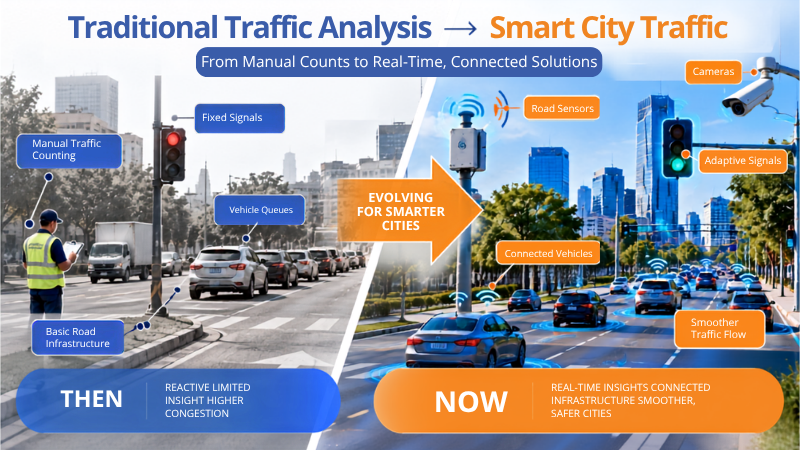
What Is a Traffic Impact Analysis (TIA) and Why It Matters in Smart Cities
Traffic impact analysis is an engineering report that estimates the effect that a particular project such as the building of a shopping center, office complex, or residential area would have on the traffic in the surrounding roads. This type of report is usually required by cities and counties when considering any major project. The outcome of the study decides whether additional traffic facilities are needed.
Core Elements of a Traffic Impact Assessment Study
Traffic Impact Studies usually involve the following core elements; however, the level of detail can vary based on the size of the project and location:
- Trip Generation – number of trips generated by the new development
- Trip distribution — which roads and intersections those trips will use
- Site access review — where driveways and site entrances should go
- Level of service (LOS) traffic analysis — how intersections will perform under the added load
- Mitigation recommendations — signal upgrades, turn lanes, or geometric changes needed to offset impact
Why Traditional TIAs Fall Short in Connected Cities
However, the traditional TIA is based upon a single static observation of a few hours of manual counts conducted on a typical day of the week. While this may be okay for times where the traffic is very predictable, in a smart city, the traffic signals are regularly being modified; moreover, the traffic scenario changes each hour due to the introduction of ride-sharing services and delivery trucks. The existing sensors can offer much more information than manual counting could.
Smart City Traffic Management Is Rewriting the Rules
In smart city traffic management, connected infrastructure is used in conjunction with sensors, cameras, and signalling networks to manage traffic flows on an ongoing basis rather than using static, pre-defined traffic timing plans that have been designed years before. From the perspective of transport engineers, the benchmark conditions against which a TIA would be judged are always changing.
Intelligent Transportation Systems (ITS): The Backbone of Modern Traffic Planning
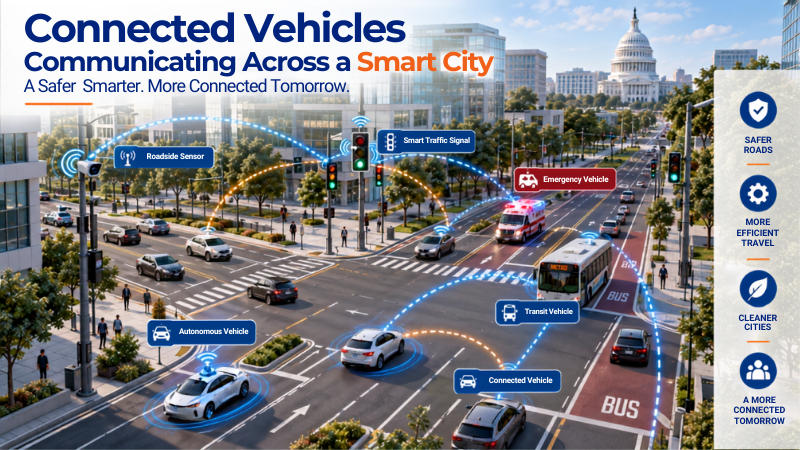
ITS technologies are comprised of the sensors, communications infrastructure, and software required to enable intelligent transportation in smart cities. Instead of approaching individual intersections as stand-alone issues, ITS solutions view traffic as a network, using the shared data from the lights to synchronize traffic flow such that congestion at one intersection will cause synchronization at the subsequent intersection.
Real-Time Traffic Management Systems in Action
RTTMS use information collected from cameras, road sensors, and smart cars to make split-second decisions. There have been many pilot programs that use smart intersections developed by the Department of Transportation in the United States. In one such program in Detroit, the expansion of smart intersection implementation has been done with the explicit aim of reducing collisions through real-time analysis.
The implications for engineers performing TIA are thus direct: mitigation measures have to address the adaptive signal timings that will continue beyond the duration of the TIA rather than the existing timings in effect at the time of the TIA.
Evolving Intersection Design Methodology
Data for smart cities not only revolutionized the monitoring of traffic but is also transforming the way the intersection designs are carried out.
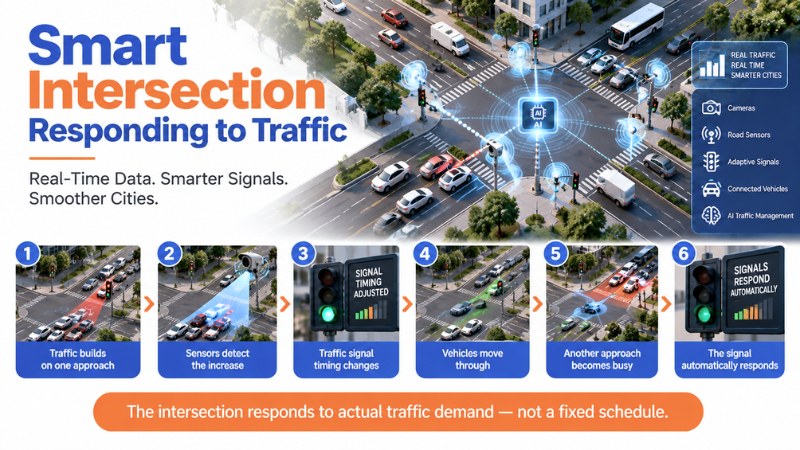
Smart Intersection Design Basics
The technique of smart intersection design involves overlaying the sensors, adaptive signal controller, and in some cases the vehicle-to-infrastructure technology on the geometrical design of the intersection. Smart intersection design increasingly depends on connected data and coordinated digital workflows. This aligns with the broader shift toward BIM as a project operating system, where project information is managed across workflows rather than isolated design stages. This creates an intersection that responds to the actual demand rather than a time-based process and is focused on transit priority and queue clearance.
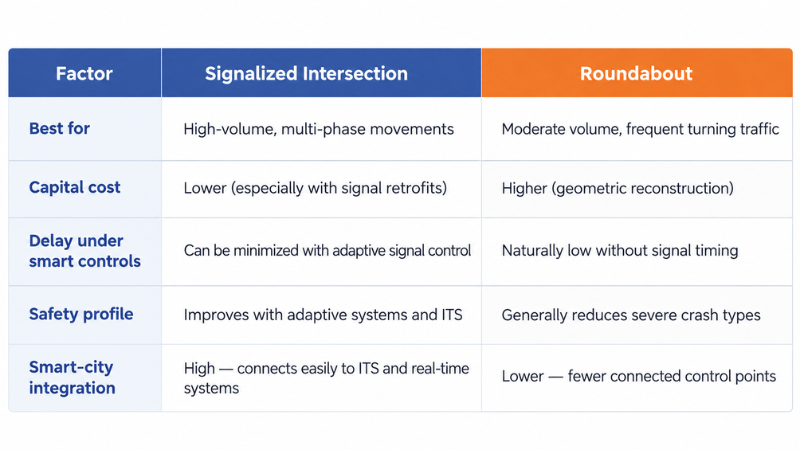
Signalized Intersection vs Roundabout: Choosing the Right Design
One of the most frequently made decisions in any intersection design approach is that of signalling versus roundabout construction. Some recent case studies for smart cities have compared the approaches of optimizing signals at a signalled intersection against the option of constructing roundabouts, and in several peak hour urban cases, the optimization of signals proved to be better than roundabout conversion, but roundabouts proved to be better in low volume or safety critical areas.
Adaptive Traffic Signal Control and Signal Timing Optimization
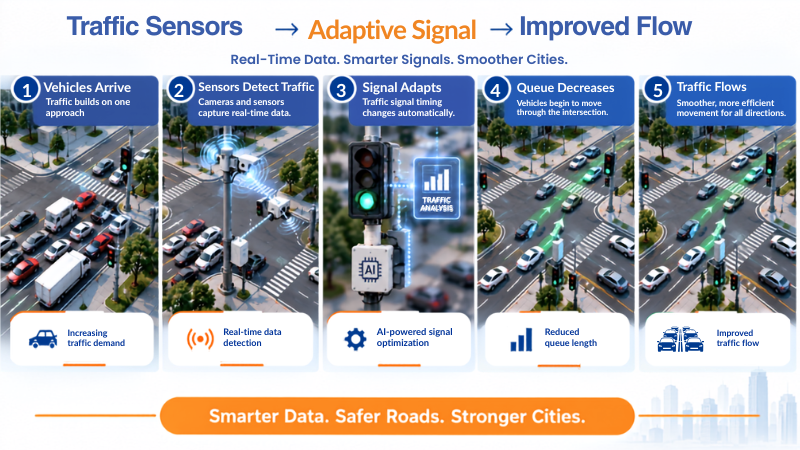
Adaptive Traffic Signal Control is designed to adjust the green time dynamically to reflect real demand, instead of being scheduled to an existing fixed schedule. When coupled with signal timing optimization, such technology may be the most cost-efficient choice prior to any geometric re-design, particularly when space for roundabouts is not available.
Connected Technology Shaping the Next Generation of Intersections
In addition to signaling and geometric configurations, an additional level of vehicle technologies is beginning to affect decisions about intersection design.
Connected and Automated Vehicles (CAV) in Intersection Planning
CAVs communicate with the infrastructures and also amongst themselves. Analysis conducted by researchers on the integration of CAVs in the intersection geometry reveals that as the number of CAVs increases in the traffic system, there is an observable change in terms of performance and safety at the intersection compared to the conventional traffic flow.
V2X Technology and Traffic Safety
Vehicle to everything (V2X) technology allows for communication between vehicles, traffic signals, and roadside infrastructure. In the case of intersection design, vehicle to everything technology provides such capabilities as requests for signal priority by transit or emergency vehicles, and warning messages for red-light runners that influence clearance time and sight distance design.
Autonomous Intersection Management: What’s Next
Autonomous intersection management looks further ahead, exploring how intersections might eventually coordinate fully autonomous vehicles without traditional signal phases at all. Current research on intersection management protocols is still working through practical constraints like guaranteeing worst-case response times for mixed traffic of human-driven and autonomous vehicles which means this remains a forward-looking design consideration rather than a near-term standard.
Level of Service (LOS) Traffic Analysis in a CAV World
As the use of CAVs becomes more common, so does level of service (LOS) traffic analysis. Existing LOS grades were designed based on the reaction’s times of humans and their distances. As CAVs can reduce their following distances and reacting faster than a human would, there needs to be consideration as to whether these existing grades still represent actual capacity.
Tools and Methods Behind Modern TIAs
None of this evolution is useful without the right analytical tools to model it. “The FHWA Traffic Analysis Toolbox provides guidance on traffic-analysis methods and tools.”
Traffic Simulation Software and Microsimulation Traffic Modeling
The traffic simulation software has evolved to the point that it is no longer simply a matter of calculating the LOS using spreadsheets. Advanced microsimulation traffic modeling software like PTV Vissim and Aimsun models vehicle behavior at the second-by-second level and is being extensively used to simulate signal timing schemes, roundabout conversion, or even CAV implementation without breaking ground on the project.
Common uses for traffic simulation software in a modern TIA include:
- Testing multiple intersection design alternatives side by side
- Modeling queue lengths and delay under different demand scenarios
- Evaluating how adaptive traffic signal control performs against fixed timing
- Stress-testing designs against forecasted growth in trip generation
Trip Generation Study and the ITE Trip Generation Manual
Trip generation studies continue to underpin the vast majority of TIAs, while the ITE Trip Generation Manual continues to be the bible of the industry when it comes to estimating the number of vehicle trips created by a particular land use. As smart city models incorporate real-time data into the process, the manual continues to serve as the baseline that regulators are expected to see and is rarely an option to omit.
Choosing the Right Traffic Engineering Consulting Services Partner
With TIA methodology evolving this quickly, the choice of who runs the analysis matters as much as the analysis itself. Look for traffic engineering consulting services that can demonstrate real fluency in both traditional trip generation studies and the newer smart-city toolkit adaptive signal control, microsimulation, and CAV-aware design rather than a firm still running every project through a 1990s-era static model. For firms managing growing transportation workloads, specialized support can also help teams scale without overloading internal resources. Learn more about drafting outsourcing for scaling AEC teams.
This is exactly where Contragenix’s AEC Design and Support Services team fits in pairing traditional transportation engineering discipline with current smart-city methodology on every intersection design and traffic impact study we support.
Conclusion
A traffic impact analysis is not a static task anymore; instead, it has become a dynamic field that is defined by the existence of real-time traffic management technologies, adaptive traffic signal control and increasingly complex connected vehicles. Regardless of whether you are comparing a signalized intersection with a roundabout, analyzing trip generation relative to the Trip Generation Manual of the Institute of Transportation Engineers or simulating a corridor in traffic analysis software, the fundamental question remains the same: will this intersection work as it is expected to in five to ten years?
Achieving that goal requires having the proper transportation engineering fundamentals in place as well as an understanding of the new technology being used in smart cities. It is this kind of knowledge that helps differentiate between a TIA that will be approved and one that won’t.
Scale Your AEC Projects with Expert Design Support
Whether you’re managing multiple projects or facing resource constraints, our experienced engineering professionals seamlessly integrate with your team to provide accurate design, drafting, BIM coordination, and technical documentation, keeping your projects on schedule and within budget.