

Government Shutdown 2026: What to Know Before Jan 30
If you’re a federal contractor reading this, stop what you’re doing and keep reading. You have to understand what’s at stake with the January 30, 2026, government funding deadline. This isn’t political chatter – it’s a real-world risk that could impact your cash flow, contracts, and people if you’re not ready.
This risk is credible because Congress is operating under a temporary funding patch, and past shutdowns under similar conditions have led to delayed payments, paused contract performance, and weeks of operational disruption for contractors.
“Another potential government shutdown is on the horizon because Congress has only temporarily funded many of its agencies through January 30, 2026, and negotiations on remaining appropriations are still ongoing.” If Congress doesn’t pass a full appropriations bill or another continuing resolution by then, much of the federal government will shut down once again – and that’s something you can’t afford to ignore.
What exactly is happening on January 30?
Congress established a stop-gap measure for certain federal appropriations that will expire at midnight on January 30, 2026. If Congress fails to pass the remaining appropriations bills or another continuing resolution by then, certain parts of the federal government will lack the authority to spend funds, potentially leading to a partial shutdown of agencies and programs not affected. This is the mechanism: no new appropriations = no new spending obligations.
Which agencies are affected? “Certain FY2026 appropriations bills have already been enacted, but others including Homeland Security and several other discretionary agencies remain unfunded and would be affected if the deadline passes.” The political fight has focused on the DHS appropriations and riders, making a partial shutdown more likely than a full one.
The five things every contractor needs to absorb immediately
- 1.The real cliff is January 30, and Congress may not complete the remaining funding, which causes a partial shutdown that begins the next business day.
- 2. “Excepted functions continue, while non-excepted functions are generally paused and affected employees may be furloughed, subject to agency contingency plans”. This determines whether the government will continue to support and accept contractor work on a program.
- 3.A shutdown does not automatically end a contract, but it can stop contract performance if it requires additional appropriations or government employees who are no longer available. You need to quickly assess whether your contract is “funded” during the period and whether the COR/CO is still available.
- 4.Contract payments can be delayed, and use of facilities, government systems, or personnel may be denied – so your cash flow and security-dependent activities are the biggest risks.
- 5. There are contingency plans and agency-specific guidance documents (from OMB, GSA, DoD, HHS, DOJ, State, and others) that lay out the procedures; these are authoritative and will drive how your contracting officer behaves.
How a shutdown affects contracts
- Contracts do not magically terminate: The government, in general, cannot obligate funds it does not have, but many contracts have funds already obligated for a period of performance. If your contract has funded CLINs (contract line items), you can continue your performance until those funds are depleted—but key government approvals, inspections, or access may not be available.
- If your performance requires continuous government approval or new appropriations (task orders, options, or new invoices requiring new appropriations), you may be forced to stop performance. The DoD and other agencies have guidance that states contracts supporting excepted activities are continued, while those not supporting excepted activities are furloughed/paused. This is why your first step is to categorize your performance.
- Payments and Invoices: In the past, agencies have made an effort to pay invoices for work performed when funds were available, but during a shutdown, this process has been delayed. Do not count on timely payment if your contract has administrative offices that will be operating under hiring/furlough restrictions.
- Agencies Are Watching One Another: Treasury, GSA, and now DoD are auditing preference contracting broadly. The SBA audit is not isolated. The federal government is collectively scrutinizing how preference programs are used agency wide.
- Program Narrative Has Shifted: The SBA and federal leadership are reframing the 8(a) Program narrative from socioeconomic support to program integrity. That means expectations are changing about what constitutes acceptable eligibility and participation.
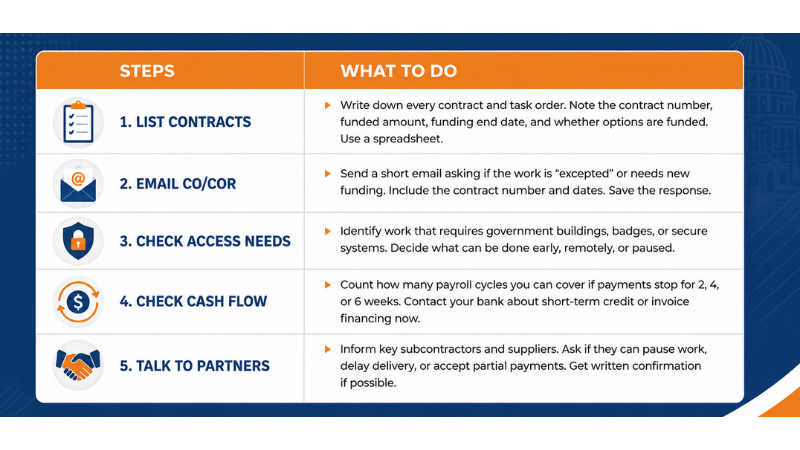
Immediate, practical checklist — what to do before Jan 30
Lessons from Past Government Shutdowns
Government shutdowns have happened 22 times since 1976, totaling just 109 days—with most lasting only a few days to two weeks. The 2025 shutdown stood out as the longest at 43 days, causing over $11 billion in losses and major delays for federal contractors like slowed payments and frozen awards.
Key takeaways are simple: Short shutdowns test your basics, while long ones hit cash flow hard. One of the longest recent shutdowns in 2025 lasted over a month…”
“Many contractors report building larger cash reserves after recent shutdowns.”
Most shutdowns end fast with a temporary funding fix (called a CR).
Longer ones, like 2018-2019 (35 days) or 2025, spike furloughs and claims—prep beats recovery every time.
Common wins: Firms that documented everything recovered 80% of costs via FAR claims.
Treat this as practice. Run your checklist now, test cash flow models, and train staff—it turns risk into routine.
Stay Ahead Until January 30
Keep watching SAM.gov for contract updates and agency notices daily. Follow reliable news on funding votes and prediction markets for real-time odds. For federal contractors, smart prep always wins over worry—your edge is readiness.