

Introduction
Is it possible to detect a life safety issue through automation that even the most seasoned reviewer cannot spot? This is a valid question that many more architectural and engineering firms need to ask themselves now that deadlines are tighter than ever and codebooks are getting fatter with each edition.
Plan review has traditionally been a laborious process with stacks of paper, a limited number of qualified reviewers, and plenty of bottlenecks. This is because someone must analyze and compare the drawings with the code requirements. The code compliance automation process aims at eliminating such bottlenecks.
This blog will look at how automation helps streamline some stages of code compliance, where human review becomes unavoidable and how to merge these two into one process. If you are considering purchasing plan review software or have doubts about its reliability, you will learn a practical solution here.
What Is Code Compliance Automation?
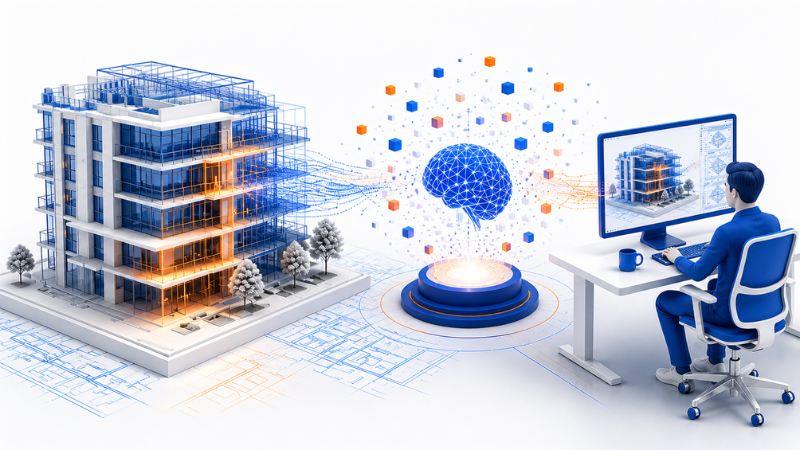
Code compliance automation is the use of software often AI-powered to check building designs, drawings, or documents against applicable codes, standards, and local amendments, instead of relying only on a manual, page-by-page review.
In practice, it covers a range of tools and tasks:
- Software that checks for plan codes from drawings that have been digitised
- Construction software that looks for missing egress width, clearance or fire ratings
- Code enforcement software used by municipalities to standardise permit reviews
- BIM-integrated tools that check models against code rules as they're designed, not after
The goal isn’t to replace the reviewer’s judgment. It’s to remove the repetitive, rule-based checking that eats up most of a reviewer’s day, so their expertise gets spent where it matters.
Where AI Helps in Code Compliance
This is where construction A.I. earns its keep. AI is genuinely strong at fast, consistent, rule-based checking; the part of compliance review that’s repetitive by nature.
Automated Plan Check and Review
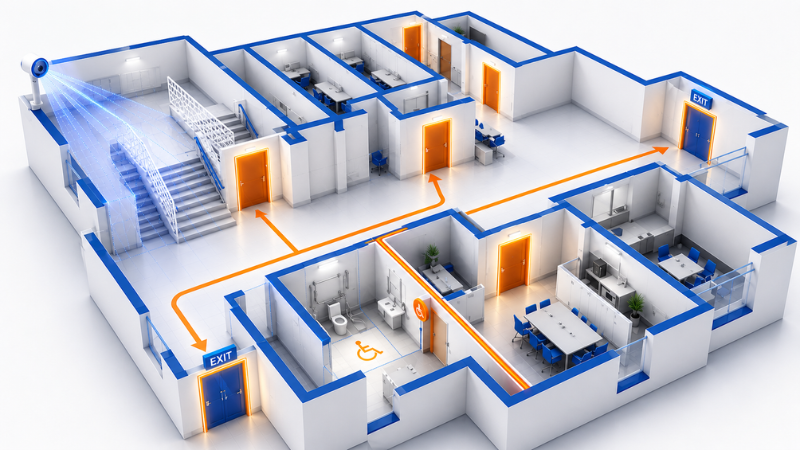
A manual plan check is an exercise where each drawing sheet is reviewed and checked against the codebook. In the use of AI in construction, plan checking becomes fast by scanning the digital plans and highlighting:
- Door sizes, corridors and exit routes not compliant to codes
- Not enough or incorrect fire ratings for materials used
- Inaccurate accessibility clearance distances
- Sheet inconsistencies, such as a mismatch between the wall type shown on the plans and schedule
Instead of a reviewer starting from a blank sheet, they start from a pre-flagged list of possible issues, which is a much faster starting point.
AI Construction Software for Real-Time Code Checking
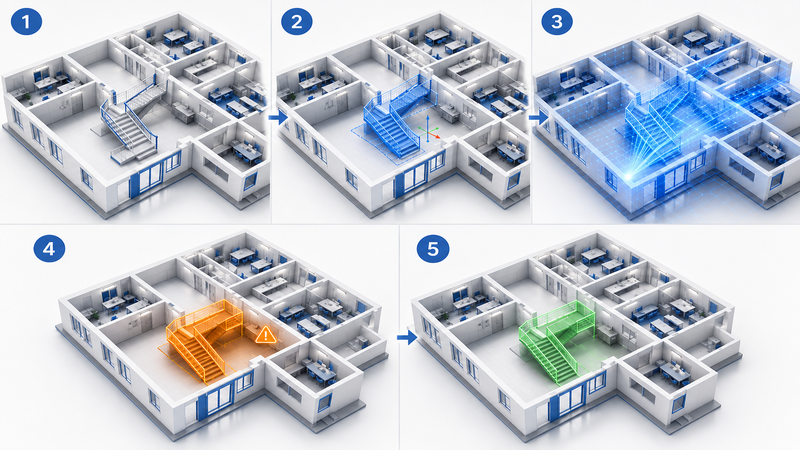
Artificial intelligence in construction is moving earlier into the process. Rather than waiting until drawings are complete to run a compliance check, modern A.I. construction tools plug directly into the design environment and check rules as the design develops. A designer adjusting a stair layout, for example, can get an immediate flag if the new riser height falls outside code long before the drawing set ever reaches a formal review.
This shift from “check at the end” to “check as you go” is one of the biggest practical wins A.I. and construction have delivered together. It catches problems when they’re cheap to fix, not after they’re built into hundreds of sheets.
Site and Zoning Checks with GIS
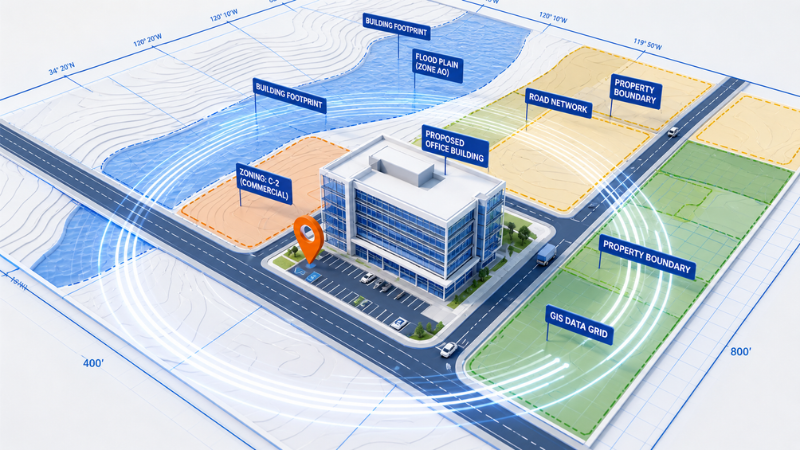
Compliance is not just about the structure. The use of GIS tools checks the compliance of a project’s location with zoning maps, flood areas, as well as other amendments on a site-by-site basis. There is more to be said about the contribution of BIM technology into compliance and here it goes.
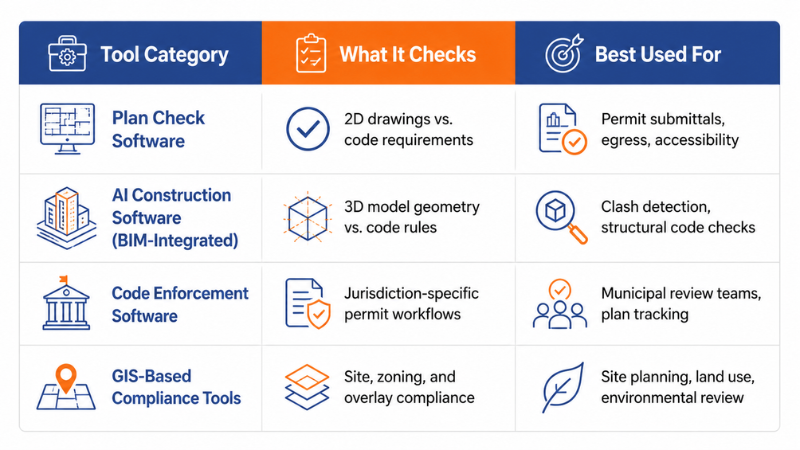
Used well, these tools don’t just speed up review they shrink the number of round trips between designer and reviewer, which is often the real source of project delay.
How AI Is Changing Engineering Consulting
Zoom out from plan review specifically, and the bigger shift is in engineering consulting team’s workday today. AI is starting to change how engineers process information and flag potential problems not by replacing their judgment, but by changing where their time goes. For firms facing growing workloads or limited internal capacity, offshore AEC support can provide additional design, drafting, BIM, and engineering resources
From Manual Search to Automated Screening
Picture an engineer reviewing hundreds of design elements against a requirement. The old way means scanning every element by hand. An automated screening pass can flag the ones worth a second look instead something like “these three doors may not meet the required clearance” so the engineer starts from a short list instead of a blank one.
That’s a shift from Search → Find → Check → Record to Scan → Flag → Investigate → Decide. On a large project, that difference adds up fast.
AI Can Process Information Faster — But Speed Isn’t Certainty
AI systems are good at processing large volumes of text and project data quickly: extracting requirements, sorting rules, spotting inconsistencies, and drafting preliminary compliance summaries. The same approach is becoming relevant earlier in the design process, where predictive design can help teams evaluate options before designs are finalized. There’s active research interest in translating building regulations into machine-readable rules that can be checked directly against BIM models a sign of where this is headed.
But a fast answer is only useful if the rule, the project data, and the interpretation behind it are all correct. Speed without accuracy just means finding the wrong answer faster. That’s exactly why engineering consulting teams keep a professional in the loop rather than treating an automated flag as a final answer.
Why BIM Design Strengthens Automated Compliance
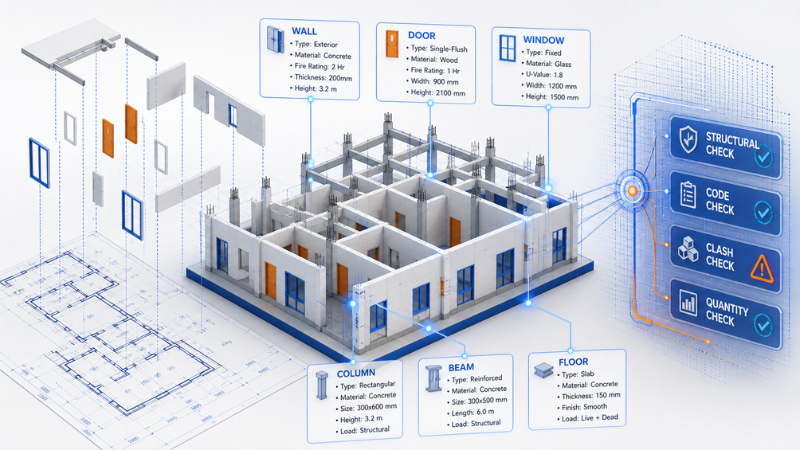
Automation of compliance checking can be as effective as the data that’s being checked against. “Companies that spend money on quality BIM services don’t just end up with better looking models; they’re constructing the data structure that automated compliance checking relies upon.”
Turning Drawings into Structured Data
A 2D drawing will present a review with just a door symbol, a dimension, and a label. A good BIM model presents the automation program with a door object that has its width, height, position, floor level, and spatial relations to the surroundings. This additional information is what enables the process of automation. Otherwise, there would be no data to be analysed by the program.
BIM Structural Engineering and Compliance
The same holds true for BIM structural engineering. A structural model can hold sufficient data on columns, beams, slabs, walls, foundations, and materials for an automated check to reveal any cases that require further analysis. However, a geometrically accurate model does not mean that a structural engineer’s input is not required in regard to loads, structure performance, and other site conditions that cannot be considered using the model alone. BIM simplifies what needs to be reviewed manually; it does not substitute engineering.
Better Multidisciplinary Coordination
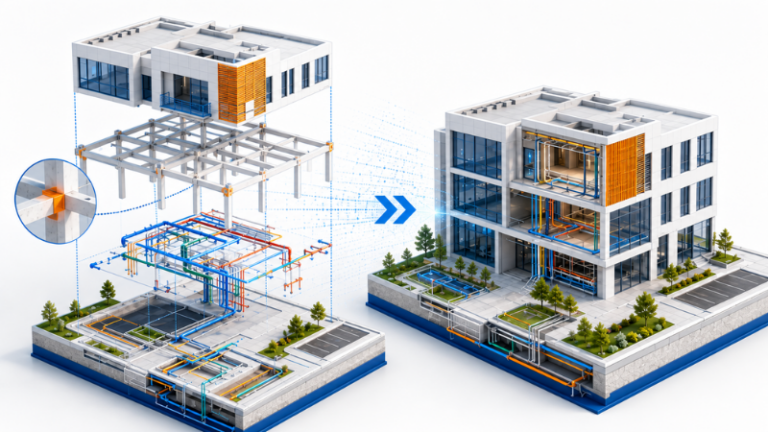
Compliance issues rarely stay in one lane. A change that looks architectural can carry structural or civil implications the design team hasn’t traced yet. This multidisciplinary coordination becomes especially important in complex infrastructure projects such as AI data centers, where multiple engineering disciplines must work together. This is where civil and structural engineering design coordination earns it keep. A strong BIM workflow surfaces those cross-discipline relationships earlier, before they turn into a late-stage redesign.
The takeaway: automation doesn’t create the value on its own. BIM design is what gives it something reliable to work with.
Where Human Review Still Matters
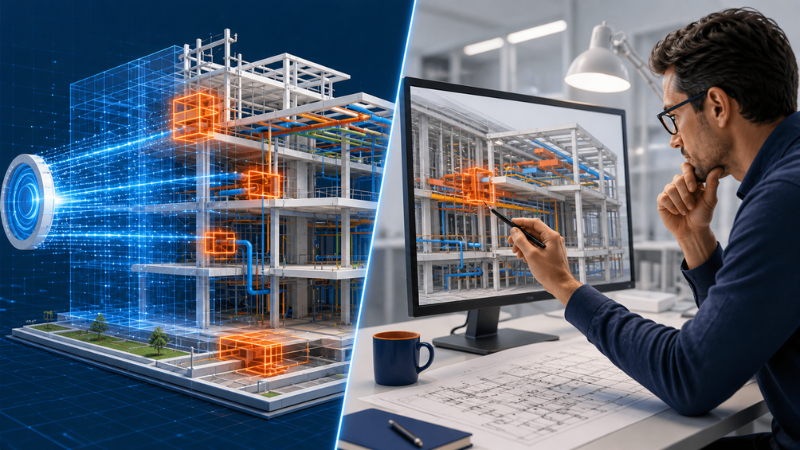
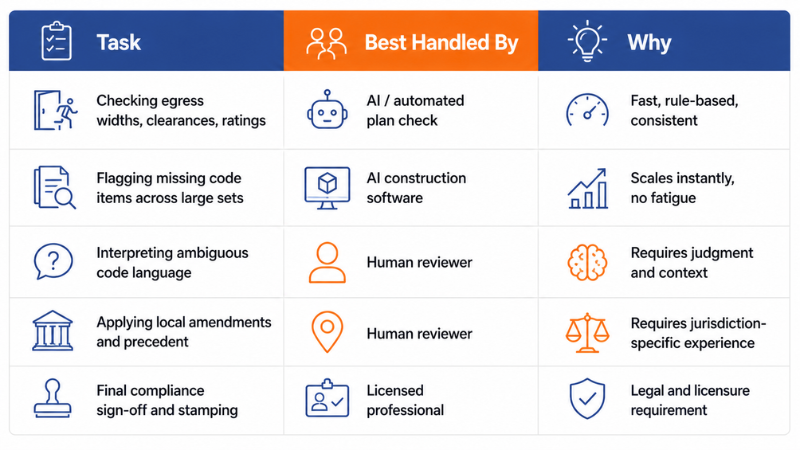
For all that A.I. construction software can do, code compliance automation still runs into a hard limit: codes are written in language, not logic, and language leaves room for interpretation. That’s where a licensed reviewer earns their role.
Professional Judgment and Code Interpretation
Building codes abound with terms such as “substantially equivalent,” “approved method,” and “as determined by the authority having jurisdiction.” None of these terms are mechanical rules; rather, they are terms that need to be evaluated with knowledge and experience behind their meaning. A code reviewer who has witnessed the results of a comparable situation on ten previous projects is using information no computer program can know.
Liability, Licensure, and the Engineer’s Stamp
Compliance with codes is legally binding. Stamping any drawing by a licensed engineer or architect means they have placed their license on the line. Any software cannot take responsibility for this legal binding decision, nor will any authority accept an algorithmic output as the replacement for a signed off by a licensed professional.
Local Amendments and Site-Specific Context
Model codes like the IBC set a national baseline, but nearly every jurisdiction layers on its own amendments, historical exceptions, and unwritten local practices. A reviewer who has worked with a specific building department for years often knows what that department enforces not just what the code technically says. AI tools are only as current and as complete as the code data, they’re trained on, and local nuance is exactly the kind of detail that’s easy to miss in a database.
Edge Cases and Unusual Conditions
Standard buildings with standard layouts are where automation performs best. Unusual geometries, mixed-use occupancies, adaptive reuse projects, and historic structures all introduce edge cases that fall outside typical code scenarios situations where a reviewer must weigh competing code sections against each other and decide which intent should govern.
Building a Hybrid AI-Plus-Human Compliance Workflow
The most effective firms aren’t choosing between AI and human review they’re sequencing them.
The Hybrid Review Model
A practical hybrid workflow usually looks like this:
- AI does the first pass — flagging obvious, rule-based issues across the full drawing set
- The design team resolves flagged items before formal submission
- A licensed reviewer focuses on judgement calls — interpretation, local context, and edge cases — instead of re-checking basic dimensions
- Final sign-off stays human — with automation providing a documented audit trail of what was checked and when
Setting Up an AI-Assisted QA/QC Process
To make this work in practice, most teams:
- Automate checking at every major stage of design, and not only before the final submittal
- Direct the flagged issues to the appropriate technical lead, and not to a general queue
- Have a manual list of all the amendments that the software does not have knowledge of
- Keep track of everything you flag and resolve through the process of automation
This structure keeps review fast without asking automation to make judgment calls it isn’t built for.
Choosing Code Compliance Automation Tools for Your Team
Not every plan review software solves the same problem, so it helps to know what you’re actually buying before you commit to a platform.
Key Features to Look For
When evaluating construction compliance software, prioritize:
4. Start Narrow, Then Expand
- Code library coverage — does it include your relevant model code plus local amendments?
- BIM/CAD integration — can it check your models directly, or does it require exporting files?
- Update frequency — how often is the code database refreshed as jurisdictions revise requirements?
- Audit trail reporting — can you export a clear record of what was checked for submittal or QA purposes?
- Human-in-the-loop workflow — does it route flagged items to a reviewer or just generate a static report?
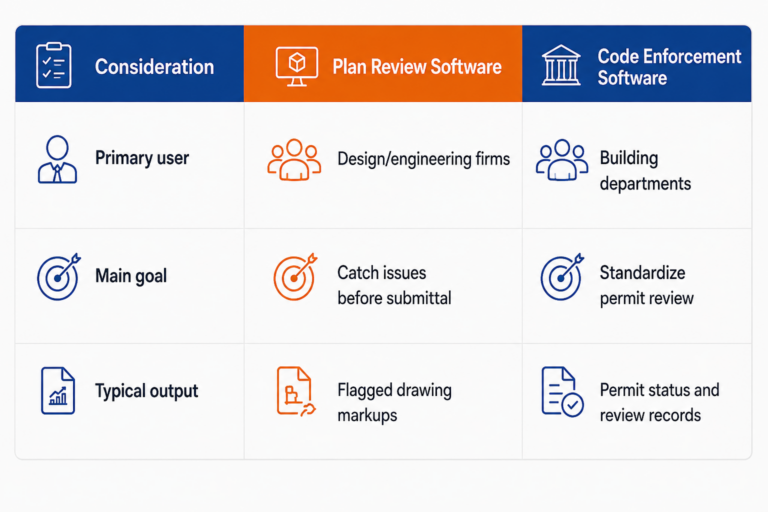
Plan Review Software vs. Code Enforcement Software
These two categories are often confused, but they solve different problems:
- Plan review software is typically used by design and engineering teams to self-check drawings before submittal.
- Code enforcement software is generally used by municipal building departments to manage and standardise permit review across their own staff.
Firms doing their own pre-submittal compliance checks want the former; firms building tools for a jurisdiction or partnering with one need to understand the latter.
The Future of AI in Civil Engineering and Code Compliance
AI in civil engineering is still early, but the direction is clear. As A.I. construction news continues to cover new plan-check and modelling tools, expect automated compliance checking to move further upstream into early design and even conceptual massing rather than sitting only at the final review stage.
That is not likely to change any time soon as a licensed professional will still be required to translate the technical coding language, consider the local environment and make legal decisions. A.I. civil engineering applications will keep improving in the ability to automate the process of compliance with the help of rules-based procedures. The interpreting part remains human and that’s how the process works.
In short: AI finds, BIM manages, engineers interpret and professionals decide.
Need the human expertise behind automated compliance?
AI can help identify potential issues, but successful AEC projects still depend on coordinated design, accurate documentation, BIM expertise, and professional review.
Contragenix AEC Design & Support Services provides multidisciplinary support across architecture, structural, land development, civil-municipal design, transportation, and water resources from due diligence and design through construction documentation, coordination, regulatory approvals, and QA/QC.
Conclusion
AI in Code Compliance Automation does not replace the reviewer; rather, it provides the reviewer with a better place to start from. The construction AI tools quickly and uniformly perform the repetitive, rules-based checks, allowing the discovery of problems at an early stage when the corrections are still inexpensive.
The best solution is not the AI alone but the combination of AI, BIM, and engineering expertise with a license-holder doing the last word. The firms that gain the most benefits do not choose between these two approaches. Instead, they create a process where AI does the routine checks and BIM provides AI with reliable information to work with.
Scale Your AEC Projects with Expert Design Support
Whether you’re managing multiple projects or facing resource constraints, our experienced engineering professionals seamlessly integrate with your team to provide accurate design, drafting, BIM coordination, and technical documentation, keeping your projects on schedule and within budget.