

Introduction
Is ASCE 7-22 changing the way your next low-rise steel structure will be designed and engineered, all without you realizing it? For most engineers, fabricators, and contractors, the answer would be yes, and the surprise always comes when the plans are being reviewed.
The problem is simple. The 2024 International Building Code (IBC) adopts the newer load standard, so loads you once pulled from a table, or a quick calculation may now come from a different source and follow a different method. Wind, snow, and seismic values have all moved, and a whole new tornado chapter has been added.
This blog covers all the new changes for low-rise steel structures and cold-formed steel structures that you need to know about. This blog will show you what the changes are and how important they are to you, along with what to look out for when preparing for the next submittal.
1. What the ASCE 7-22 Changes Mean for Your Projects
ASCE 7 is the standard that tells designers how much load a building must be able to carry. The 2022 edition, known as ASCE 7-22, is the version the 2024 IBC points to. You can read the publisher’s overview on the ASCE/SEI 7-22 page
ASCE 7-22 vs ASCE 7-16: A Quick Comparison
The jump from ASCE 7-16 to ASCE 7-22 is bigger than a routine update. Training providers such as the ICC describe the changes as numerous and substantive. Here is a simple summary of the biggest shifts
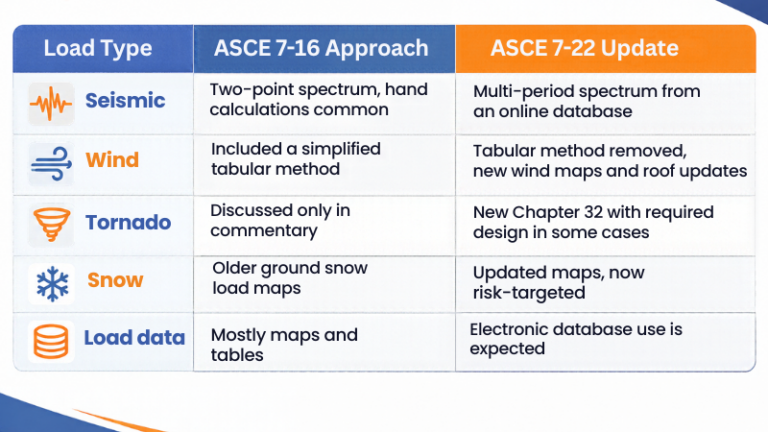
How the IBC 2024 Changes Connect to ASCE 7-22
Most of the IBC 2024 changes in structural design come from the standards it references. When the IBC points to a newer ASCE 7, the new loads flow straight into the building code. The IBC also reorganized its steel chapter, Chapter 22, to make it easier to use, as explained in this STRUCTURE magazine review of the 2024 IBC steel changes.
There is one other issue to consider. Codes are enacted on a state-by-state and city-by-city basis; thus, the codes followed on your project might be out of date. It is always important to know what version of the IBC your jurisdiction uses. Keeping up with changing code requirements is also becoming easier with digital tools. Learn how code compliance automation supports engineering teams during design and plan reviews
2. ASCE 7-22 Seismic Provisions and the New Hazard Data
The ASCE 7-22 seismic provisions are among the most talked-about updates. Committee members have described the new edition as a correction to the previous one. Overall seismic force levels are similar, but some sites see higher demand and others see lower demand, according to an industry summary from E2G.
The Multi-Period Spectrum and the ASCE 7 Hazard Tool
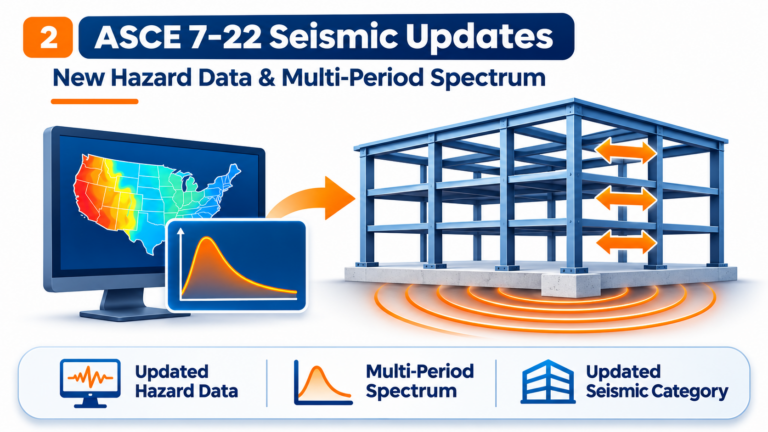
The biggest practical change is how you get ground motion data. ASCE 7-22 relies on a multi-period response spectrum, and you now get it from an online database. In practice, this means you can no longer finish the job with hand calculations alone.
The free ASCE 7 hazard tool is where designers pull this data. The older two-point spectrum is still in the text, but it is meant as a fallback when the newer data is not available
Seismic Design Category in ASCE 7-22
Since the ground motion inputs have been modified, it is important to verify the seismic design category as determined by ASCE 7-22 at an early stage. This is because the seismic design category of the site might be different from what was found before. In particular, for light steel buildings, the seismic design category determines whether any seismic detailing is required or not. Seismic design also involves understanding how structures respond to lateral forces and displacement. For a deeper look at structural behavior in taller buildings, explore our guide to construction sequence analysis and storey drift
Nonstructural Components
The new edition also adds a new force equation for nonstructural parts, such as ceilings, mechanical units, and wall cladding. Low-rise steel projects often include these items, so make sure your team reviews them and does not only focus on the main frame.
3. ASCE 7-22 Wind Loads: What Is Different
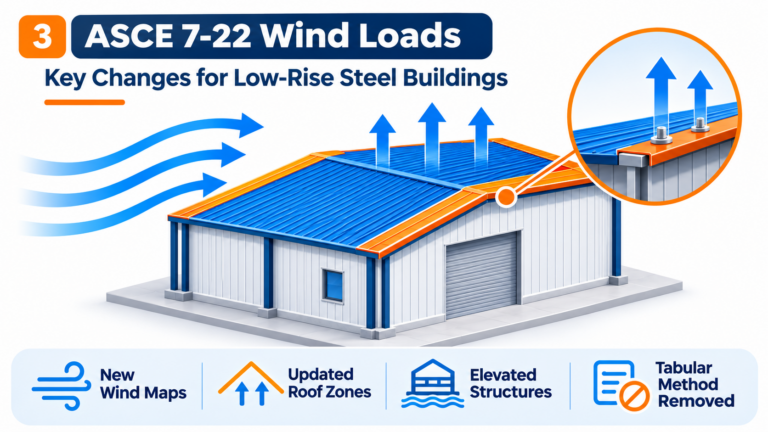
Wind often controls the design of lightweight steel buildings, so the ASCE 7-22 wind loads deserve close attention. Low-rise steel and cold-formed roofs are light, and uplift can be a major concern.
Key wind updates include:
- New design wind speed maps in the wind chapters.
- Removal of the tabular simplified procedure, so more projects use the full methods.
- Roof pressure coefficient and zone changes, which can shift the loads on edges and corners.
- New provisions for elevated structures, such as buildings raised in flood-prone areas.
These details come from the E2G code summary and the ICC wind overview. For your project, compare your old calculations with a fresh run. Small zone changes can alter fastener spacing and purlin sizes. Wind loading is equally important in other lightweight structural systems. Our guide to utility-scale solar tracker design explains how engineers evaluate wind forces, structural connections, and load requirements under standards such as ASCE 7-22.
4. ASCE 7-22 Tornado Loads: The New Chapter 32
Tornado design is brand new in the main body of the standard. Earlier editions only touched on it in the commentary. ASCE 7-22 tornado loads now sit in their own chapter, Chapter 32.
When Do Tornado Loads Apply?
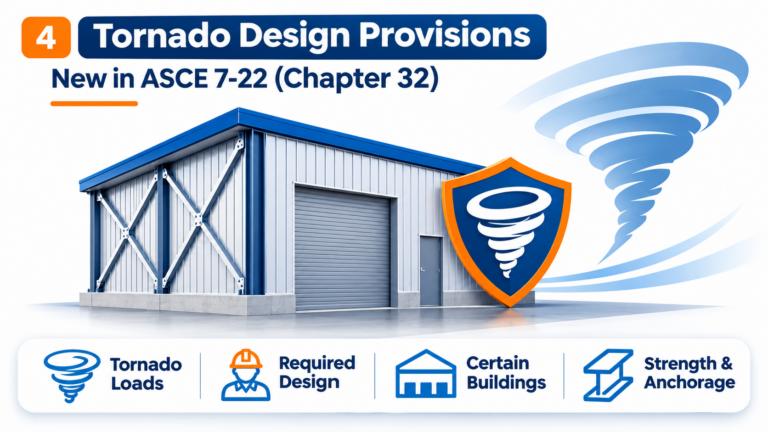
Not every building must be designed for tornadoes. The rules apply to Risk Category III and IV structures, such as schools, large assembly buildings, hospitals, and emergency facilities. They also apply only in the tornado-prone region east of the Rocky Mountains, and only where the mapped tornado speed passes a set limit. Per the E2G summary, that limit is 60 mph.
A flowchart in the standard helps you check whether regular wind controls. If it does, you can skip the tornado calculations.
Why Tornado Loads Can Surprise You
- Tornado speeds on the map can be lower than normal wind speeds, yet the resulting pressures can still be higher.
- Tornado wind is the strongest near the ground, which is the opposite of normal wind patterns that grow with height.
- Risk Category III and IV buildings are designed to the greater of tornado or regular wind loads.
For a low-rise steel school gym or a small emergency station, this can change bracing and connection design.
5. ASCE 7-22 Snow Load Changes and ASCE 7 Load Combinations
Snow design has seen major updates. The ASCE 7-22 snow load changes include new ground snow load maps, the first major refresh in roughly thirty years. Snow is now treated as a risk-targeted load too, similar to wind and seismic.
What This Means for Roof Design
In the main strength design combination, snow now uses a load factor of 1.0. That is a different mindset from older editions, so the combinations need a fresh review.
Updating Your ASCE 7 Load Combinations
The ASCE 7 load combinations changed because the load chapters changed. Do not copy old combinations from a past project. Instead:
- Rebuild the combinations from the current standard.
- Check snow, wind, and seismic factors one by one.
- Review roof drift and unbalanced snow cases for low-slope steel roofs.
- Document the edition you used in your calculation package.
If you are comparing options, remember that ICC training notes also point to major changes in snow, ice, and tsunami provisions.
6. Cold-Formed Steel Design Under the Updated Codes
The design of cold-formed steel structures is usually at the heart of most low-rise constructions. It is good to note that while the loading on cold-formed sections changed considerably, the basic design criteria for such sections didn’t change as much.
AISI S100 Cold-Formed Steel Rules in the IBC
The IBC points to AISI S100 for the design of cold-formed carbon and low-alloy steel members. Cold-formed stainless steel follows ASCE 8, and special bolted moment frames follow AISI S400. Diaphragm work may also be called on AISI S310. These links are laid out in the STRUCTURE magazine article.
The AISI S100 cold-formed steel specification has also been supported by worked examples. AISI released a set of 22 design examples tied to the S100-16 (2020) edition with Supplement 3. These help teams learn the updated provisions.
Cold-Formed Steel Framing and Light Gauge Steel Framing
If you work with cold-formed steel framing or light gauge steel framing, two points matter:
- The IBC reorganized Chapter 22, and the light-frame section was renumbered. Update your code references in specs and drawings.
- The group that manages the framing standards changed. After AISI ended its standards work in 2023, the Steel Framing Industry Association (SFIA) took care of the framing standards, as reported by Walls & Ceilings. Industry voices said major code-referenced changes were not expected soon.
Why Heavier Loads Are Not the Only Issue
Light-frame construction may be vulnerable to uplift, drift, and connections under wind loads. After changes to loading, verify the studs, track spacing, fastener spacing, and hold-downs. The member that passed load criteria before may only require a slight modification now.
7. Low-Rise Steel Building Design: A Practical Compliance Checklist
Good low-rise steel building design starts with clean inputs. Use this checklist to avoid rework.
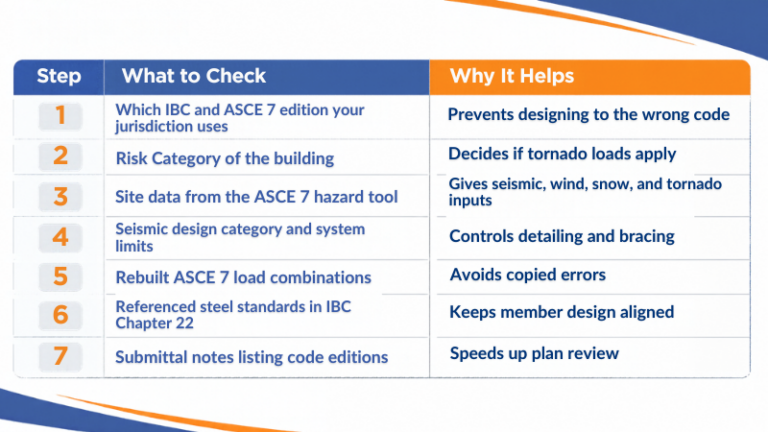
Building Code Updates for Steel Structures: Stay Current
Changes to building codes for steel construction happen in waves. Stay abreast of your state’s adoption schedule, get updates on changes from the standards organizations, and educate your team well ahead of implementation. Learning early is always less costly than redesigning later.
Structural Engineering Building Code Compliance Tips
Where structural engineering building code compliance is concerned, be sure to keep your data clean. Document the loads that you’ve used, the sources for those numbers, and the code that you’ve used. It helps reviewers work quickly.
In reviewing the structural design requirements of IBC, go beyond the loads chapter. The special inspection, foundation, and steel chapters may all change with a new edition of IBC.
Need Expert Support with Structural Design and Code Compliance?
Changing building codes shouldn’t slow down your project. Contragenix’s AEC Design and Support Services help engineering teams with structural analysis, steel design, CAD/BIM coordination, and construction documentation aligned with applicable project requirements.
Conclusion
The ASCE 7-22 changes and the 2024 IBC updates affect nearly every part of low-rise steel and cold-formed design. Seismic data now comes from an online database; wind rules and roof zones have shifted, snow maps are refreshed, and tornado loads are a new design check for important buildings. Cold-formed members still follow AISI S100, but the loads reaching them are different.
The best approach here would be to check your local code version, update your site information, and redo your load calculations. After that, go over your steel and cold-formed details with an engineering professional. Some simple planning will pay off in the long run
Scale Your AEC Projects with Expert Design Support
Whether you’re managing multiple projects or facing resource constraints, our experienced engineering professionals seamlessly integrate with your team to provide accurate design, drafting, BIM coordination, and technical documentation, keeping your projects on schedule and within budget.