

Introduction
Is predictive AI stormwater modeling the missing piece in your next land development project? Many developers still lose weeks to drainage redesigns, review comments and surprise flood risks. These delays eat into budgets and push back schedules.
The problem is simple. Rain patterns are changing, sites are getting tighter, and old methods often cannot keep up. Predictive AI offers a faster and smarter way to test ideas before you pour a single yard of concrete.
In this blog , you will learn what predictive AI in stormwater and hydrologic modeling really means, where it helps most, and how land developers can use it today. We will keep the language simple and the advice practical. Let’s get started.
This blog explains how a smart multi-sourcing strategy fixes that risk. You will learn how to plan capacity, spread work across more than one source, and keep modeling quality steady. We use plain language and practical steps, so you can apply the ideas to your next project.
What Is Predictive AI Stormwater Modeling?
Predictive AI stormwater modeling uses machine learning to forecast how rain turns into runoff on a site. Instead of relying only on fixed equations, the model learns from past rainfall, soil, land cover, and flow data. It then predicts what may happen in future storms.
How It Differs from Classic Hydrologic Modeling
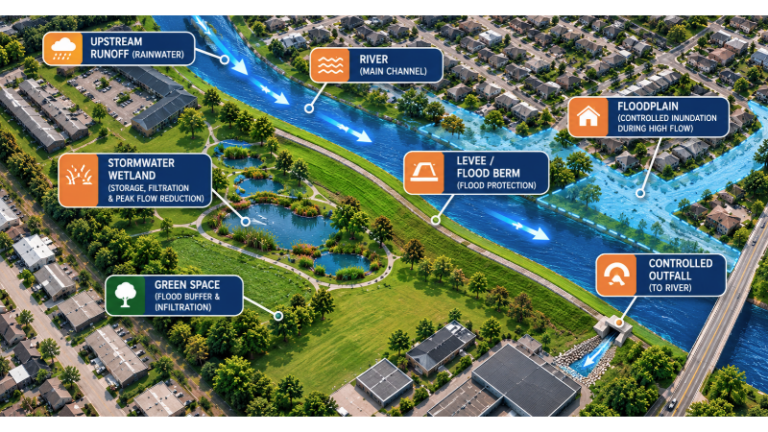
Hydrologic modeling traditionally uses physics-based rules. Engineers set inputs, run the model, and study the results. This works well, but each new scenario can take time.
AI models work differently:
- They learn patterns from large data sets.
- They run new scenarios in seconds or minutes once trained.
- They can improve as more data comes in.
Key Terms You Should Know
- Machine learning flood prediction: Computer models that learn from data to forecast flood events
- AI hydrology models: Machine learning tools built to predict streamflow, runoff and water levels.
- Surrogate model: A fast AI copy of a slow, detailed simulation.
Researchers are already testing this approach. One recent study built a machine learning framework to predict how stormwater treatment systems behave during changing storm loads, which would normally need very heavy computing (Shatarah, Liu and Li on arXiv). Other work shows that LSTM neural networks can predict river flow from weather data and even learn patterns that match how water systems behave (NeuralHydrology research on arXiv).
Why Traditional Hydrologic Modeling Is Not Enough Anymore
Traditional tools are still valuable. But land developers now face new pressures that make slow workflows risky.
Changing Rainfall and Tighter Sites
Storms are less predictable, and many parcels have little room for ponds. A design that looked safe on paper may struggle in real heavy rain.
Slow Scenario Testing
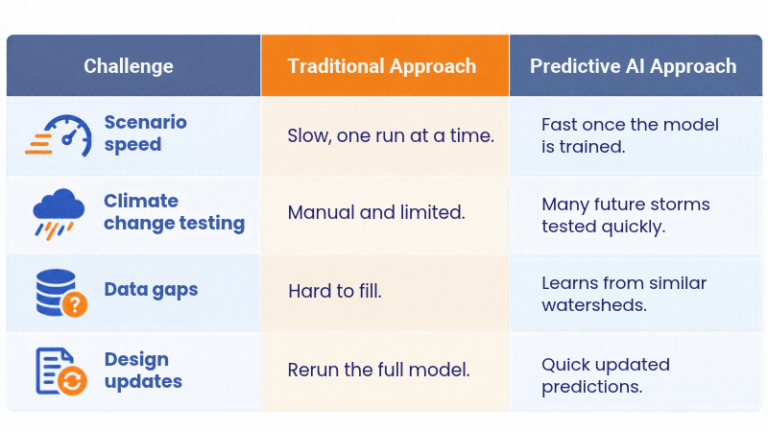
A classic stormwater runoff calculation or full model run may take hours per scenario. If the reviewer asks for three changes, the schedule slips.
Data Gaps
Many sites have little or no flow data. Research on regional hydrologic behavior shows that machine learning can help carry what we learn from one watershed into another (Kratzert et al. on arXiv).
7 Proven Benefits of Predictive AI Stormwater Modeling for Land Developers
1. Faster Design Decisions
AI helps you compare many layouts quickly. You can test different pond sizes, pipe routes, and grading plans in a short time.
2. Better Flood Risk Modeling
Flood risk modeling becomes more forward-looking. Instead of testing one design storm, you can explore many possible storms and see where the site is weak.
3. Smarter Stormwater Detention Design
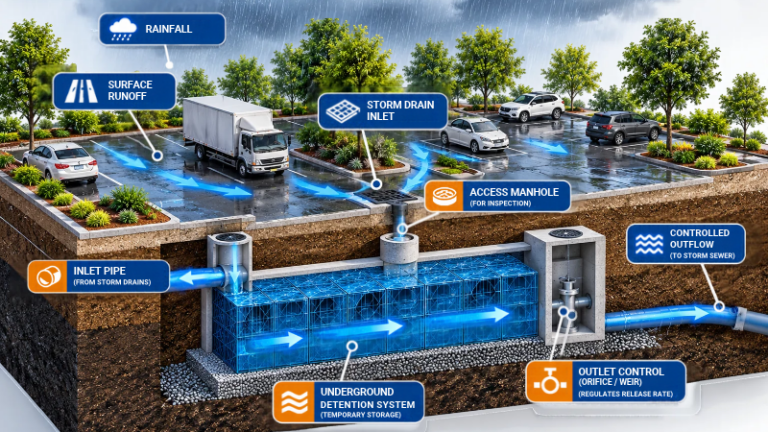
Stormwater detention design is a major cost driver. AI-assisted tools can help you right-size ponds and vaults, so you avoid over-building or under-building.
4. Lower Project Costs
Fewer redesigns and smaller, better-fitted facilities can reduce construction and engineering costs.
5. Stronger Permit Packages
Clear, well-tested designs help reviewers trust your submittal. This can reduce back-and-forth comments.
6. Improved Water Quality Planning
AI tools are also being used to study stormwater quality and green infrastructure. A Springer review in Water Resources Management looks at how stormwater modeling tools and AI can work together to improve water quality (review summary on IDEAS/RePEc).
7. Future-Proof Projects
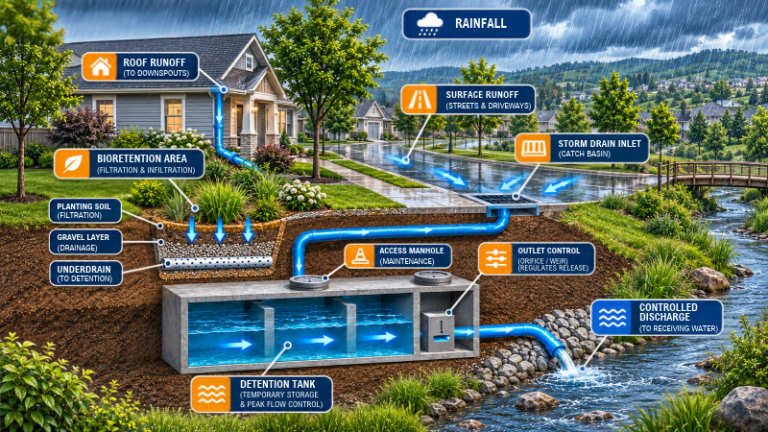
Clients, lenders, and cities care more about climate resilience each year. Showing that your project was tested against many future storms is a real selling point. For projects involving open channels or drainage systems, you can also explore our guide on natural channel design vs. hard armor for long-term erosion control and flood resilience.
How AI Works With Hydrology and Hydraulics (H&H) Study Tools
AI does not replace your engineer or your approved software. It works alongside them.
Using AI With Common Tools
Many teams already use SWMM stormwater modeling or HEC-HMS hydrologic modeling. You can learn more about these tools on the official pages for the EPA Storm Water Management Model (SWMM) and the US Army Corps of Engineers HEC-HMS.
AI can help in three simple ways:
- Speed up runs: A trained AI copy predicts results faster than the full model.
- Screen options: AI finds the best few layouts, then engineers confirm them in approved software.
- Spot patterns: AI flags risky outlets, low points or overloaded pipes.
What a Modern Hydrology and Hydraulics (H&H) Study Can Look Like
A hydrology and hydraulics (H&H) study often follows this flow:
- Collect rainfall, soil, and land cover data.
- Build the hydrologic model.
- Build the hydraulic model for pipes, channels, and ponds.
- Use AI to test many what-if cases.
- Confirm final designs in approved stormwater engineering software.
Choosing Stormwater Modeling Software and Hydrologic Modeling Software
When you compare stormwater modeling software, hydrologic modeling software or stormwater engineering software, look for:
- Approval or acceptance by your local reviewing agency
- Easy data import from CAD and GIS
- Clear reports for permit submittals
- Support for climate scenarios
- Options to connect with AI or automation tools
Predictive AI Stormwater Modeling for Land Development Requirements
Every city and county has its own rules. Understanding stormwater requirements for land development early can save you from costly redesigns.
Common Requirements You May Face.
Read our guide on stormwater management ordinances to understand how local requirements can affect drainage design, detention planning, and land development approvals
- Limits on post-development peak flow
- Detention or retention rules
- Water quality treatment standards
- Floodplain and downstream impact checks
- A full drainage study for land development in many areas
Where Predictive AI Fits In
Use AI for early planning and option testing. Then use your agency-approved method for the final stormwater management plan. This gives you speed in the early stage and acceptance at the final stage.
Stormwater Management for Developers: Quick Planning Tips
- Talk to the reviewing agency before choosing a modeling method.
- Keep a clear record of your data, assumptions, and checks.
- Test at least one extreme storm beyond the minimum requirement.
- Compare your AI results against a trusted physics-based model.
If you are exploring the wider field, see how predictive design in early-stage engineering is being used to test design alternatives, identify risks earlier, and improve decisions across civil, structural, transportation, and water-resource projects. Many of the same principles used in predictive stormwater modeling apply across the broader AEC design process.
For readers who want deeper research, here is the Springer Nature article shared for this topic and a growing set of studies on AI agents in hydrologic modeling.
Real Challenges and How to Handle Them
AI is powerful, but it is not magic. Be honest about its limits.
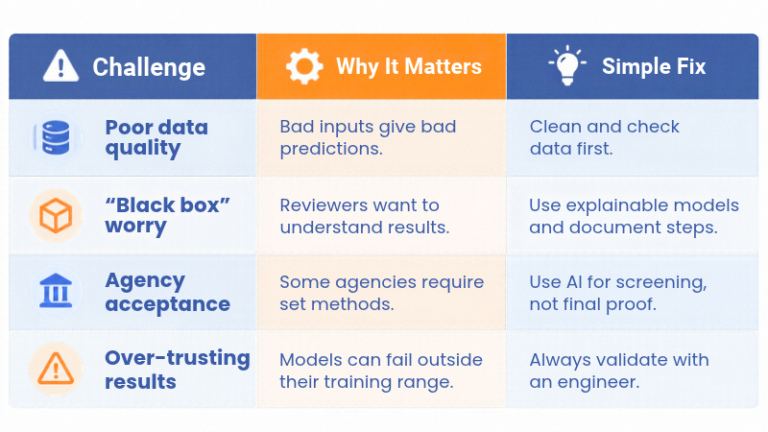
Keep a Human in the Loop
A licensed Professional Engineer should review every output. AI supports good judgment. It does not replace it.
How to Get Started: A Simple 5-Step Plan
- Pick one pilot project. Start small, such as a single residential or commercial site.
- Gather your data. Collect rainfall records, soil maps, survey data, and past model files.
- Choose your tools. Combine your approved modeling software with an AI tool or a trained consultant.
- Validate the results. Compare AI predictions with your standard model.
- Document and share. Write a short summary so your team and reviewers can follow your process.
Need Expert Support for Your Next Stormwater or Land Development Project?
Predictive tools can accelerate analysis, but successful land development still depends on sound engineering judgment, accurate modeling, coordinated design, and regulatory-ready documentation.
Contragenix AEC Design and Support Services provides multidisciplinary support across water resources, civil and land development, transportation, structural design, CAD/BIM, and municipal infrastructure. From hydrologic and hydraulic modeling and stormwater management to grading, flood studies, design documentation, and QA/QC, our team can work alongside your existing engineers from early planning through final design.
Conclusion
Predictive AI stormwater modeling is quickly becoming a practical advantage for land developers. It speeds up decisions, improves flood risk modeling, supports better stormwater detention design, and helps you build stronger permit packages. It works best when paired with trusted hydrologic modeling tools and expert review.
The smart move is to start now. Test AI on one project, learn what works, and grow from there. Developers who adopt predictive AI in stormwater and hydrologic modeling early will be better prepared for tougher rules, heavier storms and tighter budgets.
Ready to plan your next project with confidence? Talk to a qualified engineering team and ask how predictive AI can fit into your stormwater workflow.
Scale Your AEC Projects with Expert Design Support
Whether you’re managing multiple projects or facing resource constraints, our experienced engineering professionals seamlessly integrate with your team to provide accurate design, drafting, BIM coordination, and technical documentation, keeping your projects on schedule and within budget.