

Introduction
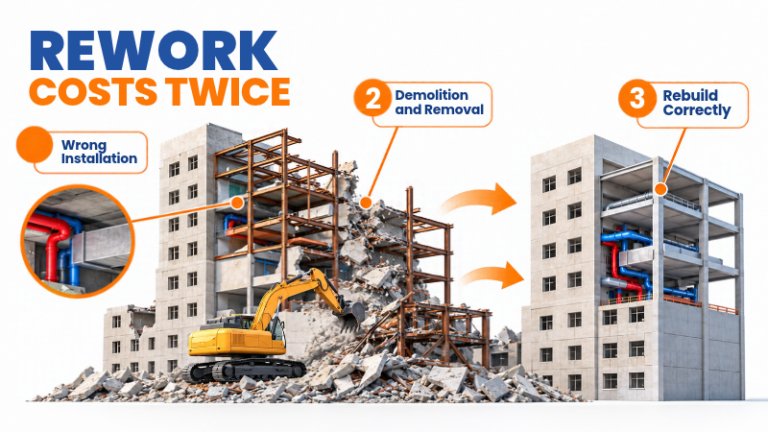
Why is rework in construction constantly eroding profits even for projects managed by seasoned management? The reason why most companies know cannot be “bad luck.” Projects need to be built twice because there were ambiguities in the drawings, no checks were performed, or because two teams had different information.
This is an actual issue for both the builder and consultant. Re-working affects profit margins, delays project deadlines, and jeopardizes client trust. On the other hand, clients now evaluate building firms based on their delivery performance, not only on cost.
In this blog, you will learn what rework is, what causes it, and how to put rework reduction strategies to work in seven clear steps. You will also see why firms that control rework are starting to win more bids, keep more clients, and protect their margins.
What Is Rework in Construction and Why Does It Matter Now?
Re-work in construction implies repeating an activity due to errors in its execution or changes in plans after commencement of construction. Re-working entails tearing down previous construction, correcting incorrect installation of equipment, and revising plans that were faulty.
The Cost of Rework in Construction
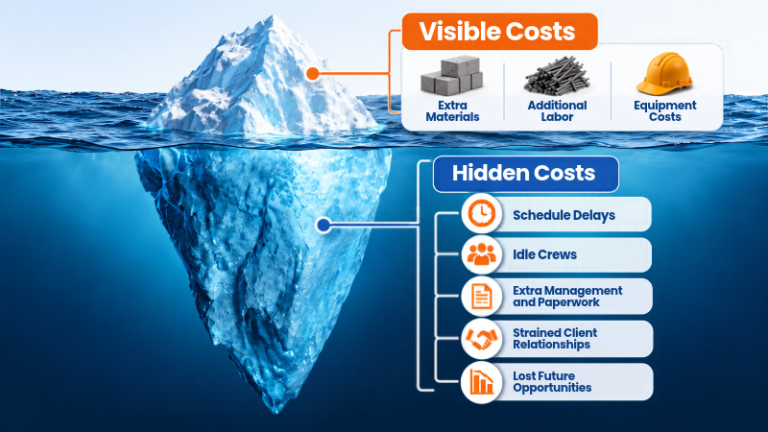
Research from the Construction Industry Institute (CII) puts direct field rework at about 5% of total project cost on average. Across different project types, the range runs from roughly 2% to 20%. You can read more in the CII guide to construction rework reduction.
That may sound small until you apply it to a large budget. On a project worth ten of millions, even 5% is a serious loss. And these numbers cover mostly direct costs. The hidden costs come on top.
Rework, Construction Project Delays, and Cost Overruns
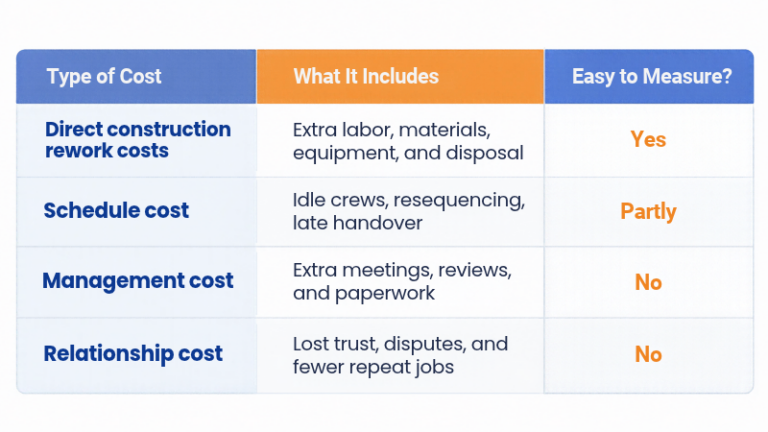
Rework is among the primary causal factors for turning small errors into large issues. An erroneous dimension detected too late may lead to delays in construction projects. Delays result in overtime, increased site costs, and potential penalties, leading to rework becoming one of the main drivers of cost overrun in construction projects.
Rework also hurts people. Crews lose morale when they rebuild work, they just finished. Project managers lose time that should go to planning. Over a year, those losses add up.
Causes of Rework in Construction
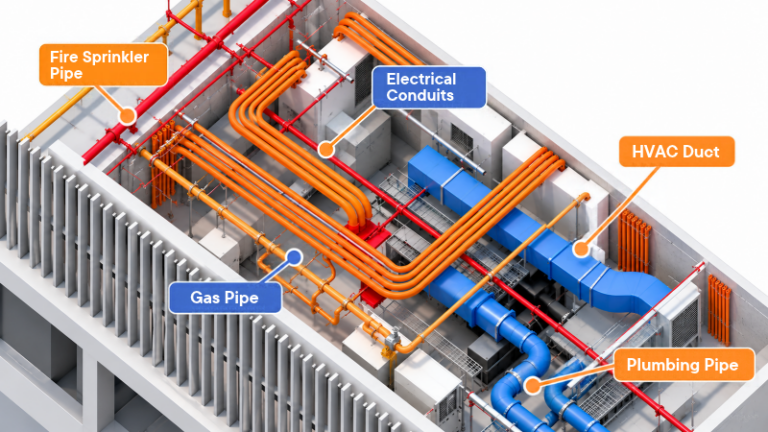
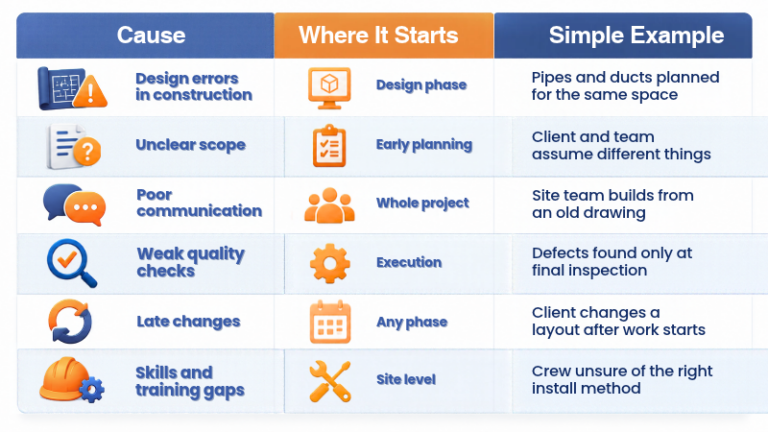
You cannot fix what you do not understand. The causes of rework in construction usually fall into a few groups. Most of them start long before anyone picks up a tool.
Design Errors in Construction
Design mistakes during the construction process are some of the most expensive reasons, because they are inherent in the project since its beginning. It could be a failure to detect a clash between the structure and the services, an erroneous load assumption, or an omission in detailing. Using BIM clash detection can help teams identify conflicts between disciplines before construction begins, reducing the likelihood of costly field adjustments and rework.
At that point, however, correcting it involves demolition, not merely correction. This is precisely the reason why the engineering design review process is so important.
Poor Communication and Document Control
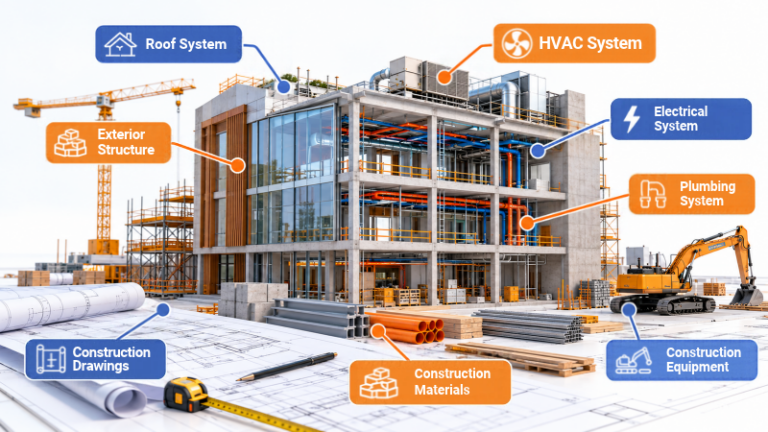
Teams often waste time due to lack of a single source of the truth. Strong communication and coordination on construction sites also help teams manage contractor activities and reduce the risks created by disconnected project information. If drawings, specifications, and RFIs are scattered around in multiple locations, construction is done using an incorrect version. Good document management is easy to achieve and provides a rapid ROI.
Weak Construction Quality Control
Defects are detected by most groups at the very end when they become too costly to rectify. Effective construction quality control ensures that such detections occur early enough to handle the defect easily.
Late Changes and Rushed Starts
Starting work before the design is ready feels fast. In practice, it often creates changes later. Every change after construction begins, carries a rework risk.
How to Reduce Rework in Construction: 7 Rework Reduction Strategies
Here is how to reduce rework in construction with steps that any consultant or contractor can start using. Together, these rework reduction strategies form a loop of tracking, learning, and improving.
1. Track and Classify Rework
Begin with measurement. Document all rework incidents, their causes, and their cost. Most organizations do not measure since rework is not reported. According to the Construction Industry Institute, one of the reasons for lack of progress is that there is no program in place, and another is that people might shy away from reporting rework.
Make Reporting Safe
Consider rework reports as learning information and not as finger-pointing tools. The more secure people feel, the better the information will be.
2. Build a Strong Engineering Design Review Process

A good engineering design review process catches problems on paper, where they are inexpensive . A good engineering design review process catches problems on paper, where they are not costly . Predictive design in early-stage engineering can further help teams identify conflicts and risks before they become construction-stage problems. Use these basics:
- Review designs at set stages, not only at the end.
- Bring in people from different disciplines, such as structural, MEP, and civil.
- Use a checklist based on past errors.
- Record every comment and how it was closed.
Add a Fresh Pair of Eyes
An independent/ peer reviewer often spots what the original team no longer sees. This is where outside consulting support can add real value.
3. Invest in Front-End Planning and Constructability
The time before any construction begins is where the most influence takes place in terms of rework. Ask basic questions at the outset. Is this really buildable? In what sequence? What access will the team have? Constructability studies answer these questions.
4. Strengthen Quality Control on Site
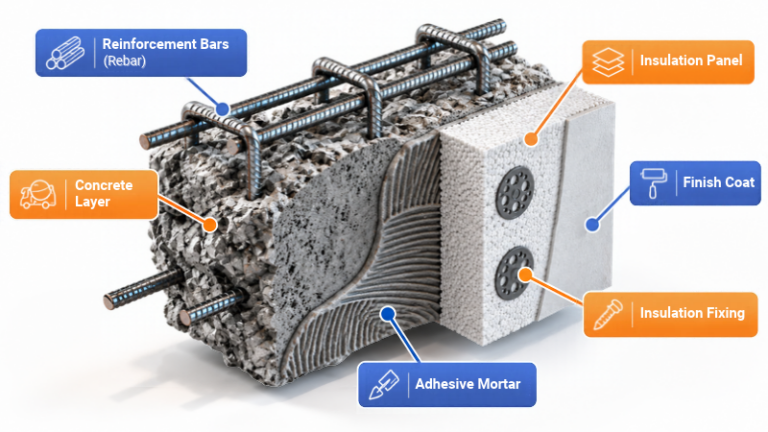
Move from “inspect at the end” to “check as we go.” A defined QA/QC process can establish review points, documentation standards, and checks before errors spread across a drawing package or project. Useful habits include:
- Short pre-task briefings that confirm the plan and the standard.
- Hold points before work gets covered up.
- Photo/ Video records of key stages.
- Quick feedback when something is off.
5. Train Teams and build a “Get It Right the First Time” Culture
CII research on field rework found that training and a focus on quality both help cut errors. Leadership sets the tone. When managers give time and resources to quality, teams follow. You can explore the idea in CIIs Making Zero Rework a Reality.
6. Link Rework to Construction Risk Management
Treat rework as a risk rather than something that comes as a surprise and incorporate it into your risk management process for the construction project. Have a responsible person and an action plan for each risk, particularly those involving complex interfaces and long lead times. In this manner, “hope” becomes a plan.
7. Use Digital Tools the Right Way
Use digital tools such as BIM platforms, cloud-based document management, and real-time project tracking to keep drawings, specifications, and revisions aligned. Ensure everyone works from the latest approved information to avoid errors caused by outdated documents, missed updates, or miscommunication. Better access to accurate project information helps teams reduce avoidable rework and keep construction moving efficiently.
Construction Rework Prevention as a Competitive Advantage in Consulting and Construction
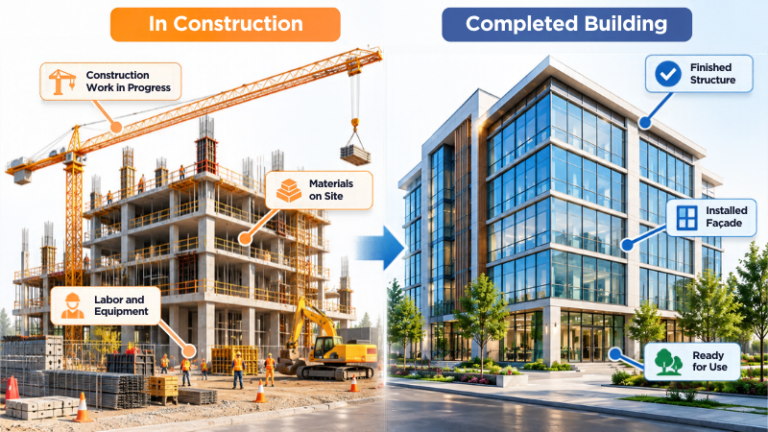
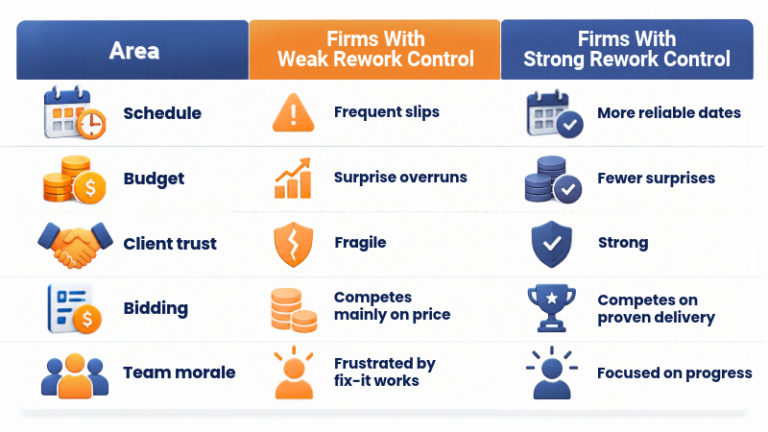
Cutting rework is not just a cost saving. It is a way to stand out. Clients today want firms that can show how they avoid mistakes. This is where construction rework prevention becomes a real consulting competitive advantage in construction.
Why Clients Notice
Businesspeople are sick and tired of being surprised. It will be more appealing to deal with an organization that knows how to explain their review process, their checks, and their reputation.
Advantages for Consultants
- Stronger proposals: You can describe your review process and quality steps in plain terms.
- Better margins: Fewer fix-it hours mean more time for paid work.
- More repeat work: Clients return to teams that deliver clean drawings and fewer RFIs.
- Clear value: Independent design checks show you protect the client's budget.
Advantages for Contractors
- Tighter schedules: Less rebuilding means fewer slips.
- Fewer disputes: Clear records reduce arguments over who pays.
- Lower construction rework costs: Savings go straight to the bottom line.
- Better reputation: Word spreads fast in a small industry.
Construction Project Management Habits That Make Rework Reduction Last
Idea is not useful if there are no habits. Construction project management and construction quality management will maintain what has been achieved.
How to Improve Efficiency of AEC Project Delivery
Efficiency of AEC project delivery can be improved through effective communication among design, engineering and construction groups. Short coordination meetings should be held with clear definition of who signs off on what. Clearly defined handoffs prevent hidden errors.
Link Rework Reduction to Construction Productivity Improvement
Rework and productivity are two sides of the same coin. Every hour spent redoing work is an hour not spent on new progress. That is why construction productivity improvement, and rework reduction should be managed together, with shared goals.
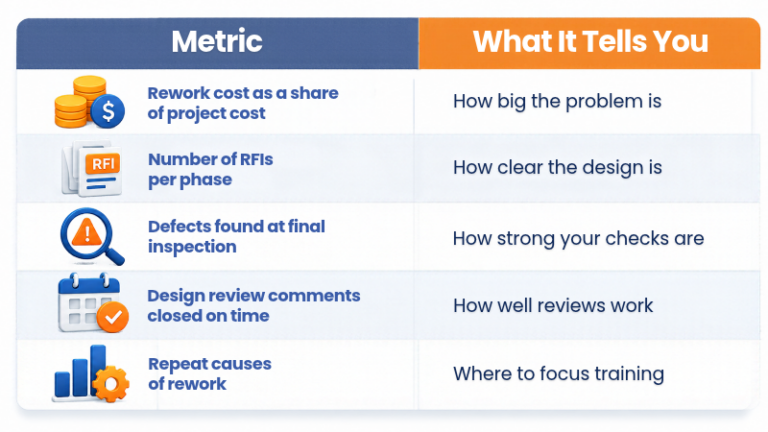
Track a Few Simple Metrics
A Simple 90-Day Starter Plan
- Days 1 to 30: Start logging rework and its causes on one project.
- Days 31 to 60: Add a design review checkpoint and a pre-task briefing.
- Days 61 to 90: Review the data, share lessons, and set a target for the next project.
Need to Reduce Rework Before It Reaches the Field?
Rework often starts long before construction begins with design gaps, coordination issues, incomplete details, or drawings that were not reviewed from a constructability perspective.
Contragenix AEC Design & Support helps engineering and AEC consultants strengthen project delivery with reliable architectural, structural, civil, land development, transportation, water resources, CAD, and BIM support.
From design coordination and drafting to independent reviews and documentation support, our team helps you catch issues earlier and deliver with greater confidence.
Conclusion
Construction rework is an expensive, common and often unspoken problem. Studies done by CII indicate that direct rework cost for projects stands at about 5% but varies greatly depending on project type. The reasons for rework include design flaws, ineffective communication, poor quality control measures, and delayed changes. The silver lining here is that rework can be managed.
Construction firms that identify and track rework, improve design reviews, plan, monitor quality control measures on site, train workers, manage risks, and use digital tools effectively can significantly reduce construction rework. Those companies will maintain their profit margins and will have an upper hand while choosing contractors.
Start small. Choose one project, record your rework costs and solve the leading cause of it. Companies that embrace rework reduction as one of their key skills will be chosen next by their clients.
Scale Your AEC Projects with Expert Design Support
Whether you’re managing multiple projects or facing resource constraints, our experienced engineering professionals seamlessly integrate with your team to provide accurate design, drafting, BIM coordination, and technical documentation, keeping your projects on schedule and within budget.