

Federal Proposal Volumes: What Goes Into Each One?
You open an RFP expecting to plan a proposal response. Then you reach the submission instructions and find five separate volumes, each with its own page limits, content requirements, and formatting rules.
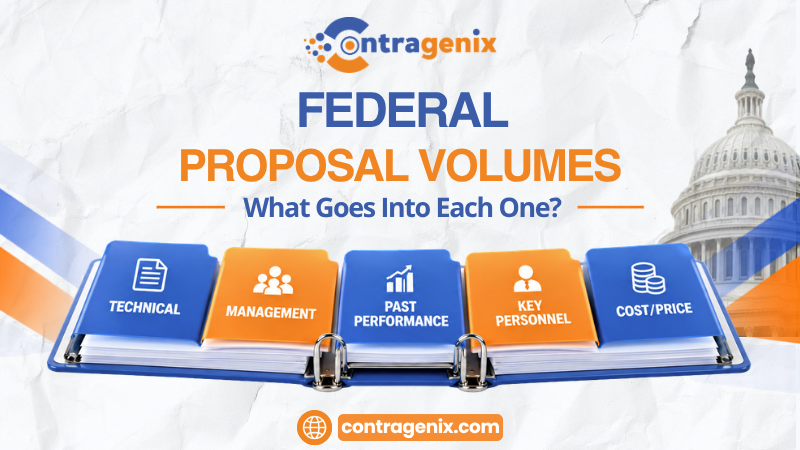
Technical. Management. Past Performance. Staffing. Price.
The challenge isn’t just developing good content. It’s knowing what belongs where—and what should not appear in the wrong place.
That’s the purpose of federal proposal volumes. They divide a complex proposal into separate sections so the government can evaluate specific aspects of an offer in an organized way. But there’s one rule contractors should keep in mind from the beginning:
The solicitation controls the proposal volume structure.
There is no universal set of volumes that works for every federal opportunity.
What Are Federal Proposal Volumes?
Federal proposal volumes are separate sections or files within a government proposal that organize different types of information for submission and evaluation. A solicitation may separate technical approaches, management plans, past performance, staffing, and pricing into individual volumes, but the number and content of those volumes depend on the specific solicitation.
Agencies may divide proposals this way for several reasons. Separate volumes can make complex submissions easier to review, align information with evaluation factors, and keep sensitive pricing information separate from technical content where required.
Some solicitations combine multiple subjects into one volume. Others create highly specific submission volumes for areas such as transition plans, key personnel, small business participation, or oral presentation materials.
The point is not to force every proposal into a standard template. The point is to follow the proposal volume requirements established by the government for that acquisition.
Why Proposal Volume Structure Matters
Volume structure isn’t just an administrative detail.
Each volume may have its own instructions, page limitations, file naming conventions, and evaluation relationship. A contractor that develops excellent content but places it in the wrong location can make the evaluator’s job harder and create an avoidable compliance issue.
A well-written answer in the wrong volume can still create a proposal problem.
Proposal teams need to understand:
- What information is required in each volume
- Which requirements are subject to page limits
- How each volume relates to evaluation criteria
- Where pricing and supporting financial information should appear
- Whether content should be submitted separately or combined
This is why proposal organization should begin with the solicitation—not with a recycled outline from the last opportunity.
Common Types of Federal Proposal Volumes
There is no universal federal proposal structure. Still, certain categories appear frequently across government proposal volumes.
Technical Volume
A technical volume proposal generally explains how the contractor intends to perform the work.
Depending on the requirement, it may address the contractor’s technical approach, methodology, work processes, deliverables, transition approach, risk management, or quality controls.
The strongest technical content does more than repeat the statement of work. It connects the proposed approach to the government’s actual requirement and shows how the contractor plans to execute.
A common mistake is turning the technical volume into a company brochure. Evaluators are typically looking for evidence related to the requirement—not a long description of everything the company has ever done.
Management Volume
A management volume proposal may focus on how the contractor will organize, oversee, and control performance.
Depending on the solicitation, this could include program management, organizational structure, communication processes, reporting, governance, quality management, risk controls, or subcontractor management.
The line between technical and management content isn’t always identical from one RFP to another. Some solicitations combine both into a single volume. Others clearly separate technical execution from management oversight.
Again, the solicitation determines the boundary.
Past Performance Volume
A past performance volume commonly presents previous contracts that demonstrate experience relevant to the current requirement.
Information requested may include contract descriptions, periods of performance, contract values, customer references where requested, performance outcomes, and explanations of relevance.
Past performance is not simply a company history section.
The strategic question is, why does this previous work matter to this requirement?
A highly impressive contract may add little value if the proposal does not clearly establish its relevance to the work being evaluated. Contractors should follow the solicitation’s instructions on which references to provide and how relevance should be addressed.
Staffing or Key Personnel Volume
Staffing information doesn’t always have its own volume.
A solicitation may require staffing plans and key personnel information as a separate submission, within the technical volume, or as part of the management volume.
Common requirements can include key personnel resumes, qualifications, labor categories, staffing plans, organizational charts, and availability commitments.
This is one area where contractors should resist assumptions based on previous proposals.
The solicitation determines where staffing information belongs.
Small Business or Participation Volume
Depending on the acquisition, a proposal may include separate requirements related to subcontracting, small business participation, teaming arrangements, or socioeconomic participation.
These requirements are not universal. Their structure and applicability can vary significantly based on the procurement.
When a separate participation-related volume is required, contractors should carefully distinguish between general corporate statements and the specific information requested by the government.
Cost or Price Volume
The price volume proposal presents the contractor’s financial response according to the solicitation’s pricing instructions.
Depending on the acquisition, it may include pricing tables, cost breakdowns, labor rates, pricing assumptions, supporting cost information, or subcontractor pricing.
Many solicitations intentionally separate price information from technical content. That separation makes it especially important to avoid placing financial details in a technical narrative unless the solicitation specifically calls for them.
The pricing strategy may support the overall proposal approach, but the actual submission must follow the government’s instructions regarding what belongs in the price volume.
Not Every Federal Proposal Has the Same Volumes
One RFP might request:
- Volume I: Technical
- Volume II: Management
- Volume III: Past Performance
- Volume IV: Price
Another may combine technical and management content into one submission. A different solicitation may create separate volumes for transition, key personnel, small business participation, or other requirements.
The structure depends on the acquisition, agency, and evaluation approach.
Never build your proposal around a generic volume template before reading the solicitation instructions.
This principle also connects to the broader types of government proposals contractors encounter. Different acquisition approaches can produce very different submission structures, even when the underlying work appears similar.
Where Should Contractors Look for Volume Requirements?
For federal opportunities, contractors typically access solicitation documents through official sources such as SAM.gov. Once the solicitation is available, the proposal instructions should be reviewed before outlining individual volumes.
Look for details covering volume names, submission order, page limitations, file naming, formatting requirements, and required content.
For many negotiated acquisitions, Section L and Section M are particularly important reference points. Section L commonly addresses instructions for preparing and submitting proposals, while Section M commonly explains the basis on which proposals will be evaluated. The exact solicitation structure can vary, so contractors should read the actual document rather than rely on assumptions.
A useful proposal outline should reflect both sides of the equation: what the government asks contractors to submit and how the submitted information will be evaluated.
Proposal Volumes vs. Government Proposal Format
Proposal volumes and proposal format are related, but they aren’t the same thing.
A government proposal format addresses the broader rules governing how a proposal must be organized and submitted. That may include page limits, fonts, margins, file requirements, naming conventions, and submission instructions.
Proposal volumes are the larger divisions within that overall submission.
For example, a solicitation might require five volumes. Each volume could then have its own page limits, formatting instructions, and required sections.
Understanding this distinction helps proposal teams avoid treating “format” as simply a list of volume names. One governs the broader presentation and submission structure; the other organizes major categories of proposal content.
How to Build a Proposal Volume Strategy
The best starting point is simple: start with the government’s structure.
Build an internal compliance matrix or proposal outline that maps each requirement to the correct volume. This helps prevent content from being overlooked, duplicated unnecessarily, or placed where evaluators aren’t expecting to find it.
Teams should also think about who will use each section. Different volumes may support different evaluation factors, so content should make the relevant evidence easy to locate.
At the same time, separate volumes should not become isolated writing projects.
Technical promises should align with staffing. Management processes should support the technical approach. Past performance examples should reinforce the credibility of the proposed solution. Pricing assumptions should not contradict the staffing or delivery model described elsewhere.
For complex submissions, coordinated proposal development services can help teams maintain that alignment across multiple contributors and volumes.
The Biggest Mistake Contractors Make With Proposal Volumes
The biggest mistake is treating proposal volumes like separate assignments instead of connected parts of one proposal strategy.
Consider what happens when the technical volume promises a staffing model that isn’t reflected elsewhere. Or when the management approach describes processes that don’t support the technical methodology. Or when past performance examples look impressive but have little connection to the requirements being evaluated.
Each volume may be physically separate, but the government’s view of the offer is still shaped by the consistency of the overall response.
Separate volumes should not mean separate strategies.
That is the real discipline behind managing multi-volume proposals. Follow the government’s structure precisely, but ensure every volume supports the same core understanding of the requirement, the same solution, and the same reasons the contractor is qualified to perform.
The solicitation determines what goes into each volume. The proposal team’s job is to make sure those separate pieces still tell one coherent story.