

Introduction
Utility-scale solar tracker design is becoming increasingly important as the clean energy industry expands but how do engineers ensure that thousands of moving solar panels can withstand wind, soil, and long-term structural demands?
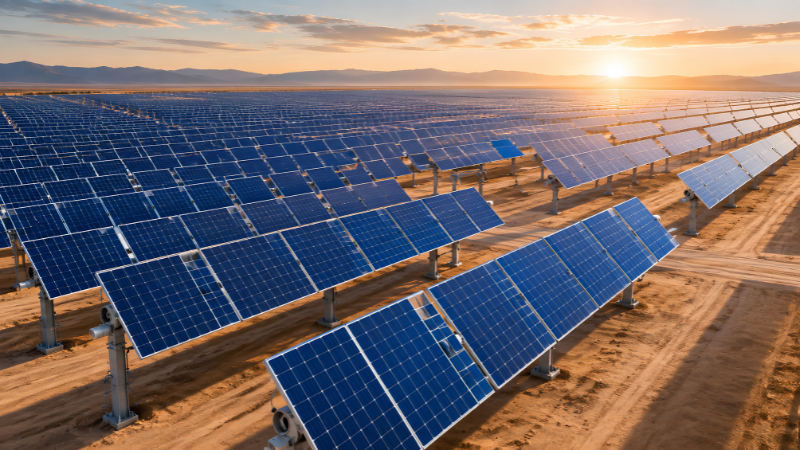
A utility solar farm is not just an area covered by photovoltaic panels. There is also a system of structures supporting all the equipment, transferring loads to the ground, allowing for movement, and standing firm under the influence of ever-changing environmental factors.
This is where solar tracker structural engineering becomes critical.
Solar trackers improve energy production by changing the orientation of photovoltaic modules throughout the day. However, their moving configuration also creates unique engineering challenges. Wind direction, tracker position, soil conditions, foundation behavior, structural connections, and repeated movement can all influence performance.
The challenge becomes even greater at utility scale. A small design weakness repeated across thousands of tracker rows can become a major project risk.
This blog examines the most important structural challenges in solar tracker design, including wind loading, torque tube design, foundation behavior, geotechnical conditions, structural reliability, and the application of standards such as ASCE 7-22.
What Is Utility-Scale Solar Tracker Design?
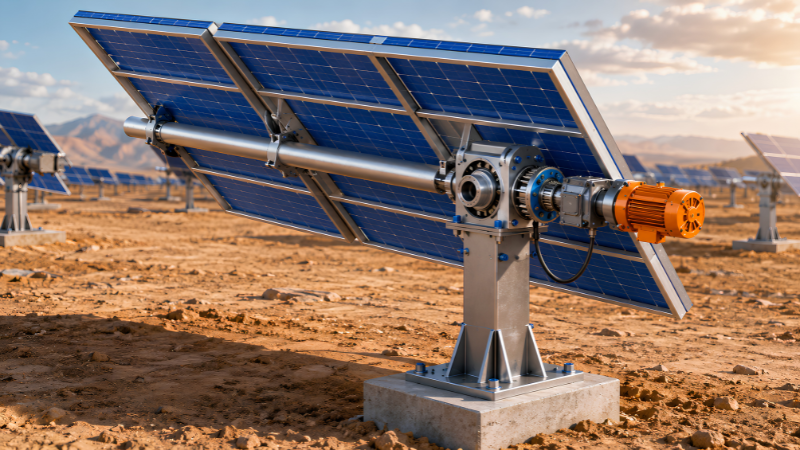
Utility-scale solar tracker design involves engineering the mechanical and structural systems that support photovoltaic modules and allow them to rotate according to the sun’s position.
Unlike fixed-tilt solar systems, tracking systems use moving components to change the panel orientation. One of the most common configurations is the single-axis tracker.
A typical tracker system may include:
- Photovoltaic panels
- Torque tubes
- Poles or piles
- Bearings
- Drive mechanism
- Dampers
- Brackets
- Foundations
- Electrical and control components
The structural system should behave as an integral unit.
The engineering objective is not simply to make the structure strong. It must also be:
- Stability
- Efficiency
- Durability
- Economy
- Buildable
- Maintainable
- Resistance to environmental loads
On the utility scale, small changes in structural efficiency will impact thousands of foundation structures, poles, joints, and tracking arrays.
Why Structural Engineering Matters in Solar Tracker Design
Solar farms are exposed to environmental conditions for decades. As a result, solar farm structural engineering must account for more than the static weight of photovoltaic modules.
The structure can experience:
- Wind pressure and uplift
- Dynamics of wind force
- Snow load
- Seismic force
- Temperature variation
- Soil movement
- Corrosion
- Movement of the tracker
- Connection fatigue
- Settlement of foundation
ASCE/SEI 7-22 provides loading provisions covering hazards such as wind, snow, seismic effects, soil, rain, ice, and other environmental loads. ASCE also specifically identifies provisions and training related to wind loading for ground-mounted solar arrays.
Therefore, structural engineering for utility-scale solar must connect site conditions, tracker configuration, loading requirements, material behavior, and foundation performance.
The goal is to create a system that remains reliable not only during normal operation but also under extreme conditions.
Key Structural Challenges in Solar Tracker Design
1. Solar Tracker Wind Load Design
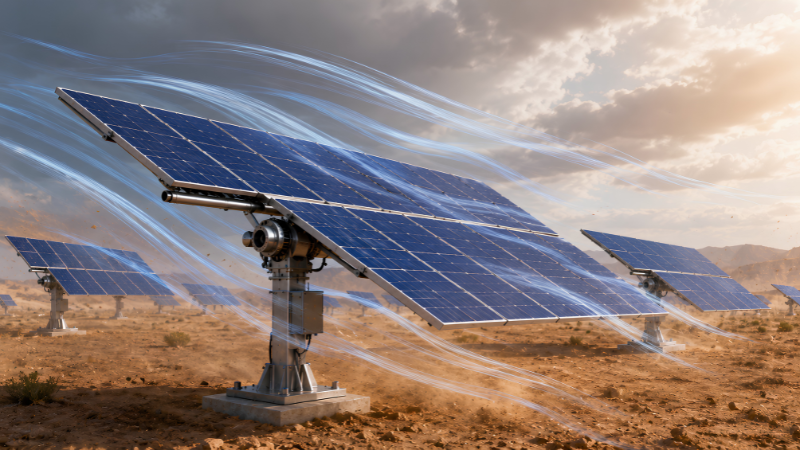
Wind is one of the most important considerations in solar tracker wind load design.
A solar tracker is exposed to wind from multiple directions, and its aerodynamic behavior can change depending on the tracker angle.
Wind can create:
- Uplift
- Downward pressure
- Lateral forces
- Torsion
- Bending
- Connection forces
- Foundation reactions
The tracker position is particularly important.
A tracker operating at one angle may experience significantly different wind behavior from the same tracker in another position. High-wind conditions may therefore require specific stow strategies.
The U.S. Department of Energy notes that tracker manufacturers may use high wind stow positions to reduce exposure during severe wind conditions.
Why Wind Loading Is Complex
The wind does not act on one component independently.
The load path can move from:
PV modules → mounting system → torque tube → bearings/posts → foundation → soil
Every component must transfer the resulting forces safely.
A weakness at any point in this load path can affect the performance of the complete tracker system.
2. Torque Tube Design
The torque tube is one of the key structural components in many single-axis tracking systems.
Its job is to transmit rotational movement while also carrying structural loads from the photovoltaic modules.
Torque tube design for solar trackers should thus consider:
- Bending
- Torsion
- Axial forces
- Deflection
- Connection behavior
- Properties of material
- Tracker span
- Arrangement of modules
- Loading by wind
The study of solar tracker structures must analyse the effects of loads, such as vertical and horizontal reaction loads, drive strut forces, and bending forces in torque tubes.
Why Torque Tube Performance Matters
Deformation may lead to problems with:
- Alignment of tracker
- Positioning of modules
- Performance of drive system
- Strength of connections
- Durability of structure
Thus, design of torque tubes should be considered within the framework of the whole structure.
3. Solar Tracker Foundation Design
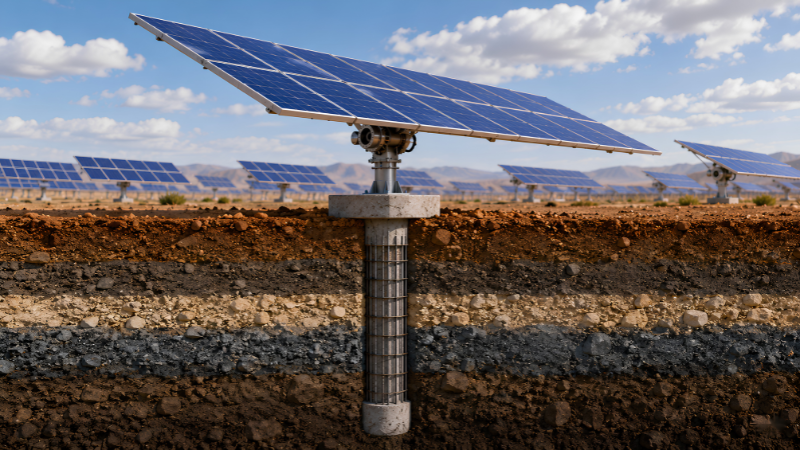
A tracker can have a well-designed superstructure and still experience problems if its foundation is not appropriate for the site.
Solar tracker foundation design must account for the interaction between the structural system and the ground.
Depending on site conditions, projects may use different foundation approaches, including driven piles, ground screws, drilled foundations, or other engineered solutions.
Foundation design may need to consider:
- Axial Compression
- Axial Uplift
- Lateral Loads
- Overturning Effects
- Soil Resistance
- Settlement
- Corrosion
- Groundwater
- Foundation Installation
It is crucial for the foundation to transmit the structural loads to the ground without excessive movement or instability.
4. Solar Tracker Geotechnical Design
Structural design cannot be separated from geotechnical conditions.
Solar tracker geotechnical design considers how soil characteristics affect the behavior of posts, piles, and foundations.
Two solar sites may have identical tracker systems but require different foundation solutions because their ground conditions are different.
Important site parameters can include:
- Soil type
- Soil strength
- Density
- Groundwater conditions
- Rock depth
- Corrosivity
- Settlement potential
- Frost conditions
- Slope
- Existing ground conditions
This is why geotechnical information should be incorporated early in the engineering process.
A foundation optimized without understanding the site can create installation problems, unexpected movement, or additional project costs.
5. Solar Tracker Structural Reliability
A utility-scale solar project may contain thousands of tracker components.
That makes solar tracker structural reliability especially important.
A failure affecting one component may appear minor. But if the same design issue exists across hundreds or thousands of tracker rows, the project-wide impact can be substantial.
Issues related to reliability shall include:
- Structural adequacy
- Serviceability
- Fatigue
- Connection adequacy
- Protection against corrosion
- Foundation adequacy
- Manufacturing tolerances
- Installation adequacy
- Maintenance requirements
The objective here would be that of avoiding the transformation of localized weaknesses into system-wide project issues.
Single-Axis Tracker Structural Design: Key Considerations
Single-axis tracker structural design presents a unique balance between movement, structural capacity, and energy production.
The tracker needs to rotate while maintaining adequate stiffness and stability.
Engineers typically need to evaluate:
Tracker Geometry
Geometry is responsible for the load distribution, module spacing, torque tube characteristics, and structural reactions.
Structural Stiffness
Stiffness is required in the system to manage deformations without excessive material usage.
Connections
Connections transmit loads between members and can become important points under cyclical loading.
Drive System
The drive system will need to rotate the tracker without exceeding any structural/mechanical limits.
Wind Position
Tracker angle influences aerodynamic behavior. Therefore, design scenarios should consider relevant operating and stow positions.
Foundation Interaction
The support structure and foundation must be designed as a connected load path.
Solar Tracker Foundation Failure: What Can Go Wrong?
Foundation failure of a solar tracker could be due to several contributing factors rather than one single flaw in the design.
Some of the reasons include:
.
- Lack of sufficient lateral stability
- Inadequate embedment
- Poor soil quality
- Soil settlement
- Incorrect understanding of soil properties
- Corrosion
- Mistakes in construction
- Groundwater issues
- Environmental loadings
A structure which functions well normally may not function well in extreme winds or other environmental loadings.
For that reason, foundation design should consider both normal operating conditions and credible extreme events.
ASCE 7-22 Solar Tracker Wind Load Considerations
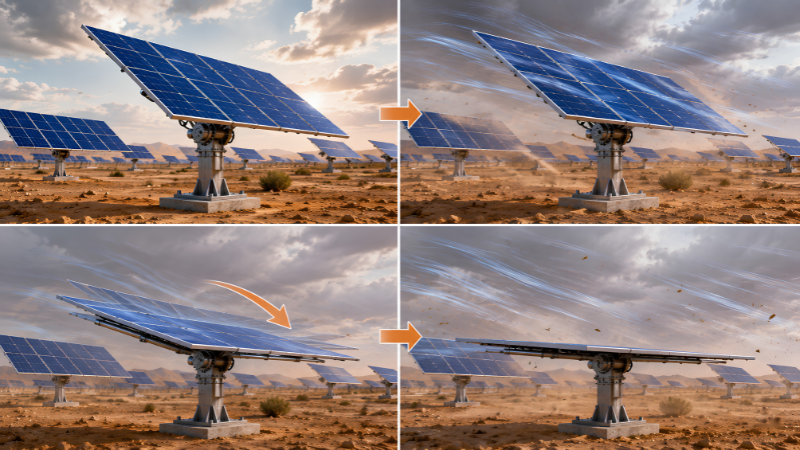
ASCE 7-22 solar tracker wind load considerations are particularly important for projects in the United States.
ASCE/SEI 7-22 is the current edition of the ASCE 7 loading standard and provides design-load provisions for hazards including wind, snow, seismic, soil, rain, ice, and other environmental conditions.
ASCE also highlights changes and guidance associated with solar arrays and wind loading. Its educational material specifically addresses the application of wind provisions to ground-mounted solar arrays.
However, engineers should not treat a standard as a substitute for project-specific engineering judgment.
Site-specific factors can influence the actual design, including:
- Geographic location
- Basic wind speed
- Exposure
- Terrain
- Array geometry
- Tracker configuration
- Tracker orientation
- Stow position
- Site elevation
- Local code requirements
Wind Load Analysis for Solar Trackers
A proper wind load analysis for solar trackers should evaluate how wind forces move through the complete structural system.
Simplified load path would be:
Wind force → PV modules → mounting systems → torque tubes → posts → foundations → soil
This load path needs to have the critical loads and reactions at all stages identified.
It is mentioned in the ASCE that the ASCE 7-22 standard contains the provisions for wind loading of ground-mounted photovoltaic solar arrays.
Structural Design of Solar PV Support Systems
The broader structural design of solar PV support systems requires coordination between structural, civil, geotechnical, mechanical, and electrical considerations.
A strong design process should answer several questions:
- What critical/ worst condition loads will the system experience?
- How will those load travel through the structure?
- Which components are most critical?
- How will the foundation transfer loads into the ground?
- How will the system behave under extreme wind?
- What happens if soil conditions vary across the site?
- How will the system perform over its expected service life?
These questions help engineers move beyond component-level design and evaluate the complete system.
A Practical Engineering Workflow for Solar Tracker Projects
Structured design process helps mitigate risks and enhances coordination.
Step 1: Site Understanding (Due Diligence)
Start with:
- Site location
- Topography
- Geotechnical information
- Environmental information
- Wind Information
- Snow and seismic information
- Codes
Step 2: Define the Tracker Configuration
Identify:
- Tracker type
- Row length
- Module arrangement
- Support spacing
- Torque tube configuration
- Drive arrangement
- Stow position
Step 3: Establish the Load Cases
Identify:
Develop relevant load cases for:
- Dead load
- Wind
- Snow
- Seismic
- Temperature
- Operational conditions
- Extreme conditions
Step 4: Analyze the Structural System
Evaluate:
- Torque tube behaviour
- Posts
- Bearings
- Connections
- Drive components
- Deflection
- Structural capacity
Step 5: Design the Foundation
Use structural reactions together with geotechnical parameters to develop an appropriate foundation solution.
Step 6: Check Reliability
Review:
- Strength
- Stability
- Serviceability
- Fatigue
- Corrosion
- Connection performance
- Installation tolerances
Step 7: Coordinate the Final Design
The structural solution should be coordinated with civil site design, electrical systems, tracker suppliers, EPC teams, and construction requirements.
Solar Tracker Engineering Challenges at Utility Scale
The larger the solar project, the more important engineering consistency becomes.
Solar tracker engineering challenges can include:
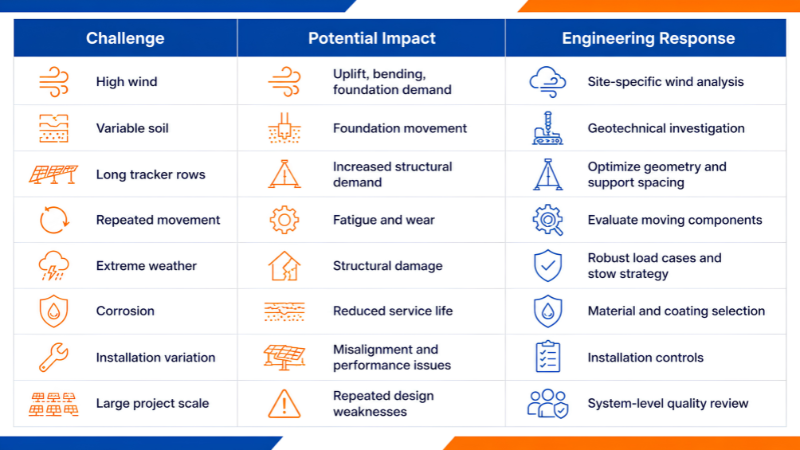
The important point is that renewable energy structural design challenges are interconnected.
A wind problem may become a foundation problem.
A foundation problem may become an alignment problem.
An alignment problem may affect tracker movement.
And a small issue repeated across a large solar farm can become a major operational and financial concern.
Clean Energy Transition and Structural Engineering
The clean energy transition structural engineering challenge is not simply about building more renewable energy infrastructure.
It is about building infrastructure that can operate reliably for decades.
Solar systems becoming more common mean that engineers face the following trade-offs:
- Energy production
- Safety
- Efficiency
- Cost of construction
- Speed of installation
- Reliability
- Climate
- Climate Change Resilience
This makes the structural challenges in renewable energy one of the issues facing modern engineers.
The structural engineer’s role is therefore expanding from simply designing individual components to helping optimize the complete system.
EPC Structural Engineering for Solar Projects
EPC structural engineering solar projects require close coordination between engineering, procurement, and construction teams.
A structurally sound design must also be practical to manufacture, transport, install, inspect, and maintain.
This is particularly important for large solar projects because even small constructability issues can multiply across thousands of components.
Effective coordination can help address:
- Foundation installation
- Tracker alignment
- Material quantities
- Connection details
- Construction tolerances
- Site sequencing
- Quality control
- Design changes
For EPC teams, structural engineering should therefore be considered part of the project’s overall delivery strategy not simply a calculation exercise.
How Engineers Can Improve Solar Tracker Structural Performance
Several principles can improve the performance of utility-scale tracking systems.
1. Design for the Actual Site
Avoid relying on generic assumptions when site-specific information is available.
2. Evaluate the Complete Load Path
Do not evaluate the tracker structure, foundation, and soil independently.
3. Consider Multiple Tracker Positions
Wind behaviour can change as tracker geometry changes.
4. Coordinate Structural and Geotechnical Design
The design of the foundation involves the interaction of the structure and the soil.
5. Optimize Rather Than Simply Strengthen
Simply putting in more materials does not make an optimal engineering solution. Geometry, spacing, and load paths could be optimized. This type of early-stage optimization can also help engineers evaluate design alternatives before detailed engineering progresses. Learn more about predictive design in early-stage engineering.
6. Consider Constructability
A theoretically efficient design may not be efficient if it is difficult to manufacture or install. Understanding how structures behave throughout different stages of construction can also support better engineering decisions. Construction sequence analysis can help engineers evaluate structural behavior during different construction stages.
7. Plan for Long-Term Reliability
Corrosion, fatigue, movement, and maintenance should be considered during initial design rather than after problems occur.
The Future of Utility-Scale Solar Tracker Design
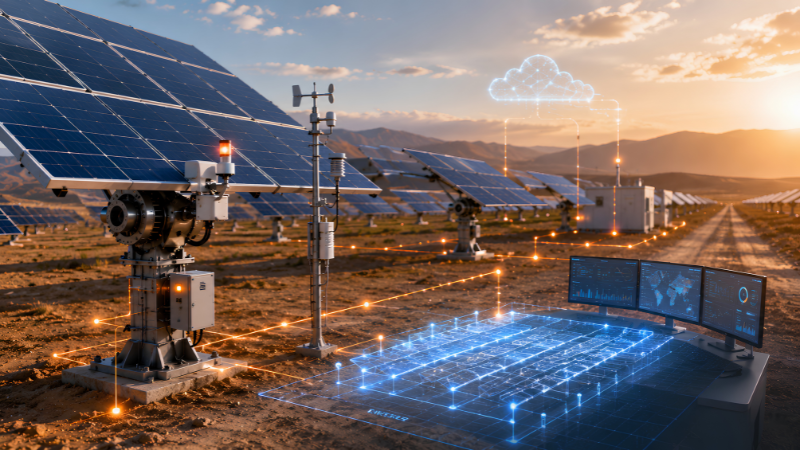
The future of utility-scale solar tracker design is likely to involve greater integration between structural engineering, data, automation, monitoring, and advanced modeling.
Research supported by the U.S. Department of Energy is exploring approaches to improve tracker resilience under strong winds, including wind nowcasting, wind-response modeling, aerodynamic mitigation, sensing, and digital-twin technologies.
This points toward a broader shift.
Future tracker systems may increasingly combine:
- Structural analysis
- Real-time environmental data
- Automated stow strategies
- Digital twins
- Structural health monitoring
- Advanced aerodynamic modeling
- Predictive maintenance
The objective is not simply to design a tracker that survives its design conditions. It is to create a more adaptive and resilient energy infrastructure.
Conclusion
The success of utility-scale solar depends on more than photovoltaic technology. It also depends on the structural systems supporting those panels.
From solar tracker wind load design and torque tube design to foundations, soil conditions, connections, and long-term reliability, every part of the system contributes to project performance.
The following should be met by a good tracking system design:
- Safe transfer of load
- Adaptation to varying environments
- Stability
- Flexibility
- Compatibility with soil conditions of the site
- Durability during the service life
- Construction and maintenance feasibility
With the increasing trend towards clean energy, structural engineering will become increasingly important when developing utility-scale solar installations.
The best projects won’t just create more power; they will incorporate effective structural design, engineering for the location, sturdy foundation, and methods of construction that ensure reliable operation into the future.
Scale Your AEC Projects with Expert Design Support
Whether you’re managing multiple projects or facing resource constraints, our experienced engineering professionals seamlessly integrate with your team to provide accurate design, drafting, BIM coordination, and technical documentation, keeping your projects on schedule and within budget.