

Introduction
Can your engineering consulting services team take on the next project without burning out the one you already have? For most AEC firm leaders in 2026, the honest answer is no, and it isn’t for lack of trying to hire.
This is the problem with how most firms still talk about offshore AEC support: they treat it like a line-item cost decision, something you turn to only when the budget gets tight. That framing is outdated, and its costing firms more than they realize in , blown deadlines, and burned-out senior staff who spend their days on drafting instead of design.
This blog breaks down why offshore AEC support is better understood as a strategic capacity layer, a way to keep pace with demand without proportionally growing headcount and walks through exactly where it fits, discipline by discipline, so that you can evaluate it with clear eyes instead of a cost-cutting mindset.
What “Offshore AEC Support” Actually Means Today
A decade ago, “offshore support” in AEC usually meant sending overflow CAD work to a low-cost vendor and hoping it came back usable. That version still exists, and it’s exactly why offshore outsourcing has a reputation problem in the industry.
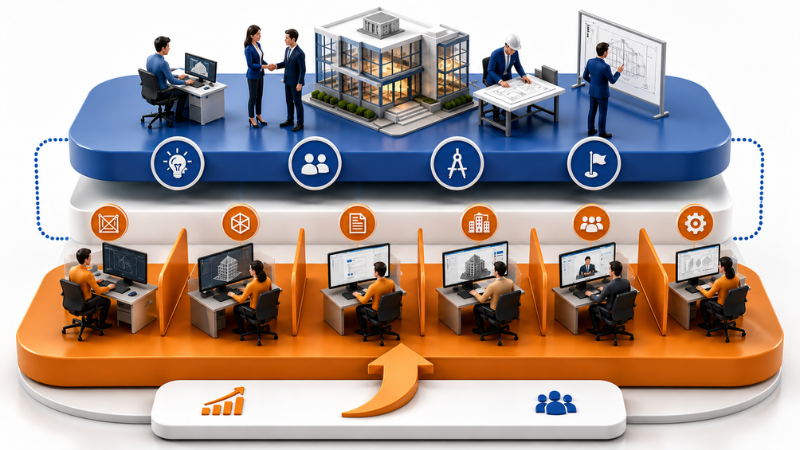
The difference now is in the underlying model. Organizations that find true benefit from offshoring operations today do not pay for the hours but invest in the capacity of engineering consulting services, which act as an extension of their organization in terms of standards, software, and accountability.
From Overflow Fix to Embedded Capability
The shift shows up in three ways:
- Integration, not isolation. Offshore professionals join design reviews and coordination calls instead of receiving files over email and disappearing.
- Specialization, not generalists. Firms are matching offshore talent to specific disciplines BIM coordination, structural detailing, and MEP drafting rather than treating "drafter" as one interchangeable role.
- Continuity, not one-off jobs. Dedicated offshore staff stay on a firm's projects long enough to learn its standards, applicable regulations, drawing conventions, and client preferences.
That distinction dedicated capability versus disposable labor is the whole argument for treating offshore support as infrastructure, not an expense to trim.
The Capacity Equation: Why Firms Feel This Now
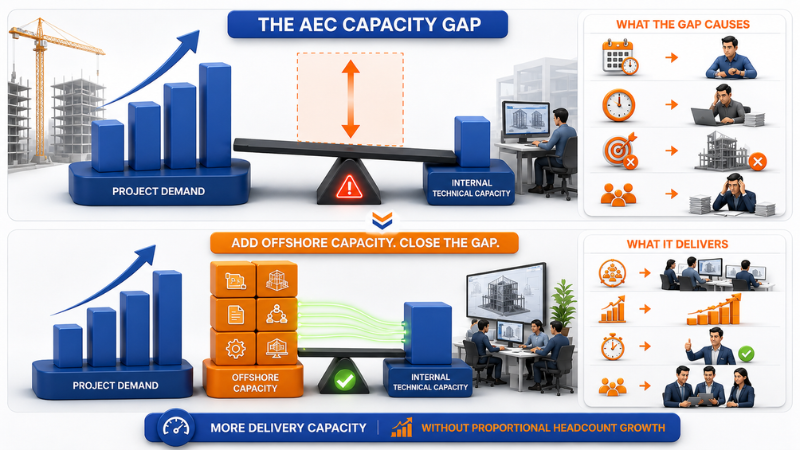
Most AEC firms are stuck in the same equation. Project demand can climb in a matter of weeks, but experienced technical talent can’t be hired at that speed and even if it could, six months of strong pipeline doesn’t always justify a permanent hire. Meanwhile, the senior staff you already have are spending real hours on documentation, model updates, drawing production, and coordination work that doesn’t require their level of experience but still must get done.
It leads to the emergence of a capacity gap, and usually goes as follows:
More projects -> More technical workload -> Limited capacity internally -> Delays, OT or missed opportunities.
The inclusion of an offshore partner into the mix transforms the dynamics as follows:
More projects → flexible distributed capacity → shared technical workload → greater overall delivery capacity.
The data backs up why firms are feeling this squeeze right now. Even with record project funding and investment, EY’s 2026 workforce analysis points to a skilled-worker shortage as the root cause of ongoing delays and budget overruns. The scope of the gap is striking as of April 2026, roughly 679,500 engineering positions were open nationwide, against only about 141,000 engineering graduates entering the workforce each year.
Deloitte’s 2026 Engineering and Construction Outlook paints a similar picture from the construction side, projecting the industry will need roughly 499,000 new workers in 2026, up from 439,000 the year before and warns that firms which don’t broaden their talent pipeline, risk compounding delays, cost overruns, and margin pressure.
It isn’t only about finding new people it’s about keeping the experienced ones. Stambaugh Ness’s 2026 AEC staffing research found that average employee tenure in architecture and engineering roles has dropped from 7.1 years to 4.9 years since 2012 a decline of more than 30% meaning firms are losing institutional knowledge faster than they can replace it.
This is not about substituting for the internal team. This is about structuring the delivery in such a way that the senior people inside you get to do what only they can judge. This also becomes important during early-stage design, where predictive design can help engineering teams evaluate options and make better decisions before a project moves further into development.
From Outsourcing Tasks to Building Strategic Capacity
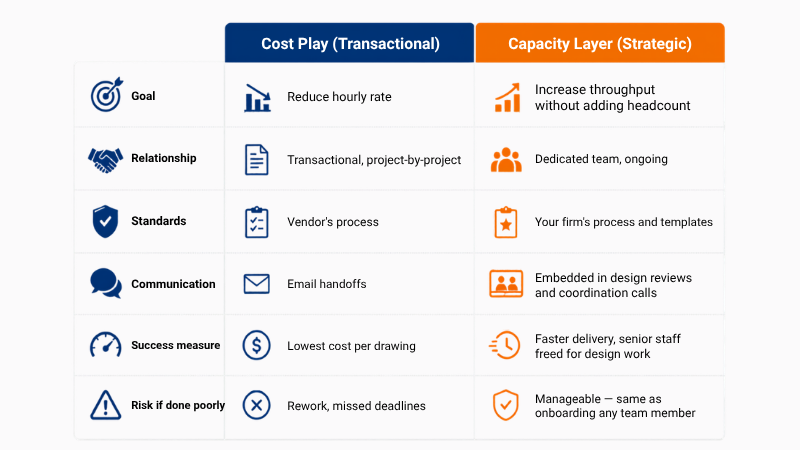
There’s a real difference between outsourcing a task and building offshore capacity, and it changes how the relationship should be managed.
Traditional outsourcing asks: “We need these drawings completed.” Strategic capacity asks a different question: “We need technical capability that can support our project pipeline consistently.”
Transactional Outsourcing
A task-by-task model typically looks like this: assign a deliverable, set a deadline, receive the file, review it, close the assignment. That can work fine for a one-off need. But repeated over time, it tends to create the same friction firms complain about with offshore work; repeated onboarding, inconsistent standards, communication gaps, and a team that never really learns how your firm operates
Strategic Offshore Capacity
With a capacity-oriented approach, everything starts differently because there is documentation of standards and expectations, integration of communication processes, review and QA processes, a team which gains true knowledge about your project type, and a capacity which expands and contracts with your workload, not for each separate task.
The result isn’t an external vendor you manage at arm’s length it becomes an extended delivery layer that functions inside your workflow.
Where Offshore Teams Actually Add Capacity (Discipline by Discipline)
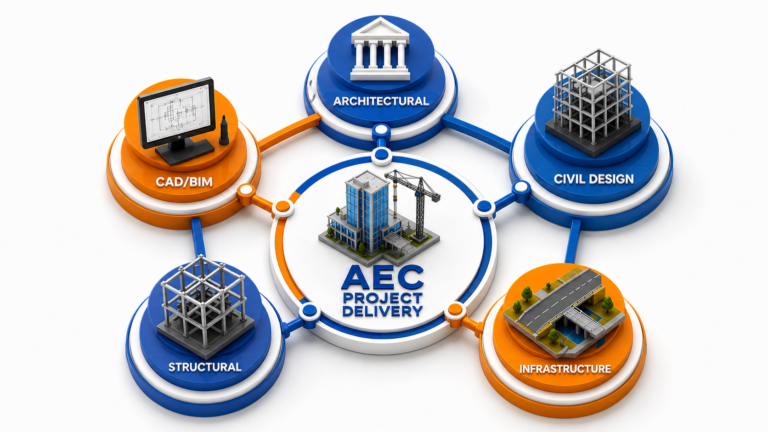
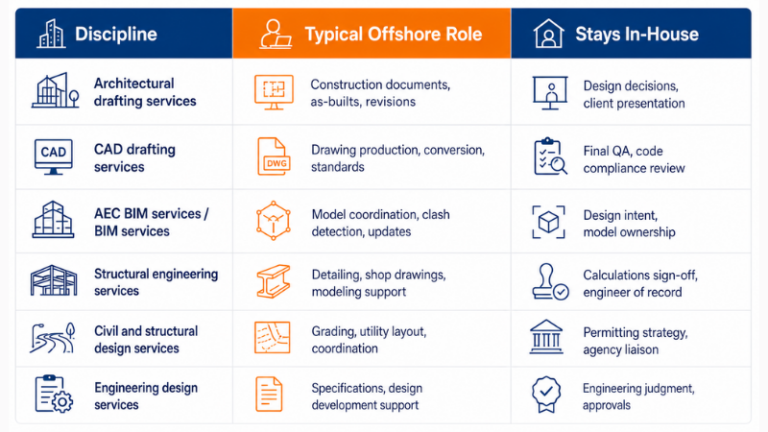
The value of offshore AEC support isn’t generic it depends on matching the right discipline to the right stage of a project. The goal isn’t to offshore everything; it’s to identify where added capacity creates measurable value.
Architectural Drafting Services
Growing architecture practices often run into a simple problem: winning the work is easier than producing all the documentation it requires within existing capacity. Architectural drafting services can support construction documentation, floor plans, elevations, sections, detail drawings, design development sets, drawing revisions, and model updates freeing senior architects to stay focused on design decisions, client communication, and project leadership instead of production work.
CAD Drafting Services
CAD remains a core part of most AEC workflows. CAD drafting services help firms add production capacity for projects that require detailed technical documentation 2D drafting, drawing conversion, detail development, revisions, and standards maintenance. For firms with recurring workloads, outsourcing CAD drawings becomes less about cutting production costs and more about maintaining predictable delivery capacity month over month.
AEC BIM Services
AEC BIM services are usually where firms start, because BIM coordination is time-intensive but highly structured a strong fit for a dedicated offshore team working inside a firm’s existing model standards. Broader BIM services can cover model development (in BIM Cloud), Cloud-coordination, clash identification, documentation, and ongoing model updates, connecting architectural, structural, and MEP workflows across a project rather than treating each as a separate handoff. This is especially useful when internal BIM specialists are already stretched across multiple projects in dispersed geographical locations.
Structural Engineering Services
For structural engineering services, offshore teams typically support structural modelling, detailing, shop drawing production, and documentation under the direction of a P.E. or an S.E. This support can also extend to construction sequence analysis, particularly on projects where the timing of structural loading can influence storey drift. The value isn’t transferring responsibility for engineering decisions it’s giving technical leaders room to take on more projects while keeping proper internal review and professional oversight in place.
Civil and Infrastructural Engineering Design Services
AEC projects increasingly need multiple disciplines coordinating at once. Civil and Infrastructural engineering design services can add technical production capacity across multidisciplinary work civil drawings, design engineering documentation, site development support, coordination, and model development. More broadly, firms looking for wider engineering design services can use a distributed team to support production without immediately expanding permanent internal staff.
Offshore Support vs. Traditional Hiring
Hiring is still essential; offshore capacity isn’t a replacement for a core team. But permanent hiring isn’t always the right answer to every capacity problem, especially when a project surge is real, but its long-term shape isn’t clear yet.
When workload jumps, firms are generally choosing between three paths: hire permanent staff, bring in freelancers for individual tasks, or build an integrated offshore team. Each comes with trade-offs.
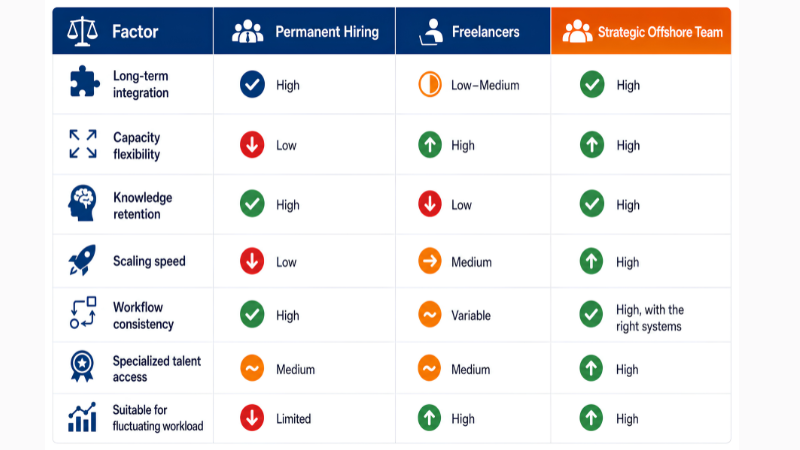
For firms that need ongoing technical support but face workload that genuinely fluctuates, a strategic offshore team can offer a middle ground added capacity without turning every busy quarter into a permanent headcount decision.
How to Build an Effective Offshore AEC Support Model
1. Decide What Actually Moves Offshore
Start by sorting the work into three buckets:
Keep in-house:
- Direct client interaction
- Final professional sign-off
- Strategic design decisions
- High-level project leadership
- Sensitive or judgement-heavy decisions
Send to offshore capacity:
- Drafting and drawing production
- BIM modeling and updates
- Documentation
- Coordination support
- Repetitive technical workflows
Automate where it makes sense:
- Templates
- Scripts and standardised workflows
- AI-assisted processes for repetitive steps
The goal isn’t to offshore more work it’s to design a better delivery system overall.
2. Document a Standardized Workflow
Before scaling offshore capacity, write down how work is supposed to move: project intake, scope assignment, technical standards, file management, communication steps, review checkpoints, QA requirements, revision procedures, escalation paths, and final delivery. A documented workflow means the process doesn’t depend on any one person remembering how things are done
3. Build a Real Communication Rhythm
Communication is not to be done as an afterthought. Establish the working hours that overlap, the project management software you will use, the file-sharing platform, the feedback loop, the escalation process, and the response times expected from everybody. It is not always true that the best teams are those that make use of the most advanced technologies.
4. Start Narrow, Then Expand
Don’t move an entire workflow offshore on day one. Start with a defined scope and phase in from there:
- Phase 1: CAD production
- Phase 2: BIM modeling
- Phase 3: Documentation
- Phase 4: Multidisciplinary coordination
- Phase 5: Broader engineering and design support
This staged approach lets a firm test quality, communication, turnaround time, and workflow fit before expanding scope which is exactly how firms outsource architectural drafting or begin outsourcing CAD drawings successfully, rather than handing over an entire project at once.
What to Look for in an Offshore AEC Partner
If you’re a civil engineering consulting firm or one of the broader engineering consulting firms evaluating offshore support for the first time, a few things separate a real capacity partner from a cost-cutting vendor:
- Discipline-specific staffing, not one generalist "drafter" role for every task
- Direct integration into your project management and communication tools
- Consistent team members, not a rotating pool assigned per task
- Software fluency in the specific platforms your firm standardises on
- Clear quality control — who reviews the work before it reaches you, and how
- References from firms your size, not just logos on a website
Not all drafting outsourcing companies operate the same way. Ask how long team members stay assigned to a client, what software licenses they hold, and how revisions are handled. Treat the vetting process the way you’d interview a candidate joining your firm directly, because functionally, that’s what a dedicated offshore team member is.
Conclusion
The firms getting real value from offshore AEC support stopped asking “how much cheaper is this?” a while ago. The better question and the one this blog have tried to answer is “how much more can we deliver without burning out the team we already have?”
This is the reality behind the idea of offshore support as a strategy: a well-documented process, a proven communication rhythm, and a phased approach that starts narrow and gains trust first before scaling up. No matter where you begin with either your AEC BIM service needs, Civil, Municipal, Infrastructure, Structural Engineering Services requirements, or basic CAD Drafting Services, the ones who regard it as a part of their capability rather than a disposable commodity are the ones experiencing its success.
Scale Your AEC Projects with Expert Design Support
Whether you’re managing multiple projects or facing resource constraints, our experienced engineering professionals seamlessly integrate with your team to provide accurate design, drafting, BIM coordination, and technical documentation, keeping your projects on schedule and within budget.