

10 State & Local Government Contracting Trends for 2026
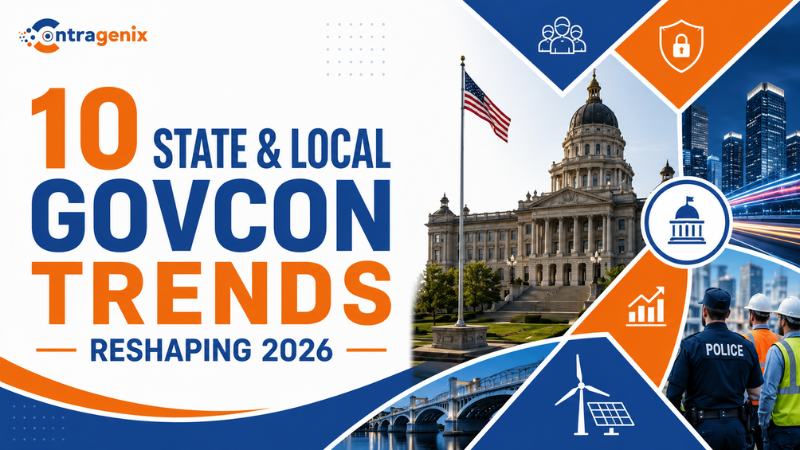
The world of state and local government contracting enters 2026 in a very different operating environment. Procurement offices are under tighter budgets, modernization mandates, cybersecurity expectations, and rising pressure to accelerate buying timelines. At the same time, agencies are expanding cooperative purchasing, infrastructure programs, and task-order-based contracting models, creating new opportunities for small and mid-sized contractors.
The challenge for government contractors is no longer just finding opportunities. What separates us in 2026 is readiness, operational, compliance, proposal, and positioning.
Here are the major state and local government contracting trends shaping the market this year and what contractors need to be doing now to stay competitive.
1. Cooperative Purchasing Vehicles Continue Expanding
Cooperative procurement is one of the fastest-growing acquisition channels in state and local government. Agencies are increasingly using contracts through OMNIA Partners, Sourcewell, NASPO Value Point, and regional purchasing cooperatives rather than issuing their own solicitations.
This trend is shortening procurement timelines and making purchasing decisions easier for resource-constrained agencies.
For contractors, the implications are significant. A cooperative contract win can open multiple jurisdictions without the need to rebid repeatedly. Agencies also increasingly prefer vendors already on established buying vehicles because it reduces administrative burden and procurement risk.
Companies looking to expand their reach in state and local markets should consider whether cooperative buying vehicles fit their services and long-term market strategy.
2. Procurement Timelines Are Shrinking
The procurement cycles at the state and local level are moving faster than many contractors are ready for. “Operational urgency and staffing shortages in procurement departments are pushing up solicitation schedules.
Many agency RFPs now require vendors to provide complete, compliant responses in days, not weeks.
This is particularly true for:
- IT helpdesk support
- Workforce and Staff Augmentation
- Administrative consulting
- Public assistance works
- Infrastructure and emergency response programs
- Contractors that rely on fully manual proposal processes are struggling to keep up.
- Proposal libraries, reusable compliance documentation, pre-approved resumes, pricing templates, and centralized past performance repositories are becoming operational necessities, not efficiencies.
Responsiveness is closely linked to competitiveness in 2026.
3. Cybersecurity Expectations Are Reaching State and Local Procurement
Cybersecurity requirements are no longer exclusive to federal agencies and defense contractors. State and local governments are now embedding stronger cybersecurity language into solicitations, vendor questionnaires, and contract clauses.
While CMMC requirements are still federal in nature, many state and local agencies are adopting similar risk-management expectations around:
- Data management
- Reporting of incidents
- Access control
- Multi-factor authentication
- Security of Third-Party Software
- Assessment of vendor risk
Contractors supporting the education, healthcare, transportation, utilities, and public safety sectors are facing particularly intense scrutiny.
Small businesses that take the initiative to capture their cybersecurity practices see a measurable competitive advantage in evaluations.
4. Infrastructure Spending Is Creating Secondary Contracting Waves
The largest infrastructure awards may already be obligated, but 2026 is producing a second wave of downstream contracting opportunities at the county, municipal, and regional authority levels.
Smaller contractors are getting the benefit of:
- Sub-contracting under the major primes
- Regional public works projects
- Environmental Services/Inspection
- Attempts to modernize utilities
- Transportation support contracts
- Construction management services
Many of these opportunities fall below large federal thresholds and remain less crowded than traditional federal competitions.
For emerging contractors, regional infrastructure ecosystems are becoming important entry points into long-term government contracting relationships.
5. Vendor Expectations Are Changing with Procurement Automation
State and local procurement offices are moving to modernize procurement systems faster than many vendors realize. Across agencies, automated solicitation platforms, supplier portals, digital evaluations, and centralized vendor management systems are becoming the norm.
This change is affecting how contractors interact with buyers.
Increasingly, the inability to complete supplier registration, lack of current capability statements, inconsistent NAICS codes, and expired certifications are disqualifying suppliers before a substantive evaluation even starts.
New operational readiness includes:
- Keeping SAM.gov records current
- Keep an eye on supplier portals regularly
- Tracking registration renewal
- Capability Messaging Standardization
- Correct alignment of NAICS and PSC classifications
Contractors that take a strategic approach to procurement administration are reducing avoidable compliance losses.
6. Small Business Participation Remains a Major Priority
Despite budget pressures, supplier diversity and small business participation remain firmly embedded in state and local acquisition policy.
Many agencies are still on the rise:
- Small Business Reserve Program
- Local preference programs
- Goals for participation of minority-owned businesses
- WOSB outreach and SDVOSB outreach, HUBZone, and disadvantaged business utilization goals
However, agencies are also becoming more focused on measurable participation outcomes rather than symbolic commitments.
Prime contractors are under increasing pressure to demonstrate realistic subcontracting plans and documented engagement with small businesses.
For smaller firms, this creates substantial partnership opportunities, particularly in large IDIQ-style and infrastructure programs where primes require qualified teaming partners.
7. AI Procurement Governance Is Emerging Carefully
Procurement offices are taking a wait-and-see approach to AI purchases in 2026, as agencies experiment with AI capabilities.
Governments are focusing on governance frameworks, data controls, and risk management standards before scaling up AI deployments rather than broad AI deployments.
This is building demand for rising:
- AI policy recommendations
- Data governance support
- Procurement compliance advisory services
- WOSB outreach and SDVOSB outreach, HUBZone, and disadvantaged business utilization goals
- Risk assessment services
- Human oversight structures
Agencies supporting digital transformation initiatives should expect contractors to ask more detailed questions about transparency, data usage, accountability, and operational controls.
The chance is no longer simply selling technology. It is helping agencies to implement governance responsibly.
8. Task-Order Contracting Models Are Expanding
More state and local agencies are moving toward master contract structures with recurring task-order competitions instead of issuing isolated one-time procurements.
This mirrors long-standing federal acquisition trends and creates more predictable procurement ecosystems.
Winning a position on statewide or regional contract vehicles increasingly matters more than the immediate base award value itself.
Areas seeing strong task-order growth include:
- IT modernization
- Program management
- Engineering support
- Administrative services
- Staffing augmentation
- Cybersecurity consulting
For contractors, market positioning is shifting from transaction-based selling to a long-term contract access strategy.
9. Compliance Readiness Is Becoming a Competitive Differentiator
Many otherwise qualified vendors are losing opportunities because of administrative deficiencies rather than technical weaknesses.
Agencies are scrutinizing:
- Insurance compliance
- Financial disclosures
- Labor certifications
- Supplier registrations
- Licensing documentation
- Conflict-of-interest disclosures
- Cybersecurity attestations
Proposal teams are also facing greater pressure to maintain audit-ready documentation throughout the procurement lifecycle.
In 2026, compliance is no longer viewed as a back-office responsibility. It is directly influencing win rates.
Contractors who centralize compliance management and conduct routine readiness reviews are significantly reducing proposal friction.
10. Relationship-Based Contracting Still Matters
Despite increased digitization, state and local contracting remains heavily relationship-driven.
Procurement officials, program managers, department stakeholders, and incumbent vendors continue shaping acquisition direction long before solicitations are formally released.
Contractors investing in pre-RFP engagement are gaining better visibility into:
- Upcoming requirements
- Budget priorities
- Evaluation concerns
- Competitive positioning
- Potential teaming structures
Attending procurement conferences, participating in agency outreach events, maintaining consistent follow-up, and building regional partnerships continue to influence access to opportunities.
In many cases, the most successful contractors engage agencies months before an RFP is publicly released.
What Contractors Should Prioritize in 2026
The contractors best positioned for growth this year are focusing on operational discipline as much as on business development.
That involves:
- Proposal-readiness for infrastructure
- Improving cybersecurity documentation
- Early contractual relationships in construction
- Better processes for capture planning
- Tracking cooperative purchasing opportunities
- Standard compliance reviews
- Investing in procurement responsiveness.
The market is rewarding those companies that can move fast, have low operational risk, and are in line with evolving procurement expectations.
Final Thoughts
The contracting process with state and local government in 2026 will be faster, more compliance-centric, and more relationship-centric. Agencies are modernizing their procurement systems and demanding more accountability from vendors.
For small- and mid-sized contractors, this environment is both an opportunity and a pressure. Companies that remain agile, operationally ready, and strategically positioned will continue to gain ground in state and local markets.
The next phase of GovCon growth will favor contractors that combine compliance maturity, proposal readiness, and market agility with strong agency relationships and disciplined execution.
For more GovCon insights, compliance guidance, and capture strategy resources: Subscribe to our Newsletter