


When a Federal Contract Win Becomes a Financial Liability
A federal contractor can win a multimillion-dollar award, report a major business development milestone, and still find that the contract is weakening the business. The revenue forecast looks stronger, the pipeline appears healthier, and the award announcement gives leadership something worth celebrating. Months into performance, however, recruiting costs are higher than expected, experienced employees are stretched across competing priorities, and the margin that justified the bid has begun to disappear.
This is one of the more uncomfortable realities of government contracting: a contract can be commercially attractive at award and financially disappointing in execution, or it can be financially weak from the moment the contractor submits its price.
Understanding why government contractors lose money on federal contracts requires looking beyond the award value. Labor assumptions, indirect costs, staffing timelines, subcontractor dependencies, contract structure, and cash requirements all influence whether the work produces a sustainable return.
Winning matters. But the economics of delivering what was promised matter just as much.
Why a Federal Contract’s Award Value Can Be Misleading
A $5 million federal contract sounds like a significant business opportunity, particularly for a small or growing government contractor. It may represent entry into a new agency, a path toward stronger past performance, or an opportunity to establish a position in a market that has been difficult to penetrate.
The problem begins when leadership treats the contract’s total value as a measure of financial success.
An award ceiling, a potential maximum value, a funded amount, and revenue actually earned are not interchangeable. An indefinite-delivery contract, for example, may establish a ceiling without guaranteeing that the contractor will receive orders worth that amount. Even a funded contract does not mean the entire amount will become profit.
Revenue is what the business earns from performing the work. Gross profit reflects revenue less the direct costs included in the company’s gross-profit calculation. Operating profit accounts for the broader operating expenses included in that measure. Net profit reflects the final result after applicable expenses, interest, taxes, and other items.
Cash flow is different again. It describes when money enters and leaves the business, not simply whether the contract is profitable on paper.
These distinctions matter because a contractor can report growing revenue while generating weak margins, or record an accounting profit while struggling to meet payroll because customer receipts arrive after significant delivery costs have been incurred.
The commercial question is not simply how much a contract is worth. It is how much the business can reasonably earn from performing it, how much cash it must commit along the way, and whether the return justifies the risk.
Why Government Contractors Lose Money on Federal Contracts
The reasons are often connected. An aggressive bid can leave little room for recruitment problems. A staffing delay can increase overtime and subcontractor spending. Higher labor costs can erode margins that were already thin because indirect expenses were underestimated.
Labor pricing can make the contract unprofitable before work begins
Labor is a central cost driver in many professional services, engineering, information technology, and consulting contracts. Yet a labor rate that appears competitive during proposal development may not reflect the actual cost of delivering the required work.
Consider a contractor that prices a role using the salary of an existing employee. That employee leaves before transition, and the replacement requires a higher salary. Alternatively, the contractor may discover that the necessary clearance, technical expertise, location, or availability makes the position more expensive to fill than anticipated.
The difference does not disappear because the government accepted the proposal price.
On a firm-fixed-price contract, the contractor generally bears the financial consequences of higher performance costs. If the company must pay more to recruit and retain qualified personnel, it may have to absorb the difference within its existing contract price.
Labor assumptions can also fail in less obvious ways. A proposed staffing model may assume that personnel are productive immediately, that vacancies will be filled quickly, or that existing employees can support the new work without affecting other projects. Each assumption can influence profitability.
A price built around ideal staffing conditions is not necessarily a price built around realistic delivery conditions.
Indirect costs can quietly consume the expected margin.
Direct labor is only part of the cost of operating a federal contract. Fringe benefits, overhead, and general and administrative expenses can materially change the economics.
Fringe may include applicable employee benefits and related costs. Overhead may cover indirect expenses associated with delivering work, depending on the contractor’s accounting structure. General and administrative expenses support the business more broadly.
The challenge is not simply estimating these costs. It is applying them consistently and understanding which expenses are included in each rate.
A contractor might calculate a price using current indirect rates without adequately considering how expansion will affect its cost structure. Adding personnel may increase benefit expenses, supervisory requirements, facilities costs, systems spending, or administrative workload. If the business grows faster than its operating model can support, the resulting cost base may be higher than the proposal assumed.
There is another complication: indirect rates can change as the company’s business mix changes. A cost structure developed around a portfolio of contracts may behave differently when one large project expands or another ends.
Contractors should therefore evaluate not only the estimated costs of the opportunity but also how winning and performing it could affect the economics of the wider business.
Recruitment and transition expenses are easy to underestimate.
A contract’s staffing requirements begin affecting the business before every position is billable.
Recruiters may need to source candidates, hiring teams must screen applicants, and managers may have to coordinate onboarding, security processing, training, and knowledge transfer. Existing employees may spend time preparing for transition rather than delivering work that can be billed elsewhere.
Subcontractors may be needed to fill gaps while permanent personnel are recruited. That can protect delivery schedules, but it may also introduce higher labor costs, additional coordination, and dependence on another company’s availability.
These expenses are particularly consequential when the contractor has priced the work tightly.
Some costs may be recoverable under the applicable contract terms and cost principles; others may have to be absorbed by the company. The treatment depends on the contract, the nature of the expense, and the applicable requirements. Contractors should not assume that every expense associated with winning or starting a contract will be reimbursed.
A realistic financial model must account for the cost of becoming ready to perform, not just the cost of performing once the team is fully staffed.
Aggressive Pricing Can Turn a Good Opportunity Into a Bad Business Decision
Competitive pricing is not inherently a mistake. A contractor may reasonably accept a lower initial margin to establish past performance, enter an agency, build a customer relationship, or develop capabilities that support future work.
The mistake is treating a strategic investment as though it carries no financial consequences.
Suppose a company bids aggressively because it expects the contract to lead to follow-on work. That expectation may be commercially reasonable, but it is not the same as a guaranteed future award. Follow-on opportunities may be delayed, recompeted, reduced in scope, or awarded to another company.
If the initial contract cannot support its share of the business’s operating costs, the contractor may end up financing a market-entry strategy without receiving the anticipated return.
Pricing pressure can also create a difficult staffing trade-off. When labor costs exceed the original assumptions, management must decide whether to accept lower margins, change the staffing approach where contractually permissible, or risk performance problems. Each option has consequences.
The better approach is to establish the financial logic before submitting the bid. Leadership should know the expected margin, the minimum acceptable return, the cost assumptions most likely to change, and the strategic value required to justify a thinner margin.
A deliberate investment in growth is a business decision. An unexplained loss discovered after award is a different matter.
Contract Type Changes the Financial Exposure
Not all federal contracts distribute financial risk in the same way.
Under a firm-fixed-price arrangement, the price generally remains fixed regardless of the contractor’s actual cost of performing the work. FAR 16.202-1 describes the arrangement as providing for a price not subject to adjustment based on the contractor’s cost experience. That creates a direct incentive to control costs, but it also means unfavorable cost variances can reduce the contractor’s profit or produce a loss.
A firm-fixed-price contract is not inherently unprofitable. A contractor with sound estimates, effective delivery controls, and a manageable scope can perform profitably under this structure. The danger arises when the price leaves insufficient room for uncertainty or when the contractor misunderstands the obligations it has accepted.
Cost-reimbursement contracts allocate certain cost risks differently. Under FAR Part 16.3, allowable costs are reimbursed subject to the contract’s terms and applicable requirements. These arrangements do not mean that every expense is recoverable, that funding is unlimited, or that the contractor has no exposure to poor cost management.
Allowability, allocability, reasonableness, documentation, funding limitations, and contract-specific obligations remain relevant. A contractor may also face administrative burdens, financing requirements, or performance risks that are not eliminated by reimbursement.
The distinction matters during opportunity evaluation. The same cost overrun may affect a contractor differently depending on the contract type, pricing structure, and applicable terms. A financial model that ignores those differences cannot adequately describe the opportunity’s risk.
A $5 Million Contract That Produces a Loss
Consider a hypothetical firm-fixed-price contract with $5 million in expected revenue over its performance period. The following figures are illustrative assumptions, not industry averages or actual contractor results.
The contractor estimates $2.4 million in direct labor costs. Fringe benefits are budgeted at $600,000, equal to 25% of direct labor. Overhead is estimated at $750,000, calculated at 25% of direct labor plus fringe. Subcontractor costs are expected to total $550,000, and materials, travel, and other direct delivery expenses add another $150,000.
Recruitment and transition costs contribute a further $200,000. For this example, those costs are treated as separate from the labor, fringe, overhead, subcontractor, and other direct expenses already listed.
The resulting cost before general and administrative expenses is $4.65 million. Applying a hypothetical G&A rate of 10% to that subtotal adds $465,000, bringing the total estimated contract cost to $5.115 million.
The financial result is a loss of $115,000 against $5 million in revenue.
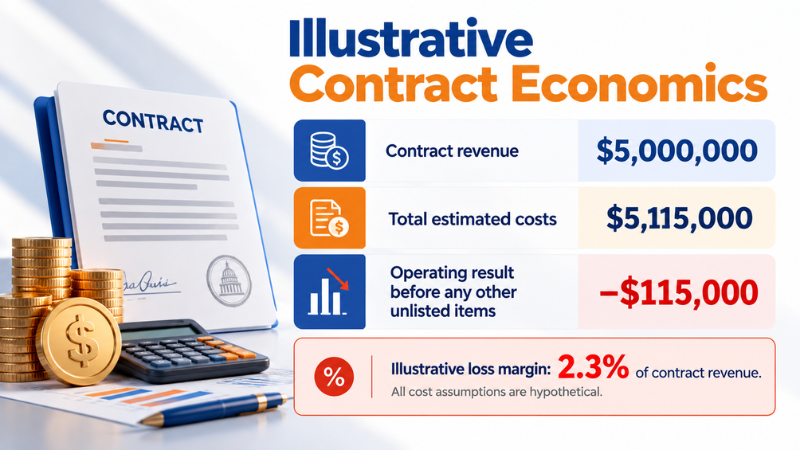
The contract’s headline value has not changed. What changed is the relationship between the price and the cost of delivery. In this scenario, the contractor earns less than it spends performing the work.
The example also shows why indirect costs need to be modeled carefully. The overhead calculation uses direct labor plus fringe, while G&A is applied to the stated subtotal before G&A. The same expense is not intentionally counted twice.
Now consider what happens if management evaluates the opportunity using only the revenue forecast and the direct labor estimate. The contract may appear attractive because the largest visible expense seems manageable. But once the full delivery model is included, the financial picture is different.
The lesson is not that every $5 million contract is risky or that contractors should avoid competitive pricing. It is that the price must support the complete cost of performance, including the expenses required to start and manage the work.
Profitable Contracts Can Still Create Cash-Flow Problems
Even when a contract is expected to generate a profit, it can put pressure on working capital.
Payroll, recruiting, benefits, and subcontractor payments may need to be funded before the contractor receives corresponding customer payments. Invoicing can be delayed by incomplete documentation, disputed charges, administrative errors, or acceptance requirements. Payment timing also depends on the applicable contract terms and circumstances.
This creates a distinction between accounting profitability and cash availability.
Imagine that a contractor is performing successfully but must pay employees and subcontractors throughout the month while waiting for an invoice to be processed and paid. The company may have earned revenue without yet receiving the cash needed to cover its immediate obligations.
The problem becomes more serious when several contracts require the same working capital at once. A growing company can win additional work, hire more personnel, and increase its revenue forecast while simultaneously exhausting its available cash.
That is why a contract-level financial review should consider the timing of cash outflows and inflows, not merely the expected margin. Contractors need to understand how much cash they may have to commit during transition, initial staffing, and early performance, and whether existing reserves or financing can support that requirement.
Growth without sufficient working capital can turn an otherwise viable opportunity into a serious operational problem.
The Financial Decisions That Should Happen Before the Bid
By the time a contract becomes unprofitable, some of the most consequential decisions have already been made. The staffing model has been proposed, the price has been submitted, and the contractor has committed to a set of performance obligations.
That is why the bid/no-bid decision should involve more than an assessment of whether the company can meet the solicitation’s requirements.
Leadership needs to understand whether the opportunity makes commercial sense. Can the company recruit the required personnel at the proposed rates? Are the indirect-cost assumptions consistent with its current operating structure? Does the proposed solution require capabilities, subcontractors, or transition activities that have not been fully costed?
The team should also examine the contract’s funding structure, pricing terms, performance schedule, and potential exposure to changes in staffing or delivery costs. Where requirements are unclear, those uncertainties should inform the pricing strategy and the decision to pursue, rather than disappear into optimistic assumptions.
This is where capture strategy and proposal development become commercially significant.
A strong capture process evaluates the opportunity in the context of the contractor’s capabilities, competitive position, customer requirements, and business objectives. It should also establish whether the company can deliver the proposed solution at a financially sustainable price.
Likewise, a well-developed proposal is more than a compliant response. The solution, staffing plan, management approach, and pricing assumptions must work together. Contragenix’s government proposal development services support contractors in developing structured, requirement-aligned proposals. Strong proposal development can improve the quality of the bid and help expose assumptions that deserve scrutiny, but it cannot guarantee profitability or eliminate the risks of contract performance.
The final commercial decision still belongs to company leadership, supported by realistic financial estimates and a clear understanding of the obligations being accepted.
What a Contractor Should Know Before Committing
A contractor does not need to predict every cost variation to make a better bid/no-bid decision. It needs to understand which assumptions matter most and how much the business can afford to be wrong.
For one opportunity, the largest exposure may be the cost of hiring cleared technical personnel. For another, it may be subcontractor pricing, a demanding transition schedule, or the amount of working capital required before the first payment arrives.
The useful question is not whether every risk can be eliminated. It is whether the expected return remains acceptable when reasonable adverse scenarios are considered.
Leadership should be able to explain the expected contract margin, the basis for the major labor and indirect-cost assumptions, the financial effect of recruitment or delivery overruns, and the cash required to sustain performance. It should also know what strategic benefit justifies the investment if the immediate financial return is limited.
After award, those assumptions should become part of contract-level financial monitoring. Comparing actual staffing costs, indirect rates, delivery expenses, and cash requirements against the original estimate helps management identify deterioration before it becomes difficult to correct.
A contract that is underperforming financially does not automatically require abandoning the relationship or compromising delivery. It does require timely decisions, an accurate view of the economics, and an understanding of which corrective actions are commercially and contractually available.
The objective is to make those decisions while the business still has options.
Sustainable Growth Means Choosing the Right Contracts
Federal contracting growth is often measured through awards, pipeline value, new agency relationships, and projected revenue. Those measures have their place, but they do not tell the whole story.
A business can expand its contract portfolio while weakening its margins. It can increase revenue while consuming cash faster than it collects it. It can win work that strengthens its past performance but places excessive pressure on its employees, management team, or financial reserves.
None of these outcomes means contractors should avoid ambitious growth. It means growth needs to be evaluated against the company’s ability to deliver, finance, and earn an acceptable return on the work it wins.
The strongest opportunity is not necessarily the largest award or the one with the highest probability of selection. It is the opportunity whose strategic value, performance requirements, financial exposure, and expected return make sense for the business.
That assessment begins before the proposal is submitted. It continues through pricing, staffing, transition, and performance. And it requires business development, proposal teams, finance, and operations to work from assumptions that are commercially realistic rather than merely competitive.
For contractors evaluating their next federal opportunity, Contragenix provides government contracting and proposal support to help businesses approach opportunity evaluation, capture strategy, and proposal development with greater discipline.
Winning a federal contract is a milestone. Building a profitable business around the work you win is the objective.