

Trenchless Construction Methods: How Cities Can Upgrade Utilities with Less Disruption
What if cities could replace underground pipes without digging up entire roads?
Imagine a busy street with cars, shops, and people walking to work. Beneath that street are water pipes, sewer lines, and other important utilities.
When these pipes become old or damaged, replacing them can mean road closures, traffic jams, and expensive repairs.
But there is another way.
Trenchless construction methods allow engineers to install or repair underground pipes with less digging.
For urban utility upgrades, this can mean fewer disruptions, less pavement damage, and easier access for nearby businesses.
When combined with smart drainage planning, these methods can also help cities make better infrastructure decisions.
What Is Trenchless Technology?
Trenchless technology is a way of installing, repairing, or replacing underground pipes without digging a long trench across the entire route.
Instead of removing a road, engineers can sometimes create an underground path for a new pipeline.
This approach is used for water pipelines, sewer systems, stormwater drains, and utility conduits.
Trenchless construction does not eliminate all digging. Workers may still need small access pits and equipment areas.
However, it can greatly reduce surface excavation compared with traditional methods.
Why Do Urban Utility Upgrades Cause Disruption?
Cities depend on underground pipelines every day. But as infrastructure ages, repairs and replacements become necessary.
During municipal infrastructure upgrades, several problems can arise.
Road Closures and Traffic
Digging across roads can block traffic and create delays for drivers, pedestrians, and emergency vehicles.
Business Disruption
Construction barriers and heavy equipment may make it difficult for customers to reach nearby businesses.
Underground Utility Conflicts
During underground utility installation, engineers must work around existing water pipes, electrical cables, gas lines, and other infrastructure.
Drainage Problems
Excavation near drainage systems can disturb water flow and create environmental risks.
The challenge is not just replacing pipes. It keeps the city functioning during construction.
Four Common Trenchless Construction Methods
Different projects require different solutions.
1. Horizontal Directional Drilling (HDD)
Horizontal directional drilling uses specialized equipment to create a controlled underground path.
A pipe or conduit can then be installed through that path.
It is often considered suitable for crossings beneath roads, rivers, and other obstacles.
Main benefit: Less need to excavate across the surface.
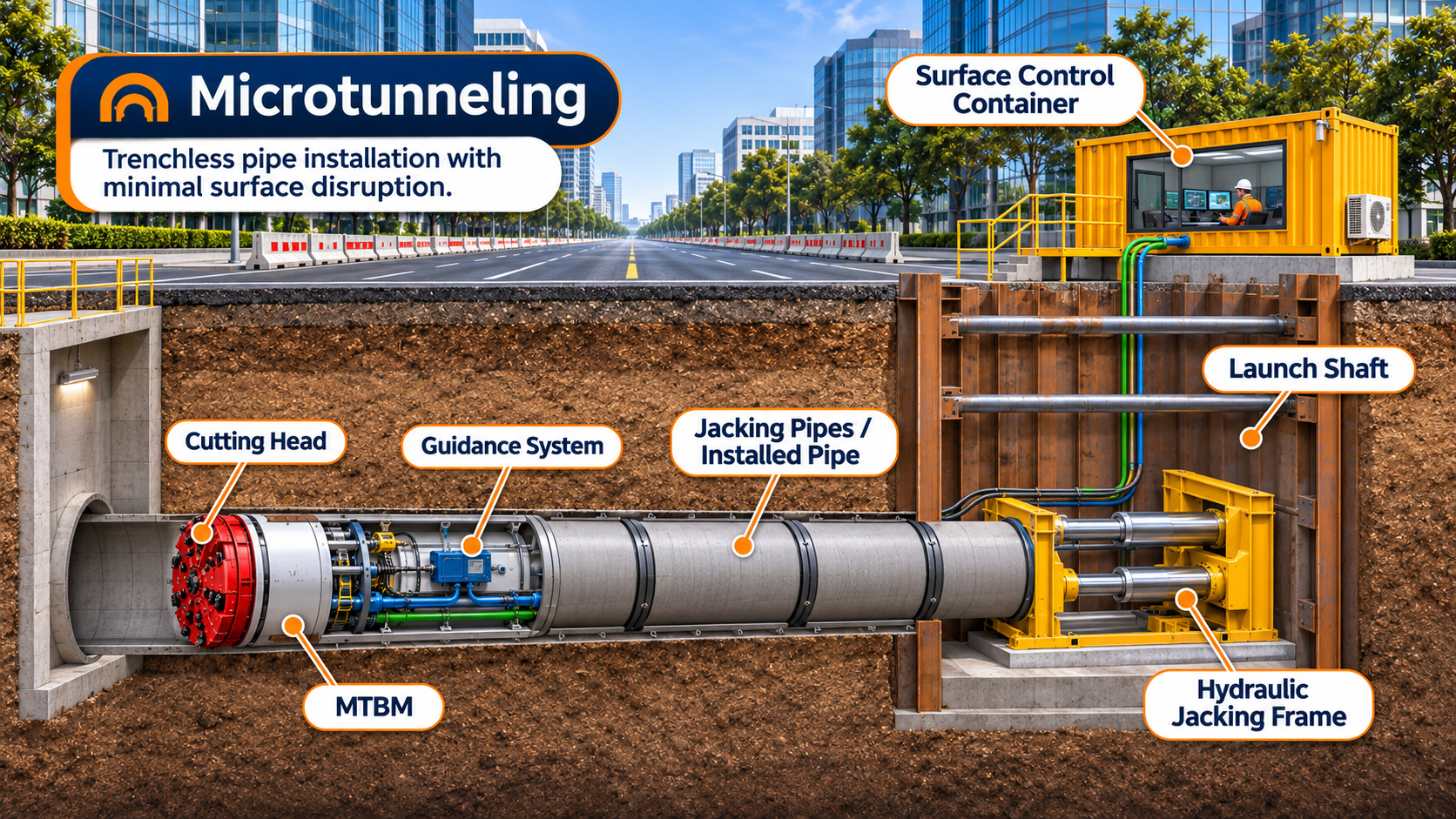
2. Microtunneling
Microtunneling uses a remotely controlled machine to create an underground tunnel while installing a pipeline.
It can maintain accurate direction and depth.
This makes it useful for certain sewer and drainage pipelines that require precise slopes.
Main benefit: Accurate pipeline installation with limited surface excavation.
3. Pipe Bursting
Pipe bursting replaces certain old pipelines by breaking the existing pipe while pulling a new one into place.
Workers do not need to excavate the entire pipeline route.
Main benefit: Replacing damaged pipes with less continuous digging.
4. Cured-in-Place Pipe (CIPP)
Cured-in-place pipe is used to rehabilitate suitable existing pipelines.
A special liner is inserted into the old pipe and cured to create a new lining.
Main benefit: Repairing certain pipelines without removing them completely.
Trenchless vs Open-Cut Construction: Which Is Better?
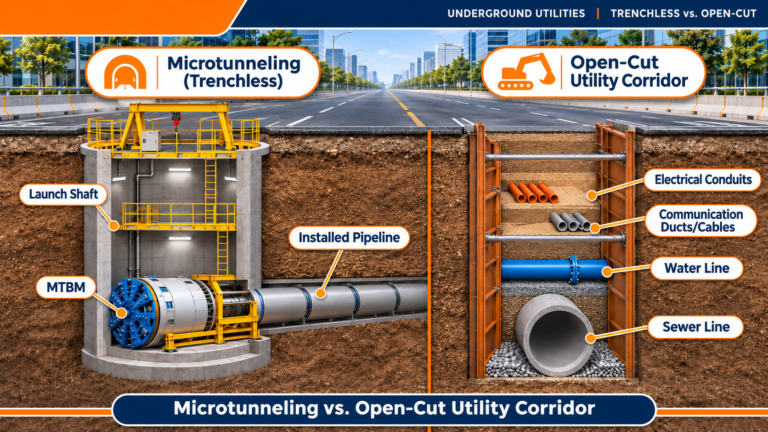
Traditional open-cut construction involves digging a trench from the surface to reach underground utilities.
Trenchless methods perform much of the work underground.
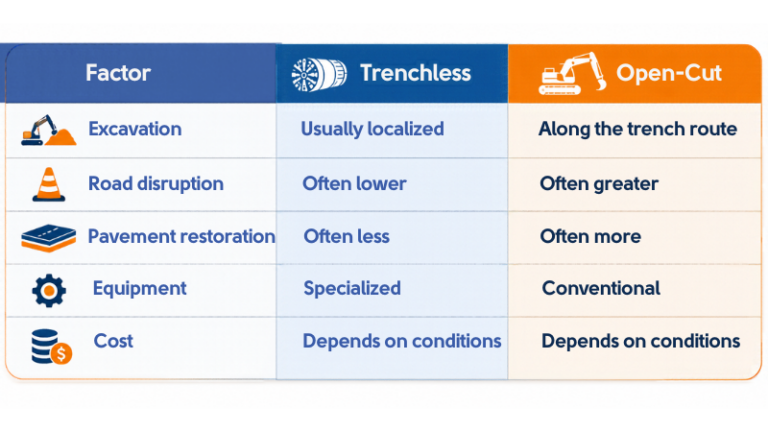
Here is a simple trenchless vs open-cut construction comparison:
Trenchless methods are not always cheaper or more suitable.
Existing Urban Infrastructure, Soil conditions, pipe size, underground obstacles, and construction costs determine which approach works best.
How Can Trenchless Technology and Drainage Planning Work Together?
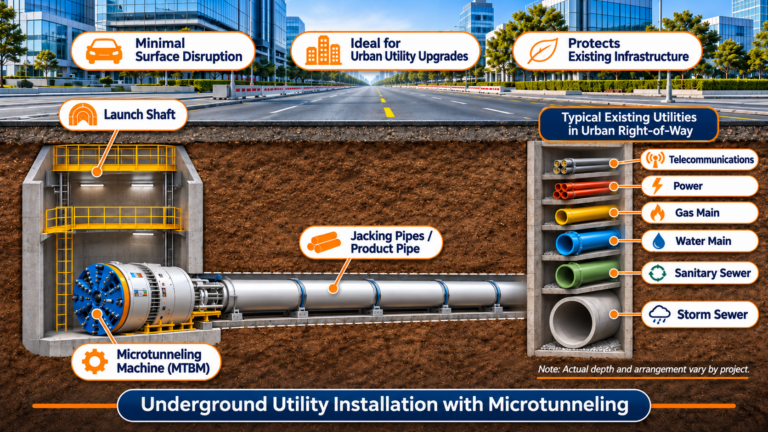
Imagine a city replacing an old stormwater pipeline beneath a busy neighborhood.
The city wants better drainage without closing the entire road.
Engineers can approach the project in four steps.
Step 1: Study Water Flow
Engineers examine how rainwater moves through the neighborhood.
They identify drainage problems and determine how much water the upgraded pipeline needs to carry.
Step 2: Plan the Pipeline Route
Through utility corridor planning, engineers select a suitable path while considering drainage requirements, existing utilities, and construction access.
The shortest route is not always the best route.
Step 3: Investigate Underground Conditions
Subsurface utility engineering helps teams identify and document existing underground utilities.
Engineers also examine soil, groundwater, and possible obstacles.
Step 4: Choose the Construction Methods
The team evaluates whether trenchless utility installation is suitable.
For example, microtunneling may be considered when a stormwater pipeline requires precise slope control.
The key is to plan the pipeline route before selecting the construction method.
What Should Engineers Check Before Construction?
Successful utility infrastructure planning requires more than choosing equipment.
Engineers should check four important factors:
Existing utilities: Are there underground pipes or cables that could interfere with construction?
Ground conditions: Will soil, rock, or groundwater affect drilling or tunneling?
Pipeline performance: Will the new pipe have the required size, slope, and capacity?
Construction risks: Could the project cause ground movement, utility damage, or unexpected disruption?
Understanding these factors early helps teams make informed design and construction decisions.
How Contragenix Supports Urban Infrastructure Projects
Upgrading underground infrastructure requires accurate designs, clear drawings, and coordination between engineering teams.
At Contragenix AEC Design & Support, we support civil engineering teams through technical documentation, CAD-based deliverables, and multidisciplinary design coordination, depending on project requirements.
From stormwater improvements to broader infrastructure planning, our support helps teams prepare coordinated engineering deliverables.
Planning your next urban infrastructure upgrade?
Explore Our AEC Design & Support Services and discuss your project requirements with our team.
Conclusion
Better underground infrastructure does not always require greater disruption above ground.
Trenchless construction methods can help cities install and repair suitable underground utilities with less excavation.
When combined with drainage-aware planning, they can also support better decisions for stormwater infrastructure upgrades.
The goal is simple: Better utilities. Smarter planning. Less disruption.
Scale Your AEC Projects with Expert Design Support
Whether you’re managing multiple projects or facing resource constraints, our experienced engineering professionals seamlessly integrate with your team to provide accurate design, drafting, BIM coordination, and technical documentation, keeping your projects on schedule and within budget.