


Introduction
What if the proposal your team spent six weeks perfecting got rejected before anyone even read your pricing page? It happens more often than most people in government contracting would like to admit, and the cause is rarely a weak idea or a bad price. It’s usually a missed instruction buried on page 42 of the solicitation. This is exactly the gap a proposal compliance matrix is built to close.
If you’ve ever wondered how seasoned bidders manage to respond to massive, multi-volume RFPs without losing track of a single requirement, the answer is almost always the same tool. If you’re new to the overall government RFP response process, understanding compliance management is one of the first skills to master.. In this blog, we’ll break down what a compliance matrix is, why it matters so much in government bidding, and how to build one step by step. Along the way, you’ll see real proposal writing examples, a sample table you can model your own matrix on, and the mistakes that quietly disqualify otherwise strong contract proposals. By the end, you’ll have a practical, repeatable system for proposal bidding that holds up under pressure.
What Is a Proposal Compliance Matrix?
A proposal compliance matrix is a structured table that maps every requirement stated in a Request for Proposal (RFP) to the exact place in your proposal where it’s addressed. Think of it as a cross-reference sheet between what the buyer asked for and what you delivered. Some teams call it an RFP compliance matrix, a traceability matrix, or simply “the matrix,” but the function stays the same: it proves, line by line, that nothing was missed.
Picture it like a packing checklist before a long trip. You wouldn’t trust your memory alone to pack everything you need for two weeks away from home — you’d write it down and tick items off one by one. A compliance matrix does the same job for proposal writing, except the stakes are a signed contract instead of a forgotten toothbrush.
Why Evaluators Use a Compliance Matrix
On the buyer’s side, evaluators are often working through dozens of submissions under tight deadlines. Before they ever judge the quality of your solution, they run a pass/fail compliance check. A proposal that skips a required certification, ignores a page limit, or fails to address a mandatory clause can be set aside immediately — regardless of how strong the technical approach is. The matrix exists to prevent exactly that outcome.
Compliance Matrix vs. Proposal Outline
People sometimes confuse the two, but they serve different purposes. A proposal outline organizes your narrative and arguments. A compliance matrix tracks obligations. The outline tells your story; the matrix proves you told the right story. Most experienced teams build the matrix first and let it shape the outline, not the other way around.
Why a Compliance Matrix Is Critical in Government Contracting
In government contract bidding, requirements are rarely listed in one tidy paragraph. A federal solicitation typically scatters instructions across multiple sections — submission format, evaluation criteria, and the statement of work — and each section can reference the others. Without a system to track this, even experienced proposal teams lose requirements in the shuffle.
Here’s what’s at stake when compliance slips:
- Automatic disqualification before technical evaluation even begins
- Wasted labor from writers, subject matter experts, and reviewers
- Damaged credibility with an agency or prime contractor you may want to work with again
- Lost revenue from a deal that was never really lost on merit, just on a technicality
This is precisely why a compliance matrix has become standard practice across government bids and contracts — it isn’t an optional nicety, it’s risk management. Organizations that provide government contracting services often make compliance tracking a mandatory step before proposal development even begins. organizations bidding repeatedly on federal, state, or municipal work, the matrix becomes part of the standard government proposal format, used on every single submission regardless of size.
Key Elements of a Government Proposal Format Compliance Matrix
While every organization customizes its template slightly, most effective matrices include the same core columns. Here’s a simple structure you can adapt:
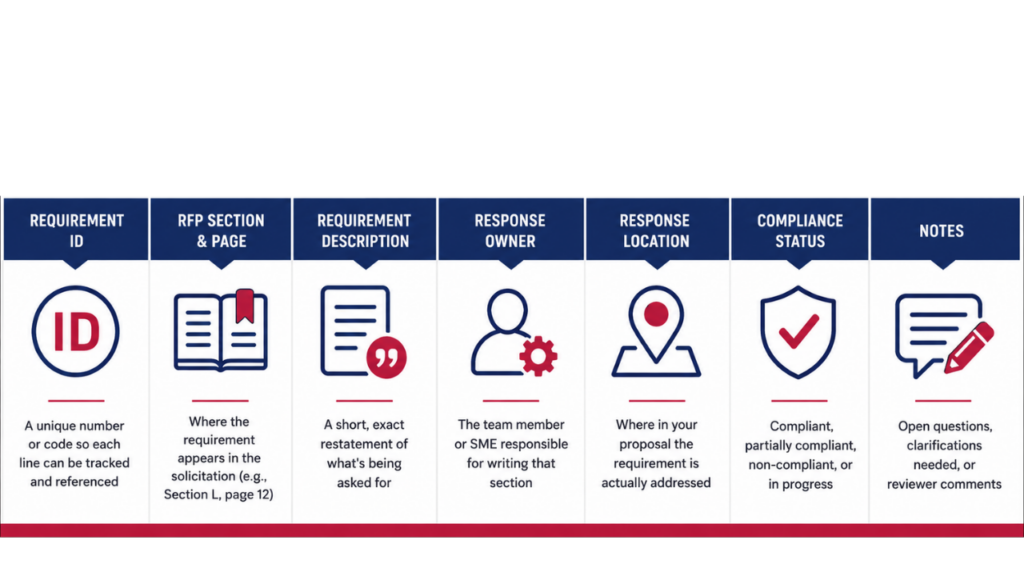
For complex federal solicitations, teams often add a column linking requirements directly to the evaluation criteria, so writers can see not just what to include but how it will be scored. This becomes especially important when working through Sections L and M of a solicitation, where instructions and evaluation factors determine how proposals are assessed. This level of detail is what separates a polished response from a rushed one — and it’s a habit worth building into every proposal writing process, not just government work.
How to Prepare a Business Proposal Compliance Matrix (Step-by-Step)
Knowing how to prepare a business proposal that survives compliance review comes down to following a consistent process. Here’s a step-by-step approach used by experienced proposal teams.
Step 1: Read the Solicitation Line by Line
Before writing a single word of the response, go through the RFP in full — instructions, evaluation criteria, and scope of work alike. Pull out every “shall,” “must,” and “will” statement. These verbs almost always signal a mandatory requirement.
Step 2: Build the Matrix Skeleton
Transfer each requirement into your matrix template with its exact source location. Resist the urge to summarize too aggressively at this stage; precision matters more than brevity.
Step 3: Assign Ownership
Every row needs an owner. Without a named person responsible for each requirement, items get assumed to be “someone else’s job” and quietly fall through the cracks.
Step 4: Track Through Review Cycles
As drafts move through internal reviews, update the status column in real time. This turns the matrix into a live dashboard rather than a one-time checklist, making it easy for reviewers to spot gaps before submission.
Step 5: Lock It Down Before Submission
In the final 48 hours, do a dedicated read-through comparing the matrix against the finished proposal, page by page. This last pass catches the small slips — a missing form, an outdated page number — that are easy to overlook when everyone is focused on the finish line.
Proposal Writing Examples: A Sample Compliance Matrix in Action
Seeing a proposal example for project work like this often makes the concept click faster than any explanation. Imagine an RFP for an IT support contract that includes this instruction in Section L: “Offerors shall submit a staffing plan describing key personnel qualifications.”
A simplified matrix row might look like this:
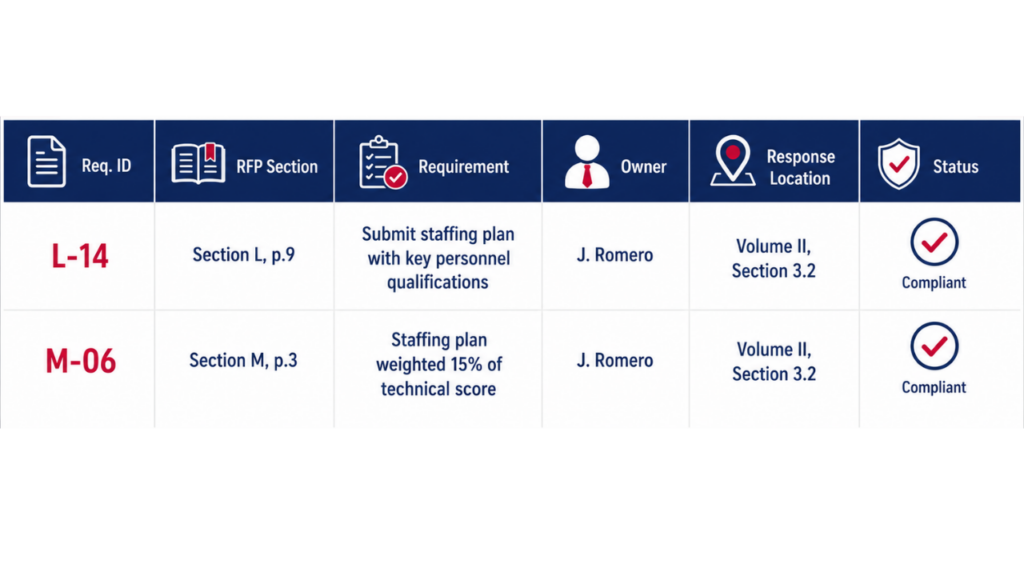
Notice how the matrix links the instruction (Section L) to the scoring weight (Section M) and then to the actual response location. That three-way link is the engine behind every reliable compliance system, whether you’re responding to a small business RFP or a multi-volume federal bid.
Common Mistakes That Sink Government Bids
Even strong teams fall into familiar traps during RFP bidding. Watch for these:
- Over-compliance — repeating the RFP's own language back at evaluators instead of demonstrating genuine understanding
- Treating the matrix as a one-time task instead of updating it as amendments are released
- Skipping clarification questions and guessing at ambiguous instructions to save time
- Building the matrix too late, after drafting has already started, which forces rework
- Removing internal columns like ownership and notes — but forgetting to do so before a matrix that's required as part of the submission goes out the door
Any one of these can quietly undermine months of work on a contract proposal, which is why discipline around the matrix matters as much as the writing itself.
Tools and Best Practices for RFP Bidding Success
For smaller or simpler responses, a well-organized table in Word can work fine. But once a solicitation involves multiple volumes, amendments, or a large review team, spreadsheet tools like Excel tend to perform better — they make filtering, sorting, and tracking changes far easier. Some organizations now use dedicated proposal management software that auto-extracts requirements from a posted RFP contract and builds a draft matrix automatically, cutting down hours of manual line-by-line review.
Whatever tool you choose, a few habits consistently separate high-performing bidders from the rest:
- Start the matrix the same day the solicitation drops, not after the kickoff meeting
- Re-check it against every amendment, no matter how minor it looks
- Keep ownership visible to the whole team, not just the proposal manager
- Run a dedicated compliance pass separate from your content quality reviews
These habits don’t just apply to government contracting — they translate directly into stronger proposal writing for commercial RFPs, grant applications, and any structured bidding process where missing a requirement carries real cost.
Conclusion
A proposal compliance matrix isn’t the most exciting part of government proposal writing, but it’s often the difference between a proposal that gets evaluated and one that gets set aside unread. By mapping every requirement to a clear owner and a clear response location, you protect the work your team has already put in and give evaluators every reason to keep reading. Whether you’re new to government bidding or refining a process you’ve used for years, building — and living by — a compliance matrix is one of the highest-leverage habits in proposal management.
For organizations looking to improve win rates and create a more disciplined proposal process, working with experienced government contracting professionals can make a significant difference. Learn more about how Contragenix helps businesses navigate government contracting and proposal development.
Need Help Winning Government Contracts?
Navigating federal procurement, FAR compliance, and proposal development can be complex. Contragenix supports businesses with expert bid assistance, proposal development, and government contracting strategy to improve win rates.