

Outsourcing VS In-House Government Proposal Writing: Which Wins?
Is your in-house team submitting proposals that keep losing to the competition — and you still don’t know why?
Government proposal writing is one of the most high-stakes activities in the federal contracting world. A single winning bid can bring in millions of dollars. A poorly written one? It disappears into the evaluation pile, never to be heard from again.
Whether you are a small business entering government contract bidding for the first time or an established contractor managing multiple IDIQs, the question always comes up: should you build an in-house proposal team or outsource proposal writing to experienced consultants?
This blog breaks down both approaches clearly, honestly, and completely. By the time you finish reading, you will know exactly which model fits your business goals, budget, and bid pipeline — and how to set yourself up to win more contracts in 2025 and beyond.
What Is Government Proposal Writing — And Why Does It Matter?
Government proposal writing is the process of responding to a federal, state, or local agency’s Request for Proposal (RFP) or Request for Quotation (RFQ) with a formal, structured document that demonstrates your company’s ability to deliver the required services or products.
Unlike writing a business proposal for a private client, government proposals must follow a strict government proposal format — typically aligned to the Uniform Contract Format (UCF), which organizes content into Sections L, M, and C. Section L tells you what to submit, Section M tells you how you will be evaluated, and Section C defines the statement of work.
A well-written government proposal must be:
- Compliant — it addresses every requirement in the RFP
- Responsive — it answers what the agency is asking
- Compelling — it gives evaluators a clear reason to choose you
The difference between a good proposal and a great one is not luck. It comes down to strategy, structure, and the quality of the people writing it — which is exactly why the in-house vs outsourcing debate matters so much.
In-House Proposal Writing: Pros, Cons, and When It WorksWhat Does an In-House Proposal Team Look Like?
An in-house proposal team is a group of full-time employees dedicated to capturing and responding to contract proposals. Depending on your company size, this could be one person wearing many hats or a complete team that includes a capture manager, proposal manager, technical writers, pricing analysts, and graphic designers.
Advantages of In-House Proposal Writing
1. Deep Institutional Knowledge:
Your in-house team knows your company’s past performance, corporate capabilities, certifications, and CPARS ratings inside and out. When writing a business proposal for a recompete or a follow-on contract, that depth of knowledge is hard to replicate quickly with an outside firm.
2. Full Control Over the Process:
You set the timeline, the review cycle, and the quality standards. There is no back-and-forth with an external firm — decisions move faster when your team is in the building (or on the same Slack channel).
3. Long-Term Institutional Memory
Every proposal your team works on builds a library of reusable content — win themes, past performance summaries, boilerplates, and proposal writing examples that save time on future bids. Over time, this becomes a genuine competitive asset.
4. Better Alignment With Business Development
In-house proposal writers work alongside your BD and capture teams throughout the pre-RFP phase — attending customer calls, shaping requirements, and building the intelligence needed to write stronger proposals.
Disadvantages of In-House Proposal Writing
1. High Fixed Overhead:
Hiring, training, and retaining experienced proposal professionals is expensive. Salaries, benefits, and overhead costs add up quickly — even during slow periods when your bid volume is low, and your team sits idle.
2. Bandwidth Limitations During Surges:
The federal market drops RFPs unpredictably. When multiple bids land at the same time, an in-house team can become overwhelmed. Submitting rushed proposals just to hit the deadline rarely wins contracts.
3. Talent Gaps in Specialized Areas:
Government contract bidding today requires much more than good writing. Pricing strategy, orals coaching, graphics support, and color team reviews demand specialized skills that most in-house teams cannot maintain at all times.
4. Risk of Stale Thinking:
In-house teams can fall into patterns. They recycle the same win themes, use the same structure, and produce proposals that start to look like each other — which is exactly what proposal evaluators notice.
When In-House Works Best
- Your company bids on a high volume of smaller, similar contracts
- You have a steady and predictable flow of RFPs throughout the year
- Your recompete rate is high and institutional knowledge is a real differentiator
- You have the budget to build and sustain a complete team
Outsourcing Proposal Writing: Pros, Cons, and When It Makes Sense
1. Access to Specialized Expertise
Experienced proposal consultants have worked across dozens of agencies, contract types, and government proposal formats. They know what evaluators look for, how to structure Section L responses for maximum compliance, and how to craft win themes that actually resonate with government customers.
2. On-Demand Scalability.
This is one of the strongest arguments for outsourcing. When your pipeline heats up and three RFPs land in the same week, an outsourced firm can scale up resources immediately — proposal managers, writers, graphic designers — without you needing to hire anyone permanently. When things slow down, you scale back. You pay for what you use.
3. Cost Efficiency Compared to Full-Time Headcount
Instead of carrying full-time salaries, benefits, and overhead for a proposal team year-round, you pay for expert support only when you need it. For small businesses doing government contract bidding with limited budgets, this math makes a strong case for outsourcing.
4. Fresh Eyes on Your Proposals
Outside consultants bring objectivity. They will tell you honestly when your technical approach is weak, when your pricing strategy is off, or when your proposal writing examples need to be rewritten entirely. That kind of candid feedback is harder to get from colleagues who are too close to the work.
5. Broader Talent Pool:
Outsourcing opens your access to proposal professionals across the country — not just those within commuting distance of your office. In a market where experienced bid writing talent is in high demand, this geographic flexibility matters.
Disadvantages of Outsourcing Proposal Writing
1. Learning Curve for Company Knowledge:
Every outsourced firm needs time to understand your company’s capabilities, culture, past performance, and key differentiators. The early proposals take more onboarding effort than you might expect.
2. Availability Risk
Quality proposal consultants are busy — especially during peak government bidding season. If you do not have a retainer arrangement, you may find your preferred firm is unavailable exactly when you need them most.
3. Less Control Over Day-to-Day Process
When an external team manages your proposal, you lose some visibility into the day-to-day writing and review process. This requires clear communication protocols and well-defined roles upfront.
4. Sensitivity of Information
Government proposals often involve sensitive technical data, past performance details, and in some cases classified or proprietary information. Introducing outside parties requires proper NDAs, security protocols, and careful information partitioning.
When Outsourcing Works Best
- You are a small or mid-size business with variable bid volume
- You are pursuing large, complex contracts where proposal quality is critical
- Your in-house team is skilled at BD but not at formal government proposal writing
- You have aggressive growth goals that exceed your current team's capacity
- You need specialized skills — pricing analysis, orals coaching, graphic design — that do not justify a full-time hire
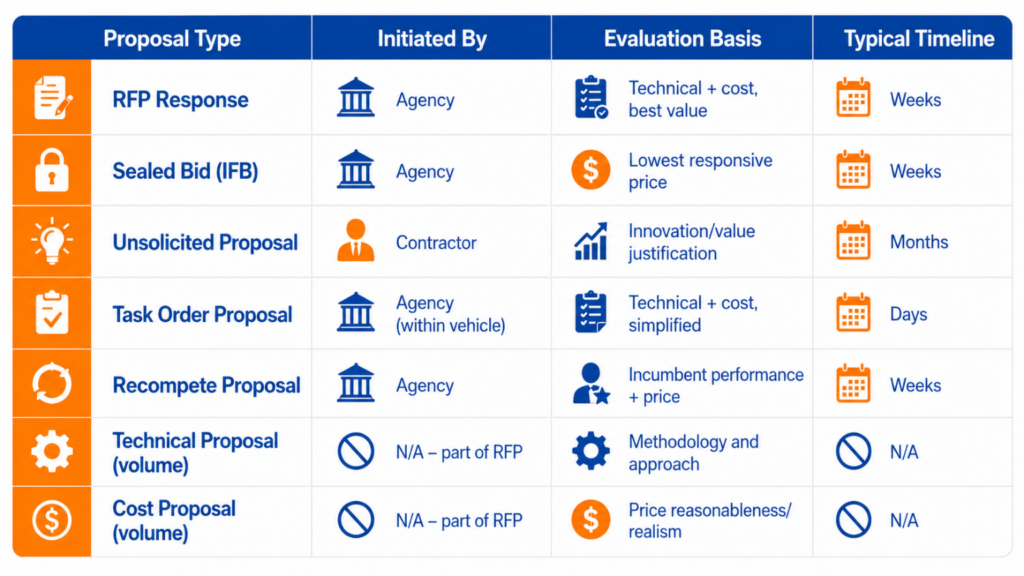
Head-to-Head Comparison: Outsourcing vs In-House Proposal Writing
Key Factors to Help You Decide
Choosing between outsourcing and in-house proposal writing is not a one-size-fits-all decision. Here are the five most important factors to weigh.
1. Your Business Development Goals
If your company has aggressive growth targets — pursuing 40% or more expansion in contract revenue — an in-house team alone will likely struggle to keep up with the volume and quality required. High-growth GovCon companies typically need outside expertise to scale their proposal capacity in line with their pipeline.
2. The Size and Complexity of Your Bids
Companies that bid on a large number of smaller, routine task orders can often manage that work in-house with a lean team. But if you are competing for large, multi-year IDIQ vehicles or complex cost-plus contracts, the proposal writing complexity usually justifies bringing in specialized help. Many contractors supplement their internal capabilities with proposal development and support services for activities such as color team reviews, pricing strategy, compliance checks, and graphics support.
3. The Flow of Incoming RFPs
Government contract bidding is not evenly distributed across the calendar year. Agencies release RFPs in waves, and your capacity needs can swing wildly from month to month. If your bid pipeline is unpredictable, outsourcing gives you flexibility that no in-house team can match without overstaffing.
4. Your Win Rate
Take an honest look at your current proposal win rate. If you are consistently losing to competitors on similar contract types, something in your government proposal writing process is not working. An outside firm can assess your proposals objectively, identify patterns in your losses, and help you restructure your approach to Section L and Section M responses.
5. Your Budget Reality
Be realistic about what you can sustain. Maintaining a fully staffed in-house proposal team — including management, writing, pricing, and graphics — can cost several hundred thousand dollars annually in salaries alone. Outsourcing can often deliver comparable or superior capability at a fraction of that cost, especially for companies that do not bid on contracts every single month.
How to Prepare a Business Proposal That Actually Wins
Regardless of whether you use an in-house team or an outsourced firm, the fundamentals of how to prepare a business proposal for government agencies remain the same. Here is what separates winning proposals from losing ones.
1. Follow the Government Proposal Format Without Exception
Government evaluators are required to score your proposal based on the evaluation criteria in Section M. If your response does not match the government proposal format outlined in Section L, it will be marked non-compliant and may be disqualified entirely. Use a compliance matrix to cross-reference every RFP requirement against your proposal structure before you submit.
2. Lead With Win Themes, Not Just Qualifications
A common mistake in government proposal writing is leading with who you are rather than why you are the right choice. Evaluators do not just want to see your capabilities — they want to understand your approach, your understanding of the problem, and your plan to deliver results. Build your proposal around two or three strong win themes and reinforce them throughout every section.
3. Use Proposal Writing Examples From Past Wins
If you have proposal writing examples from past winning bids, analyze them carefully. What structure did they use? What kind of language did they rely on? How did they respond to Section M evaluation criteria? Your own past performance data is one of the most valuable inputs you can bring to any new proposal.
4. Price to Win — Not Just to Cover Costs
Price-to-win (PTW) analysis is a critical part of any government contract bidding strategy. Submitting a price that is too high makes you uncompetitive. Submitting a price that is too low can raise red flags with evaluators or leave your company unable to perform the work profitably. Use market data, agency budget information, and competitive intelligence to set a defensible price.
5. Build in Time for Color Team Reviews
A pink team, red team, and gold team review process significantly improves proposal quality before submission. These reviews — often the first thing cut when deadlines are tight — are precisely what outsourced firms are structured to provide efficiently.
Common Proposal Writing Mistakes That Cost You Contracts
Even experienced proposal teams repeat the same avoidable mistakes in government proposal writing. Here are the most damaging ones.
- Ignoring Section L instructions and submitting a proposal that is non-compliant on format or page limits
- Relying too heavily on boilerplate instead of tailoring the response to the specific agency, program, and evaluation criteria
- Starting the proposal after the RFP drops instead of building intelligence during the capture phase
- Skipping the compliance matrix and missing a requirement that costs you the bid
- Treating bid writing as purely administrative rather than as a strategic, customer-focused sales document
- Failing to address the "so what" — listing features and capabilities without connecting them to the agency's mission and evaluation priorities
- Underinvesting in graphics when a well-designed figure or table can communicate your approach more powerfully than three paragraphs of text
For a more detailed breakdown, read our detailed guide on Proposal Writing Mistakes.
Conclusion
There is no universal right answer to the outsourcing vs in-house debate — but there is a right answer for your company, at this stage of your growth.
If you are bidding on a steady volume of similar contracts and have the budget to build and sustain a capable team, in-house proposal writing offers real advantages in institutional knowledge and process control.
If your goals are aggressive, your bids are complex, your pipeline is unpredictable, or your current win rate is not where it needs to be, outsourcing government proposal writing is not a cost — it is an investment in better outcomes.
Many of the most successful federal contractors use a hybrid model: a small in-house core team handles capture strategy and company knowledge, while an outsourced firm provides surge capacity, specialist skills, and objective proposal review during critical bids. Partnering with experienced providers like ContraGenix can give contractors access to the proposal expertise, surge capacity, and strategic guidance needed to compete more effectively in today’s GovCon environment.
The goal is not to win every proposal. The goal is to focus your resources on the right opportunities and give each one the best possible chance of winning. Whether you do that with an in-house team, an outsourced firm, or a combination of both — that decision should be driven by strategy, not habit.
Need Help Winning Government Contracts?
Navigating federal procurement, FAR compliance, and proposal development can be complex. Contragenix supports businesses with expert bid assistance, proposal development, and government contracting strategy to improve win rates.