

Introduction
The concept of natural channel design is bringing a revolution in the field of engineering in relation to stream restoration, but is it always the better choice than rigid armored concrete? It is seen that every year, towns and counties spend huge amounts of money on channel restoration schemes, and all they end up seeing after just a decade of installation is erosion of banks, loss of habitat, and escalating maintenance costs. It all comes down to just one decision that is made right at the start of designing a scheme.
This is not only a question of technology. This is related to flood resilience, water quality, habitat for wildlife, and budgets in the long run. In this blog, we will discuss what natural channel design means, why sometimes hard armoring makes sense from the engineering perspective, and compare these two solutions in terms of cost and environmental performance.
What Is Natural Channel Design?
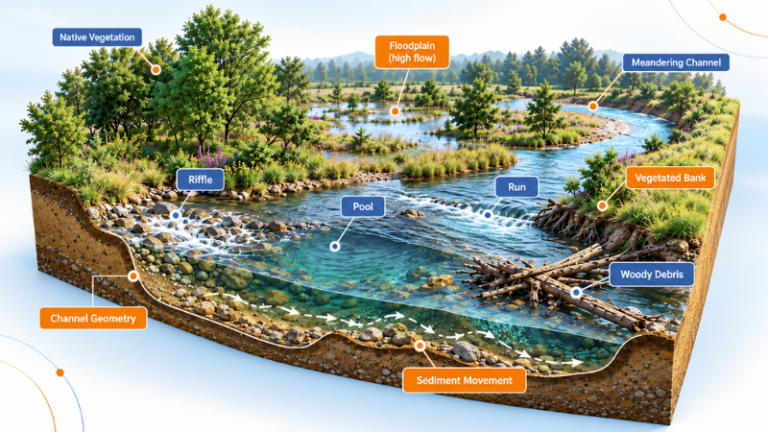
Natural channel design is a stream restoration approach that works with a waterway’s natural geomorphology instead of forcing it into a fixed, artificial shape. Rather than lining a channel with concrete or rock to resist erosion, engineers study how the stream naturally wants to move sediment, water, and energy then shape the channel restoration project around those patterns.
This creates a self-stabilizing channel in the same way as a stable stream over time. This is a process based on fluvial geomorphology, hydrology, and ecology and has become the standard procedure used by governmental agencies involved in stream bank stabilization projects. Engineers can also refer to natural stream channel design guidance when evaluating restoration approaches
Core Principles Behind Natural Channel Design
A few principles guide almost every natural channel design project:
- Design with the stream, not against it. Engineers let the channel participate in its own long-term stability instead of resisting every flow event with rigid structures.
- Match channel geometry to the watershed. Width, depth, slope, and meander pattern are sized to the sediment and flow, the stream carries.
- Reintroduce habitat features. Riffles, pools, and runs are rebuilt to support fish and macroinvertebrate life, not just to move water.
- Reconnect the floodplain. Allowing high flows to spread onto an adjacent floodplain reduces velocity and shear stress on the banks. These principles are also reflected in federal stream-restoration frameworks that consider channel stability, sediment movement, and floodplain connectivity.
Bioengineering and Soil Bioengineering Techniques
Most natural channel design work leans on bioengineering streambank methods and techniques that pair living vegetation with natural structural materials like wood, stone, or coir fiber. Soil bioengineering in blends live stakes, brush layering, and root systems with the soil itself, so the bank gets stronger as vegetation matures rather than weaker as concrete cracks and rock shifts. These methods tend to cost less to maintain long-term and blend into the surrounding landscape instead of looking like industrial infrastructure.
What Is Hard Armor Concrete, and When Do Engineers Use It?
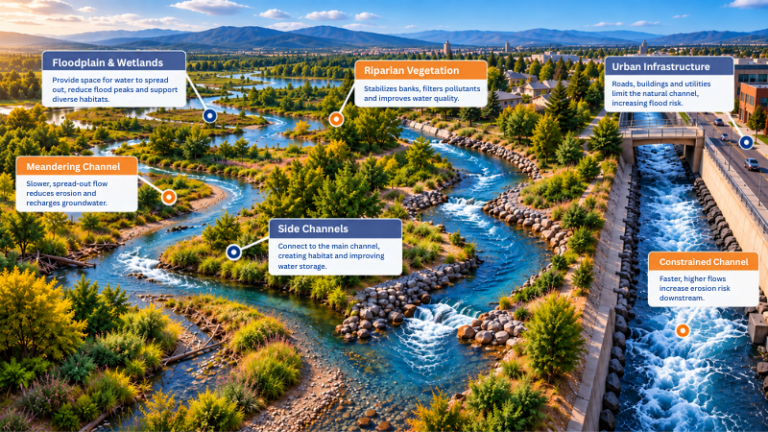
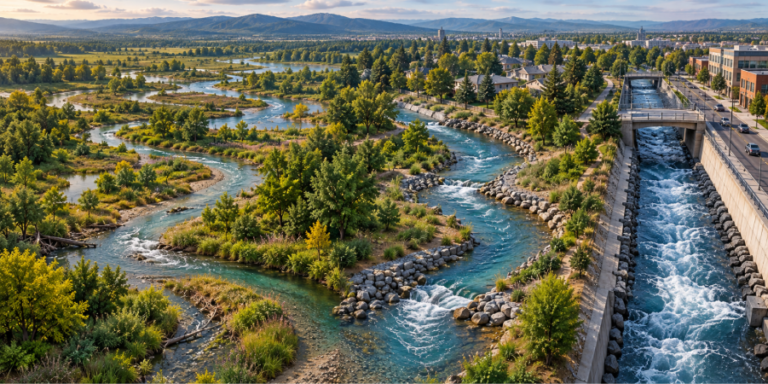
Hard armoring refers to any streambank stabilization method that relies on rigid, non-living materials to physically resist erosion. Channel hardening and riparian alteration is also recognized forms of urban stream modification. It’s the older, more conventional approach to erosion control methods, and it’s still widely used where a stream simply can’t be allowed to move completely naturally. Examples are culvert outlets, bridge abutments, or channels running through dense urban infrastructure.
Common Hard Armoring Methods
- Riprap — large, angular stones placed along a bank or channel bottom to absorb flow energy.
- Rock riprap — a heavier-grade version of standard riprap, sized for high-velocity or high-shear-stress reaches.
- Gabion baskets — wire cages filled with rock, used where a vertical or near-vertical wall is needed and space is tight.
- Concrete channel lining — poured or precast concrete that fully encases a channel bed and banks, typically in flood-control or drainage-critical corridors.
Where Hard Armoring Still Makes Sense
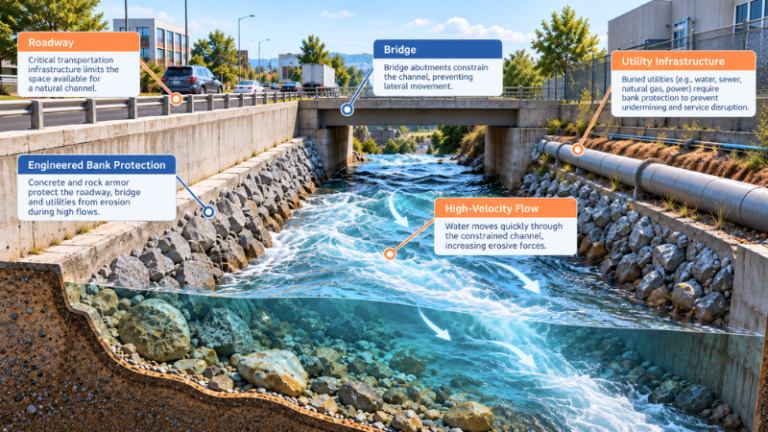
Hard armor concrete isn’t obsolete it’s a tool for specific conditions. Engineers typically reach for it when:
- Flow velocities or shear stresses exceed what vegetation and soil bioengineering can withstand.
- Space constraints rule out a natural, meandering channel footprint.
- Critical infrastructure — pipelines, foundations, and roadways directly adjacent to the waterway and cannot tolerate any bank movement.
- A project timeline or budget can't accommodate the establishment period; vegetation needs to mature.
Natural Channel Design vs. Hard Armor Concrete: A Side-by-Side Comparison
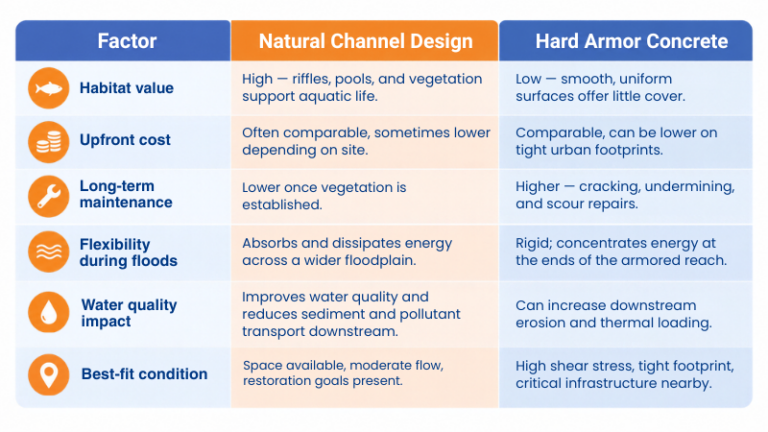
The comparison isn’t about which method is “better” in the abstract it’s about matching the method to site conditions, budget horizon, and the regulatory or habitat goals driving the project.
Natural Channel Design vs. Hard Armor Concrete: A Side-by-Side Comparison
Beyond the channel itself, engineers increasingly design the surrounding corridor as part of the solution. Green infrastructure and nature-based solutions treat the waterway as a system, not an isolated pipe or ditch and that shift is where a lot of eco-friendly erosion control performance comes from.
Living Shorelines for Coastal and Riverine Edges
Living shorelines use a combination of vegetation, sand, and in some cases a rock sill to stabilize the edge rather than building up a wall or bulkhead. This is the coastal equivalent of natural channel engineering and has become popular because it preserves the ability of the shoreline to be porous for water and wildlife passage.
Riparian Buffer Restoration and Floodplain Restoration
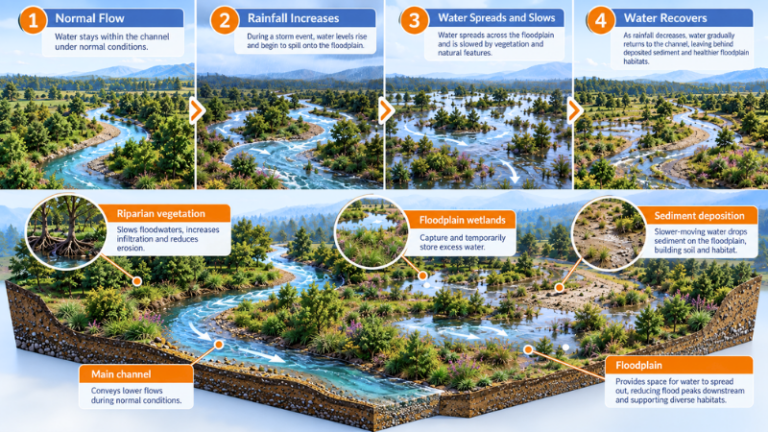
A stream is only as stable as the land around it. Riparian buffer restoration replanting native trees, shrubs, and groundcover along the bank filters runoff before it reaches the channel and shades the water to keep temperatures fish friendly. Paired with floodplain restoration, which reconnects the stream to adjacent low-lying land, these two practices absorb flood energy long before it ever reaches a bank that needs protecting.
Stormwater Channel Design That Works with Nature
The design of urban and suburban stormwater channels has experienced a similar transition. Stormwater planning also needs to account for local stormwater management ordinances and their requirements. In place of diverting the flow from rainfall via a concrete ditch, many municipalities have chosen the vegetative swale, two-stage channel, or bioretention conveyance designs that both delay and treat the water as it flows.
How to Choose the Right Streambank Stabilization Approach
There’s no universal answer. The right streambank stabilization method depends on a handful of site-specific variables. A process-based restoration approach also considers factors such as connectivity, available space, natural materials, and long-term recovery.
Site Assessment Factors Engineers Weigh
- Flow regime: bankfull discharge, flood frequency, and peak velocities.
- Available corridor width: how much room exists for a natural, meandering channel.
- Soil and substrate type: whether the bank material can support vegetation establishment.
- Adjacent infrastructure: utilities, roads, or structures that limit how much the channel can move.
- Regulatory and permitting requirements: many jurisdictions now favour or require nature-based approaches where feasible.
Cost, Shoreline Erosion Control, and Long-Term Maintenance
In evaluating different shore erosion control systems, it is best to think beyond the construction invoice and investigate the long run. While hard armor systems made from concrete are usually faster during installation, natural channel design and bioengineering systems can be cheaper to maintain as they do not have to undergo frequent repair work for scours, undermining, or replacement of cracked concrete blocks.
Need Engineering Support for a Complex Waterway or Infrastructure Project?
From streambank stabilization, floodplain analysis, natural channel design, wetland delineation, and stormwater design to civil, structural, and infrastructure support, Contragenix AEC Design & Support helps engineering teams extend their technical capacity when projects require additional design support.
Explore AEC Design & Support →
Conclusion
Natural channel design and armor concrete are not competing approaches – they are the two options that engineers choose based on the requirements of the site. In cases where there is sufficient space to allow the river to follow its natural course, a combination of bioengineering, riparian buffer and floodplain restoration will result in improved habitat quality, reduced maintenance and improved performance in extreme flow conditions. Where such space, engineering structures or shear stress preclude this, then armor concrete can still be considered a viable and properly engineered solution. The most effective projects for stream restoration and bank stabilization begin with proper site assessment.
Scale Your AEC Projects with Expert Design Support
Whether you’re managing multiple projects or facing resource constraints, our experienced engineering professionals seamlessly integrate with your team to provide accurate design, drafting, BIM coordination, and technical documentation, keeping your projects on schedule and within budget.