

How to Build a Government Proposal Compliance Matrix From an RFP
A technically strong proposal can still lose points—or become noncompliant—because one requirement was missed, misread, assigned to nobody, or never verified.
The problem usually isn’t the writing. It’s traceability.
A government RFP can contain requirements across instructions, evaluation criteria, the PWS or SOW, attachments, forms, page limits, pricing instructions, and amendments. Trying to keep all of that in someone’s head is how gaps appear.
A proposal compliance matrix gives the proposal team a structured way to move from the RFP to an actual submission: identify the requirement, assign responsibility, determine the evidence needed, map it to the proposal, and verify that it was addressed.
The most useful way to approach the process is:
EXTRACT → CLASSIFY → ASSIGN → MAP → VERIFY
Here’s how to do it.
Where Do Requirements in an RFP Actually Come From?
One of the biggest mistakes contractors make is building their government proposal compliance matrix from Section L alone.
Section L matters, but it is only one part of the solicitation.
Depending on the procurement, requirements may appear in:
- Section C, PWS, or SOW
- Section L
- Section M
- Attachments
- Exhibits
- Submission instructions
- Page-limit requirements
- Formatting instructions
- Pricing instructions
- Past performance requirements
- Key personnel requirements
- Certifications
- Required forms
- Amendments
The solicitation structure can vary, so don’t assume every RFP uses the same sections or terminology.
A useful starting point is to understand how Section L, M, and C interact. Contragenix’s guide to Section L/M/C explains the distinction and why contractors need to read them together.
Think about the relationship this way:
- Section L: What and how the offeror must submit.
- Section M: How the government will evaluate the proposal.
- Section C/PWS/SOW: What the contractor is expected to perform, where applicable.
Your compliance matrix connects those requirements to the proposal you’re actually building.
How to Build a Proposal Compliance Matrix From an RFP
Step 1: Read the Entire Solicitation
Before creating rows in your matrix, read the solicitation.
Don’t start by searching for the word “shall” and assume you’ve captured everything.
Read the RFP from beginning to end, including attachments and exhibits that apply to the offer.
You are looking for more than explicit requirements. You also need to understand:
- What must be submitted
- What will be evaluated
- What the contractor must perform
- What evidence is expected
- Where information must appear
- What formatting rules apply
- What deadlines and submission rules apply
Keyword searches can help you find requirements faster, but they should support reading—not replace it.
Step 2: Extract the Requirements
Now begin building your RFP compliance matrix.
Search for useful signals such as:
“shall”
“must”
“submit”
“provide”
“include”
Then examine the surrounding language.
For example, if an RFP says:
“The offeror shall provide a staffing plan describing its approach to recruiting, retaining, and managing personnel.”
Don’t record only “staffing plan.”
Capture the actual obligation and what the proposal must demonstrate.
This is where a compliance matrix becomes more useful than a simple list of requirements.
Step 3: Record the Exact RFP Reference
Every requirement should have a traceable source.
Record the section, paragraph, page, or other reference that allows someone on the team to find the original requirement quickly.
For example:
L.4.2
M.3.1
PWS 3.2
The exact reference matters because proposal teams will revisit requirements repeatedly during drafting and reviews.
If someone asks, “Where did this requirement come from?” the answer should be one click—or one search—away.
Step 4: Classify the Requirement
Not every requirement should be treated the same way.
Classify each item according to what it requires.
Common categories include:
Mandatory
Evaluation
Technical
Administrative
Pricing
Formatting
Classification helps determine who needs to handle the requirement and how it should be reviewed.
For example, a page-limit requirement shouldn’t be managed the same way as a technical performance requirement.
Step 5: Turn the Requirement Into an Action
This is an easy step to overlook.
Copying the RFP language into a spreadsheet doesn’t tell your team what to do.
Turn the requirement into an actionable task.
Instead of:
“The offeror shall provide a staffing plan.”
Use:
Develop staffing plan covering recruitment, retention, and personnel management.
The second version tells the owner what needs to happen.
Your matrix should function as a working tool, not an RFP transcript.
Step 6: Assign an Owner
Every meaningful requirement needs a responsible person.
Avoid assigning everything to “Proposal Team.”
Depending on the requirement, ownership might sit with the following:
Proposal Manager
Technical Lead
Staffing Lead
Pricing Lead
Contracts Lead
Capture Manager
Subject Matter Expert
Clear ownership prevents the classic problem of everyone assuming someone else handled it.
Step 7: Identify the Evidence
Ask one question:
What will prove that we satisfied this requirement?
The answer might be:
Technical narrative
Staffing plan
Past performance example
Key personnel resume
Pricing workbook
Certification
Form
Cross-reference
Attachment
This evidence column is particularly valuable during reviews because it forces the team to think beyond whether a requirement was “mentioned.”
The question is whether the proposal provides credible evidence of compliance.
Step 8: Map the Requirement to the Proposal
Now identify exactly where the requirement will be addressed.
For example:
Volume II, Section 3
is more useful than simply writing:
Technical Volume
The more precise the mapping, the easier it becomes to review the proposal.
This creates traceability:
RFP requirement → proposal owner → evidence → proposal location
Step 9: Track Status
A requirement isn’t finished simply because someone started working on it.
Use simple statuses such as:
- Not Started
- In Progress
- Complete
- Needs Review
- Verified
The distinction between Complete and Verified is important.
A writer can complete a section without the proposal manager or review team confirming that it actually satisfies the requirement.
Step 10: Perform Final Verification
The compliance matrix becomes a QA tool before submission.
Review every requirement and ask:
Is the requirement still applicable?
Is there an assigned owner?
Is the required evidence present?
Is the requirement addressed in the proposal?
Is the proposal location correct?
Does the response actually satisfy the requirement?
Has it been independently verified?
This is the final VERIFY stage of the process.
For a broader view of the proposal lifecycle, see the Contragenix government RFP response process.
Example: What a Proposal Compliance Matrix Looks Like
The matrix doesn’t need to become a massive spreadsheet with dozens of columns.
A practical version could look like this:
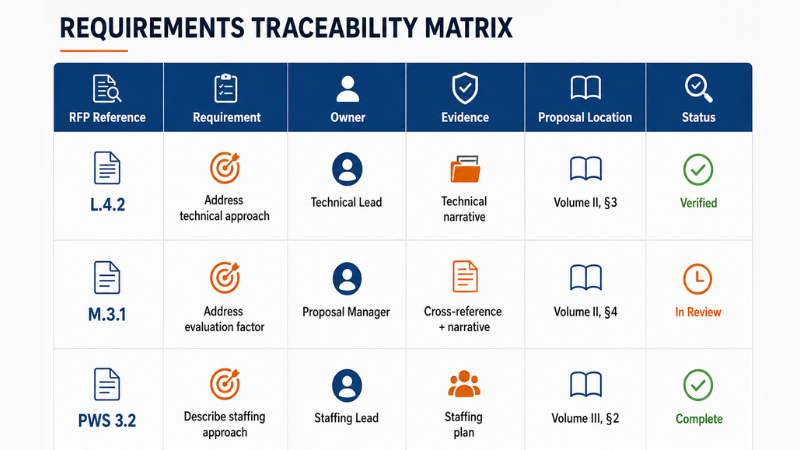
This example is illustrative and is not taken from an actual solicitation.
Each column serves a purpose:
RFP Reference: Shows exactly where the requirement originated.
Requirement: Converts the RFP language into an actionable obligation.
Owner: Establishes accountability.
Evidence: Defines what demonstrates compliance.
Proposal Location: Shows where the requirement is addressed.
Status: Makes gaps visible before submission.
The goal isn’t to build the most complicated spreadsheet.
It’s to create enough traceability that a reviewer can follow a requirement from the solicitation all the way into the final proposal.
How Amendments Change the Matrix
Your matrix is only useful if it reflects the current solicitation.
When the government issues an amendment, update the matrix rather than simply attaching the amendment to an email and moving on.
Look specifically for:
- New requirements
- Deleted requirements
- Changed requirements
- Changed page limits
- Changed deadlines
- Changed submission instructions
- Changed evaluation language
An amendment can affect multiple rows in your matrix.
A changed evaluation factor, for example, may require changes to proposal content, ownership, evidence, and proposal locations.
The final matrix should represent the solicitation as amended, not the version your team originally started working from.
Common Proposal Compliance Matrix Mistakes
Building the matrix only from Section L
Requirements can appear throughout the solicitation. Review the entire RFP.
Copying requirements without turning them into actions
A copied sentence doesn’t tell the team what needs to be produced.
Not recording the exact RFP reference
Without a source reference, tracing a requirement becomes unnecessarily difficult.
Giving every requirement the same owner
“Proposal Team” isn’t accountability. Assign a person or appropriate functional owner.
Nonidentifying evidence
Knowing what to write isn’t the same as knowing what proves compliance.
Treating “complete” as “verified”
Completion by a writer does not necessarily mean the requirement has passed QA.
Forgetting amendments
An outdated matrix can create an outdated proposal.
Not mapping requirements to proposal locations
If you can’t quickly identify where a requirement is addressed, reviewing it becomes harder.
Building the matrix once and never updating it
The matrix should evolve as the proposal evolves.
Checking compliance only at the end
By final review, fixing a missed requirement may require significant rewriting. Earlier checks are much cheaper.
Using the Matrix During Color Team Reviews
A proposal compliance matrix can also support common proposal-management reviews.
These are common practices, not universal government requirements.
Pink Team
Ask:
Are the requirements understood and assigned?
At this stage, the team should be able to see whether major requirements have owners and whether the proposal architecture gives them a place to go.
Red Team
Ask:
Does the proposal actually answer the requirements and evaluation criteria?
The matrix helps reviewers trace requirements into the actual draft rather than reviewing the narrative in isolation.
Gold Team
Ask:
Is the proposal complete, compliant, and submission-ready?
At this point, “Complete” shouldn’t be enough. Critical requirements should have reached Verified status.
Compliance Matrix vs. Compliance Checklist
The terms are sometimes used interchangeably, but they serve different purposes.
A compliance matrix provides detailed traceability:
RFP requirement → owner → evidence → proposal location → verification
A compliance checklist is generally a higher-level final confirmation that critical submission requirements have been addressed.
The matrix helps manage the work.
The checklist helps confirm the work.
For additional Contragenix proposal resources, visit the Contragenix blog.
Final Proposal Compliance Checklist
Before submitting, confirm:
- Every requirement has an RFP reference.
- Mandatory requirements have owners.
- Requirements map to proposal locations.
- Section L requirements are addressed.
- Section M evaluation criteria are mapped.
- Applicable C/PWS/SOW requirements are addressed.
- Amendments are incorporated.
- Page limits are verified.
- Required forms and attachments are included.
- Final compliance has been independently verified.
Remember: the federal government does not universally require contractors to create a proposal compliance matrix. The matrix is generally a proposal-management and quality-control tool. What contractors must comply with are the actual requirements contained in the applicable solicitation.
FAQs About Proposal Compliance Matrices
What is a proposal compliance matrix used for?
It is used to track solicitation requirements from their original RFP reference through ownership, evidence, proposal location, and final verification.
Should a compliance matrix include Section L and Section M?
Yes. Section L identifies submission instructions, while Section M explains evaluation criteria. Mapping both helps the proposal team connect what must be submitted with how the government will evaluate it.
Should the compliance matrix include the PWS or SOW?
Where applicable, yes. Performance requirements can affect the technical response and should be traceable to the proposal.
When should you create a proposal compliance matrix?
Build it early—after understanding the solicitation and before the proposal is too far into development. Continue updating it as the proposal and solicitation change.
Does MAS Refresh 33 affect all GSA Schedule contractors?
Typically, the proposal manager or designated proposal lead manages the matrix, while individual requirements are assigned to the people responsible for producing or validating the response.
Final Takeaway
A good compliance matrix does more than list requirements.
It creates traceability from the RFP to the person responsible, the evidence supporting compliance, the proposal location, and the final verification.
That is what makes it useful.
Extract → Classify → Assign → Map → Verify.
Use that process consistently, keep the matrix current through amendments, and make verification part of the proposal, not an afterthought.
Building a compliant federal proposal takes more than checking boxes. Contragenix helps government contractors turn RFP requirements into structured, compliant proposals—from requirement analysis through final review. Learn more at Contragenix.