

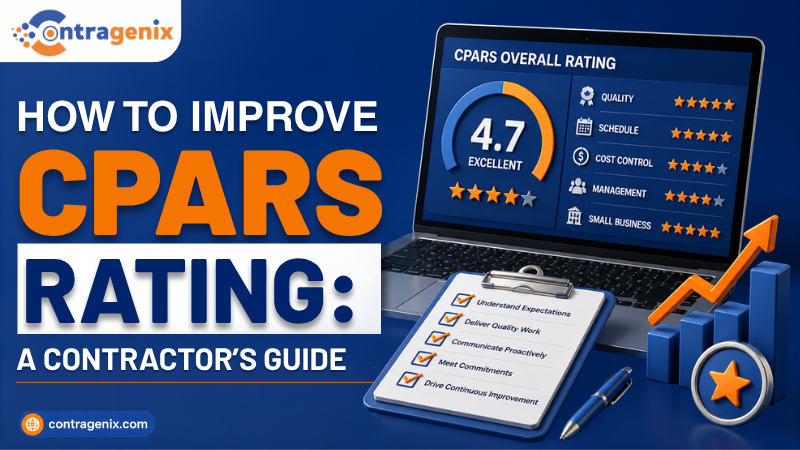
How to Improve Your CPARS Rating: A Practical Guide for Federal Contractors
A strong proposal can win a federal contract. Poor execution can make the next one harder.
That is why contractors should not think about CPARS only when an evaluation is being prepared. The performance record starts taking shape much earlier—through missed milestones, successful deliverables, customer communication, quality results, corrective actions, and the contractor’s ability to deliver what it promised.
So, how do you improve a CPARS rating? You start by improving the performance that the government ultimately evaluates.
The most effective approach is not a last-minute effort to influence an evaluation. It is disciplined contract management from day one.
What Actually Affects a CPARS Rating?
A CPARS evaluation reflects the government’s assessment of contractor performance. While the exact circumstances vary by contract, contractors should pay close attention to the areas that define successful execution: meeting requirements, delivering quality work, staying on schedule, communicating with the government, and addressing problems appropriately.
If you need a deeper explanation of evaluation fundamentals, see Contragenix’s CPARS ratings scale guide.
The important point is simple: contractors have far more influence over their performance record during contract execution than they do when the evaluation is being written.
How to Improve Your CPARS Rating During Contract Performance
Understand the Contract Before Problems Start
Many performance problems begin before the first deliverable is due.
The contractor’s team needs a clear understanding of the statement of work, deliverables, deadlines, quality expectations, reporting requirements, staffing commitments, and other contractual obligations. Those requirements should not live only in the contract file. The people responsible for delivering the work need to understand them.
Create a practical connection between the contract requirements and day-to-day execution.
For example, if a milestone has a firm deadline, someone should own it. If a deliverable has specific quality requirements, the team should know how it will be reviewed before submission. If the contract requires recurring reporting, establish the process early rather than scrambling when the reporting date arrives.
Good CPARS performance starts with knowing exactly what successful performance looks like.
Track Performance Against What You Promised
One of the most important GovCon lessons is this:
The government evaluates what you actually deliver, not what sounded impressive in the proposal.
Your proposal may have promised experienced personnel, a particular technical approach, aggressive timelines, or specific outcomes. Once awarded, those commitments become part of the execution challenge.
That means program managers should regularly compare actual performance against the commitments made during the pursuit.
Are milestones being met? Is staffing working as planned? Are deliverables meeting expectations? Is the proposed approach actually practical under real contract conditions?
This is also where performance tracking becomes valuable. A contractor that discovers a gap internally has an opportunity to address it before the government experiences the full impact.
Communicate Problems Before They Become Performance Issues
Problems happen on federal contracts. What matters is how they are handled.
If a staffing issue threatens a deadline, a deliverable is falling behind, or a technical problem is affecting execution, ignoring it rarely improves the situation.
The better approach is to identify the issue, understand its impact, communicate appropriately with the government, and work toward a realistic mitigation plan.
That does not mean flooding the customer with unnecessary updates or making excuses. It means keeping the government informed when an issue could affect contract performance.
An issue addressed early can look very different from the same issue discovered after a missed milestone or failed deliverable.
Document Results, Not Just Activity
Contractors often document what they did without clearly capturing what was achieved.
Keep useful records of deliverables, milestones, quality results, customer communications, corrective actions, and measurable outcomes. The goal is not to create paperwork for its own sake. It is to maintain an accurate record of contract execution.
For example, instead of simply recording that a deliverable was submitted, track whether it was accepted, whether revisions were required, and whether recurring issues appeared.
Good documentation also helps the contractor identify patterns. If the same type of quality issue appears repeatedly, that is a management problem worth addressing—not just another item to close.
Treat Quality as an Ongoing Responsibility
Quality should not be checked only immediately before something reaches the government.
Build quality control into the work itself. Review deliverables before submission. Monitor recurring defects. Make sure the right people are reviewing work that requires specialized knowledge.
Consistent quality reduces preventable deficiencies and gives program managers an earlier warning when execution starts drifting.
The objective is not perfection. It is control: knowing what is being delivered, identifying problems quickly, and correcting them before they become recurring performance issues.
Fix Problems and Show the Correction
A contractor can make a mistake without allowing that mistake to define the rest of the contract.
When something goes wrong, identify the root cause. Determine what needs to change. Assign responsibility. Establish a recovery milestone and monitor whether the corrective action actually works.
Most importantly, do not stop at saying the problem has been addressed.
If a process was changed, monitor the results. If staffing was adjusted, determine whether performance improved. If a quality-control step was added, check whether the original issue stopped recurring.
Corrective action does not guarantee a particular CPARS outcome. But effective problem management can prevent a temporary issue from becoming a broader performance failure.
The Biggest CPARS Mistake Contractors Make
Waiting until the CPARS evaluation to think about CPARS.
By the time an evaluation is being prepared, the underlying performance history has already happened.
You cannot go back and recover a missed deadline, redo months of poor communication, or erase recurring quality problems simply because an evaluation is approaching.
Instead, treat every contract milestone as part of a larger performance record.
That changes how a contractor manages the contract. A deliverable is no longer just something to submit. A missed deadline is not just a scheduling problem. A customer conversation is not just another meeting.
Each can contribute to the government’s overall view of contractor performance.
What to Do If Performance Starts Going Off Track
Do not wait for a bad outcome to become obvious.
When performance begins slipping, start with the facts. Identify the specific problem and determine its root cause. Is the issue staffing? Schedule management? Quality control? An unrealistic execution assumption? A communication breakdown?
Then establish a corrective-action plan with measurable recovery milestones.
Depending on the situation, that may involve reallocating resources, changing an internal workflow, strengthening quality review, adjusting staffing, or addressing a process failure.
Communication matters here as well. Contractors should appropriately keep the government informed when an issue affects contract performance rather than allowing the customer to discover the problem independently.
Document what happened, what was changed, and whether the corrective action worked.
The goal is not to manufacture a better evaluation. The goal is to recover contract performance.
How Strong CPARS Performance Starts Before Contract Award
CPARS performance problems can have their roots in the proposal.
An unrealistic staffing plan, an aggressive schedule, vague technical approach, or commitment the company cannot realistically support can create problems after award.
That makes proposal development part of the performance equation.
Before submitting a proposal, ask whether the company can actually deliver what it is promising. Are the staffing assumptions realistic? Can the technical approach be executed with available resources? Are the proposed timelines achievable? Does the pricing support the planned level of effort?
Strong proposal development services should help connect what is promised during the pursuit with what the company can realistically execute after award.
The same discipline should extend to the broader federal contracting process, including maintaining accurate business and registration information through SAM.gov when required for federal contracting activity.
The principle is straightforward: do not win a contract by promising an execution model your organization cannot sustain.
Use CPARS as a Feedback Loop for Future Contracts
A CPARS evaluation should not simply be filed away after it is completed.
Use it to improve the next contract.
Look for patterns. Were schedule commitments realistic? Did staffing assumptions hold up? Were communication issues recurring? Did the government identify weaknesses in quality? Were deficiencies preventable? Which parts of the execution approach worked particularly well?
Those answers can inform future capture strategy, proposal development, staffing, pricing, program management, and contract execution.
Past performance should teach the organization something.
A contractor that repeatedly sees the same performance weakness but changes nothing is leaving valuable information unused. A contractor that turns those lessons into better processes has a chance to improve future execution.
Conclusion
The best way to improve a CPARS rating is not to focus on the evaluation at the end of the contract. Focus on the performance that creates the evaluation.
Understand the requirements. Track what you promised. Deliver quality work on schedule. Communicate when problems emerge. Document results. Correct issues quickly and verify that the correction worked.
Most importantly, connect proposal commitments to execution from the beginning.
The strongest contractors manage every deliverable, milestone, customer interaction, and corrective action with the understanding that it can become part of their federal past-performance story.
If your organization is preparing for its next federal pursuit and wants to make sure its proposal commitments align with an executable contract strategy, Contragenix can support the proposal and federal contracting process.