

Executive Summary
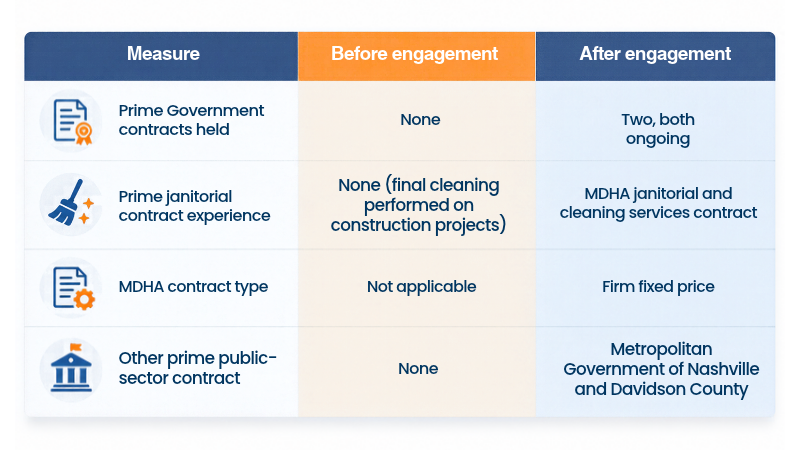
Our client, a construction management and general contracting firm, had built its record as a subcontractor to established general contractors and on commercial projects. It held no prime Government contract and therefore had no prime Government past performance to cite in public-sector proposals. Contragenix LLC supported the client in moving from subcontractor and commercial work to prime contracting with public agencies. The client has since been awarded two prime public-sector contracts, both of which are ongoing: a contract with the Metropolitan Government of Nashville and Davidson County, and a firm-fixed-price contract with the Metropolitan Development and Housing Agency (MDHA) for janitorial and cleaning services.
This case study focuses on the MDHA janitorial and cleaning services contract. It describes what Contragenix found when it analyzed the solicitation against the client’s subcontracting experience, how each finding shaped the proposal response, and what the award has and has not yet established. Contragenix supported the Metro Nashville pursuit in the same manner.
Client Background
Our client provides general building construction, historical renovation, masonry, metal building construction, lead paint removal, site demolition, and final cleaning. Its self-performed trades include carpentry, drywall, painting, demolition, acoustical ceiling tile installation, and final cleaning. As a subcontractor to established general contractors, the client worked within the general contractor’s schedule, submittal, and quality control requirements. In that role the general contractor, not the client, held the contract with the owner and managed the owner relationship.
The client’s objective was to move from that position to holding contracts directly with public agencies, where it would be responsible for the full performance cycle, including customer coordination, scheduling, quality control, and acceptance.
Challenge
The client’s limitation was not technical capability. Its construction and final-cleaning work was established. The limitation was that its experience had been earned as a subcontractor and in commercial settings, and none of it could be cited as prime Government past performance. Public-sector solicitations commonly require the offeror to submit references and demonstrate relevant experience. An offeror with no prime Government record has to show, through the content of the proposal, that its existing experience is relevant to the agency’s requirement and that it can perform without a general contractor managing the customer relationship. The client needed to obtain its first prime awards and, in doing so, establish a record that could be cited in later proposals.
Problem Analysis
Contragenix reviewed the MDHA solicitation, including its scope of work, bid submission requirements, contract provisions, and addenda, and compared them to the client’s capabilities and project history. That review produced four findings.
Finding 1: The past-performance gap was the primary weakness in the response. The MDHA bid package included a Client References requirement. The client’s references would come from subcontract and commercial work rather than from prime Government contracts, so the response could not rely on a prime Government record. It had to show relevance by describing what the client did on those projects and by connecting that work to MDHA’s scope.
Finding 2: The scope corresponds to work the client already performs at project closeout. MDHA required cleaning and sanitizing of vacant housing units before new occupancy, including bathrooms, floors, fixtures, windows, kitchens, cabinets, appliances, and utility areas, together with floor stripping, sealing, and waxing; optional carpet cleaning; and wood-floor cleaning and polyurethane application. Contragenix identified that the client performs final cleaning as a self-performed trade and also performs finish trades such as painting and drywall, which meant the scope was an extension of existing work and not a new line of business. The response needed to state this specifically and identify which MDHA tasks corresponded to which client capabilities.
Finding 3: The MDHA contract uses an assignment-based process that a prime must manage directly. MDHA assigns work to awarded contractors. The contractor has up to two business days to respond to an assignment and provide a quote for additional services, must coordinate with MDHA before starting, must notify MDHA on completion, and must obtain acceptance. On a subcontract, these customer-facing steps are normally handled by the general contractor. Contragenix determined that the response needed to show that the client could carry out each step itself, and that the client’s supervision, scheduling, and quality control experience was the relevant evidence.
Finding 4: The submission package was a compliance risk for a first-time prime bidder. The solicitation required a Bid Sheet, Client References, Representations and Certifications, Company Information, contract documents, and the property square-footage spreadsheet. The client had no prior Government bid submission on which to base its process, and an incomplete or unresponsive package would have removed the bid from consideration regardless of the client’s qualifications.
Solution
Each element of the solution addressed a specific finding.
Past performance alignment (addressing Finding 1). Contragenix developed a strategy for presenting the client’s subcontract and commercial experience as evidence of the capabilities MDHA would rely on, specifically scheduling, sequencing, quality control, and direct supervision of self-performed labor. Where the client had performed final cleaning, the response described that work directly so that the evaluator could assess its relevance to MDHA’s scope without having to infer it from project names alone.
Requirement-by-requirement technical response (addressing Finding 2). Contragenix organized the technical approach around MDHA’s own task list, addressing each cleaning area and each specialized floor task in turn and stating how the client would perform it with its own labor, equipment, and materials, as the solicitation required the contractor to furnish all three.
Assignment-to-acceptance approach (addressing Finding 3). The technical response described how the client would handle MDHA work assignments from receipt through acceptance: receipt of the assignment, response and quote within the two-business-day period, coordination with MDHA before work begins, execution under the client’s supervision, notice of completion, and acceptance. The description was based on the supervision, and quality control practices the client already applies on its construction work.
Compliance review (addressing Finding 4). Contragenix reviewed each required document against the solicitation for completeness, signatures, certifications, references, and addendum acknowledgments before submission.
Implementation
The MDHA response was carried out in the following sequence.
Opportunity identification and research. The MDHA opportunity was identified through a search for open public-sector solicitations. Contragenix and the client then began researching the requirement, and Contragenix began the solicitation analysis that produced the four findings above.
Pre-bid conference. The team attended the MDHA pre-bid conference to confirm the requirement and the submission expectations.
Parallel workstreams. After the pre-bid conference, the work was divided. The client began pricing, using the Bid Sheet and the property square-footage spreadsheet. Meanwhile Contragenix worked on the compliance requirements, the technical approach, and the alignment of the client’s past performance to the MDHA scope, applying the strategy described under Solution.
Compliance review and submission. A Contragenix resource was the sole reviewer of the package and reviewed every required document against the solicitation before submission. The response was submitted before the deadline, and the client was awarded the contract.
Results
The client moved from no prime Government contracts to two, and both are ongoing. The MDHA contract is a firm-fixed-price contract for janitorial and cleaning services covering the cleaning and sanitizing of vacant units before new occupancy. It gave the client its first prime janitorial contract experience with a public agency. The client’s first prime public-sector contract, with the Metropolitan Government of Nashville and Davidson County, was supported by Contragenix in the same manner.
- Demonstrate direct public-sector contract experience.
- Reference prime-contract performance on future opportunities.
- Expand its government-focused past-performance portfolio.
- Use its self-performance capabilities in future procurements.
- Pursue additional janitorial, facilities, construction, and related public-sector opportunities.
Conclusion
The client did not need new capabilities to compete for the MDHA requirement. It needed its subcontractor and commercial experience examined against the specific requirement and presented in a form an agency could evaluate. Contragenix’s contribution was to identify where the gap between subcontract experience and prime contract obligations actually lay: in the customer-facing assignment, coordination, and acceptance process and in the submission compliance requirements, rather than in the cleaning work itself. Each element of the proposal response addressed one of those points.
For firms in a similar position, the MDHA effort illustrates three practices: analyze the solicitation for what the prime contractor must do that a subcontractor does not; align existing experience to those specific obligations; and manage submission compliance as a controlled process. The two prime awards give the client a documented record from which to pursue further public-sector work.
Ready to strengthen your next proposal?Start with Contragenix.
Contragenix supports businesses that have commercial or subcontract experience and are preparing to compete for prime Government contracts. Its services include solicitation analysis, past performance alignment, technical and compliance development for proposals, and pre-submission compliance review. To discuss a specific solicitation, contact Contragenix LLC.