

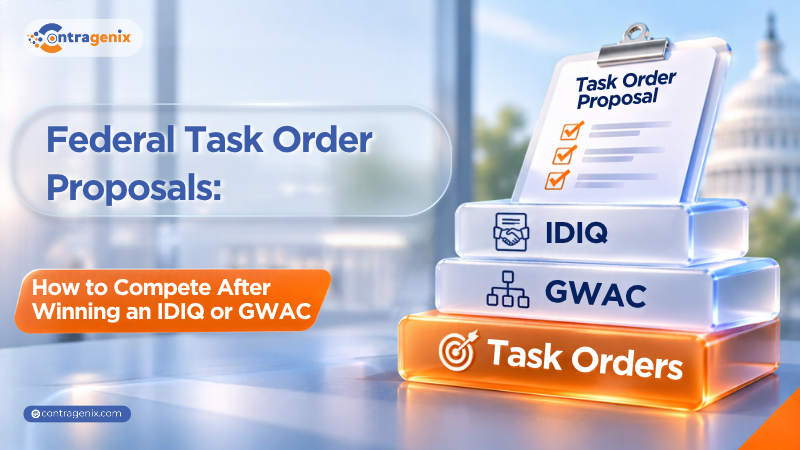
Federal Task Order Proposals: How to Compete After Winning an IDIQ or GWAC
Winning a position on an IDIQ or Governmentwide Acquisition Contract (GWAC) is an important milestone for a federal contractor. It establishes eligibility to compete for work within the vehicle’s scope, subject to its ordering procedures and individual opportunity requirements. However, holding a contract vehicle does not mean the company has secured revenue or a guaranteed pipeline of task orders.
The next challenge is competing for the actual work.
A federal task order proposal is the contractor’s response to an individual order opportunity issued under an existing contract vehicle. It must address the specific requirement, evaluation criteria, submission instructions, technical expectations, staffing needs, and pricing requirements established for that opportunity.
For contractors pursuing IDIQ task order proposals, success depends on treating every order as a distinct competition. The original vehicle proposal may establish relevant qualifications, but the task-order response must demonstrate why the company’s capabilities and proposed solution fit the work currently being solicited.
What Is a Federal Task Order Proposal?
A federal task order proposal is a response submitted by an eligible contractor to compete for a specific requirement under an established Indefinite Delivery, Indefinite Quantity (IDIQ) contract or GWAC.
The underlying vehicle establishes the contractual framework through which an agency can order services or products over a defined period. An individual task order identifies the particular work the government wants performed, along with its applicable requirements, performance expectations, and ordering procedures.
Consider the distinction: an IDIQ or GWAC establishes the broader contracting arrangement, while a task order defines the specific requirement being competed.
The contractor’s original vehicle submission and its subsequent task-order response therefore serve different purposes. The first establishes the contractor’s position on the vehicle. The second addresses whether its proposed approach is suitable for an individual requirement.
The exact response format varies. Depending on the vehicle and solicitation, contractors may be required to submit technical, management, staffing, past performance, and pricing information. The ordering agency’s instructions determine what must be included.
Why Winning a Contract Vehicle Is Not the Finish Line
A contract vehicle can provide access to future federal opportunities, but access and award are separate outcomes.
A contractor might hold a position on a vehicle and still have limited success competing for its individual orders. The reason is straightforward: vehicle-level qualifications do not automatically establish that the contractor has the right technical solution, personnel, experience, or pricing for every requirement.
This distinction becomes particularly relevant when contractors pursue specialized vehicles. For example, obtaining a position through an opportunity such as the Omnibus IV on-ramp or securing a place on a government technology vehicle does not eliminate the need to evaluate and respond to individual opportunities.
Each order introduces its own competitive considerations. The agency may have a particular operational challenge, a defined staffing requirement, a specific performance environment, or technical expectations that differ substantially from those addressed in the original vehicle proposal.
Contractors that treat their vehicle award as the primary selling point risk overlooking what the agency is actually purchasing.
The commercial priority should shift from maintaining vehicle eligibility alone to building a disciplined process for identifying, evaluating, and pursuing the right task orders.
Start With the Task-Order Solicitation
Before assigning writers or developing a technical solution, examine the actual task-order solicitation.
The statement of work or performance work statement establishes what the contractor is expected to deliver. Submission instructions establish how the response must be organized and delivered. Evaluation criteria explain the stated basis on which proposals will be assessed.
These elements should be reviewed together rather than independently.
A requirement that appears technically straightforward may involve demanding staffing qualifications, transition responsibilities, reporting obligations, security requirements, or delivery schedules. Missing one of these elements can create inconsistencies throughout the response.
Contractors should also review the applicable vehicle’s ordering procedures. FAR Part 16.505 addresses ordering under indefinite-delivery contracts, but the applicable contract terms and solicitation determine the specific process for a particular opportunity.
For contractors developing a response, a structured government proposal compliance checklist can help organize requirements and track whether the response addresses the instructions.
The objective is to understand the complete requirement before deciding how to compete.
Confirm Eligibility and Competition Requirements
A contractor’s presence on an IDIQ or GWAC does not necessarily establish eligibility for every order issued through that vehicle.
Before committing significant capture and proposal resources, confirm whether the company can participate in the specific competition.
Review the applicable contract pool, ordering category, set-aside restrictions, and any other eligibility limitations. Determine whether the requirement falls within the vehicle’s scope and whether the solicitation imposes additional conditions on participating contractors.
For example, an opportunity may be restricted to a particular small-business category or a defined group of vehicle holders. A contractor that cannot satisfy those conditions should not proceed simply because it holds a position on the broader contract.
This is also where bid/no-bid discipline matters. Eligibility is only the first consideration. The company must also determine whether it has the personnel, relevant experience, delivery capacity, and competitive positioning to perform the requirement.
A disciplined opportunity assessment prevents proposal teams from investing substantial resources in competitions they are poorly positioned to pursue.
Develop a Task-Order-Specific Technical Approach
One of the most damaging mistakes in task order proposal writing is treating an existing vehicle proposal as a reusable response.
Previous proposal content can provide useful background, including company qualifications, past performance, technical capabilities, and management experience. However, it should not replace an approach developed around the individual order.
A competitive technical response must connect the contractor’s proposed solution to the agency’s stated requirement.
If the order involves application modernization, for example, the response should explain how the contractor will approach the specified modernization activities, manage technical dependencies, address integration requirements, allocate resources, and deliver the required outcomes.
Generic statements about innovation, technical excellence, or extensive federal experience do little to establish how the company will execute the actual work.
The technical approach should also remain consistent with the evaluation criteria. If the solicitation identifies particular technical challenges or performance requirements, the response should address them directly and provide credible explanations of how the proposed solution meets those needs.
The strongest task-order responses are built from the requirement outward, not from an existing company capability statement inward.
Align Staffing, Past Performance, and Pricing
A technically convincing solution must be supported by a realistic delivery model.
Staffing is particularly important because the proposed personnel, labor categories, qualifications, and availability must support the work described in the technical approach. If the response promises a particular level of technical expertise, the proposed staffing plan should demonstrate where that expertise comes from and how it will be deployed.
Past performance requires similar discipline. A lengthy list of previous contracts is less useful than relevant experience that demonstrates the company’s ability to perform comparable work. The examples selected should reflect the requirement’s technical scope, complexity, or operating environment.
Pricing must support the proposed delivery approach as well.
Contractors should examine the applicable pricing instructions, labor categories, rate structures, assumptions, and other solicitation-specific requirements. A pricing response that does not align with the staffing model or technical solution can undermine the credibility of the entire submission.
Low pricing alone does not establish competitiveness. The objective is to develop a defensible response in which the proposed solution, personnel, experience, and pricing assumptions work together.
Manage the Task-Order Response Timeline
Task-order response preparation requires clear ownership and coordination.
The proposal manager should establish responsibilities based on the actual submission deadline and the complexity of the requirement. Capture, technical, pricing, staffing, contracts, and compliance personnel need to understand their respective contributions.
An effective process begins with solicitation analysis and an early decision on whether to pursue the opportunity. Once approved, the team can assign response sections, gather relevant experience, confirm personnel availability, develop pricing assumptions, and establish review milestones.
Internal reviews should occur early enough to identify substantive weaknesses. Waiting until the final submission stage to examine compliance or technical consistency leaves little room for meaningful corrections.
A structured federal proposal management process can help maintain accountability across these activities.
The response schedule should reflect the actual ordering process. Contractors should never assume that every task-order competition follows the same timeline or provides the same opportunity for clarification and communication.
Common Task-Order Proposal Mistakes
Several recurring weaknesses can reduce the quality of an otherwise promising task-order response.
Reusing generic vehicle-level proposal content without adapting it to the order is one. It produces responses that describe the contractor’s capabilities without sufficiently addressing the agency’s current requirement.
Failing to verify eligibility is another. Teams can spend considerable time developing a response before discovering that the company does not meet a competition restriction.
Overlooking submission instructions can create avoidable compliance problems. Required formats, page limits, response volumes, attachments, and submission methods must be checked against the actual solicitation.
Unsupported technical claims also weaken credibility. A proposed solution should be backed by a realistic execution approach, appropriate personnel, and relevant evidence.
Finally, inconsistent staffing and pricing assumptions can create questions about whether the proposed solution is practical and deliverable. Inadequate internal reviews allow these issues to remain unresolved until submission.
These are not simply writing problems. They reflect weaknesses in opportunity assessment, proposal coordination, and execution planning.
A Task-Order Response Readiness Checklist
Before committing substantial resources, can the company confirm that it is eligible to compete under the applicable vehicle and any order-specific restrictions?
Does the opportunity fall within the vehicle’s scope, and has the team reviewed the relevant ordering procedures?
Are the statement of work, submission instructions, evaluation criteria, deliverables, and deadline clearly understood?
Can the company demonstrate a technical approach that directly addresses the requirement rather than relying on generic vehicle-level language?
Are qualified personnel available, and does the proposed staffing model support the solution?
Does the company have relevant experience that credibly demonstrates its ability to perform the work?
Are pricing assumptions consistent with the proposed technical approach, labor requirements, and applicable contract terms?
Has an accountable proposal owner established the response schedule, review responsibilities, compliance checks, and final submission process?
If these questions cannot be answered confidently, the opportunity may require further assessment before the company commits its proposal resources.
When Proposal Support Can Help
Task-order competitions often require contractors to coordinate several activities simultaneously. Solicitation analysis, compliance management, technical writing, staffing coordination, past performance selection, and pricing alignment must come together in a consistent response.
For companies with limited internal proposal capacity, this workload can become difficult to manage alongside ongoing contract performance and business development responsibilities.
Professional proposal support can help organize the response process, interpret solicitation requirements, develop technically aligned content, coordinate proposal inputs, and conduct structured compliance reviews.
Contragenix supports government contractors through proposal development, capture and bid strategy, and government contracting consulting. Its proposal development services can support companies preparing responses to federal opportunities, including the work involved in developing a focused, compliant task-order submission.
The objective is not simply to produce a document. It is to ensure that the response reflects the actual requirement, supports the proposed delivery model, and communicates the contractor’s qualifications effectively.
Final Perspective
Winning an IDIQ or GWAC position establishes an opportunity to compete, not a guarantee of future task orders. The work of winning business continues at the order level, where contractors must demonstrate their ability to meet a specific requirement under the applicable competition procedures.
Companies that approach each opportunity with disciplined eligibility reviews, detailed solicitation analysis, tailored technical solutions, realistic staffing, and aligned pricing are better positioned to make informed pursuit decisions and develop credible responses.
The contract vehicle creates the opportunity. The task-order proposal must make the case for the work.
For contractors looking to strengthen their federal proposal development process, explore how Contragenix can support your next opportunity.