

Federal Proposal Checklist: 15 Things to Review Before Submission
A proposal can have a strong technical solution, experienced personnel, and competitive pricing, and still create problems during evaluation because of one overlooked requirement.
A missing attachment. An incorrect page count. A staffing inconsistency. An amendment that never made it into the final version.
These issues are often discovered when the proposal team is already working against the submission deadline.
That is why a federal proposal checklist matters. The final review is not simply about correcting grammar or making the document look professional. It is about confirming that your proposal follows the solicitation instructions, addresses the evaluation criteria, includes the required components, and is ready for submission.
Use the following 15 checks to review your proposal against the actual solicitation before sending it to the government.
15 Final Checks Before Submission
Your final review should be based on the solicitation, including its amendments, attachments, and applicable instructions. Previous proposal experience can help, but it should not replace a requirement-by-requirement review.
Confirm You Have Reviewed the Complete Solicitation
Start with the entire solicitation package, not just the main RFP document.
Review the instructions, amendments, attachments, exhibits, questions and answers, clauses, and referenced documents that apply to your response.
Requirements may be distributed across several documents. Missing an updated attachment or amendment can create a compliance problem even when the main proposal is complete.
Practical check: Have all amendments and solicitation attachments been reviewed and reflected in the proposal?
Verify Compliance With Section L Instructions
Section L commonly identifies proposal preparation and submission instructions, although solicitation structures vary.
Review the required proposal organization, volume instructions, formatting rules, page limits, submission procedures, and required content.
For example, a solicitation may require separate technical, management, and pricing volumes with specific page limits or formatting requirements.
Practical check: Does every proposal volume follow the applicable preparation and submission instructions?
For broader guidance, connect this checklist with Contragenix’s content on Section L and Section M.
Align the Proposal With Section M Evaluation Criteria
Following the instructions is only part of the review. Your proposal must also address what the government will evaluate.
Review each evaluation factor and subfactor. Check whether your response explains the proposed approach, demonstrates relevant capabilities, and supports important claims with evidence.
A technically detailed response can still be difficult to evaluate if the connection to the stated evaluation criteria is unclear.
Practical check: Can an evaluator quickly locate your response to every applicable evaluation factor and subfactor?
Confirm the Compliance Matrix Is Complete
A compliance matrix should remain useful throughout the proposal process, including the final review.
Check that requirements are mapped to the appropriate proposal sections, responsible team members, and completion status. Confirm that changes from amendments or questions and answers have been reflected where applicable.
For a small business, this does not need to be a complicated system. A well-maintained spreadsheet can help identify missing responses and unresolved ownership.
Practical check: Does every applicable requirement have a clear response location and confirmed completion status?
Check Page Limits and Formatting Rules
A proposal may contain valuable information and still fail to follow the solicitation’s formatting requirements.
Review the final page counts, fonts, margins, spacing, headers, footers, tables, appendices, and any stated exceptions to page limits.
Requirements may differ between volumes. Do not assume that a formatting rule applying to one section automatically applies to every attachment.
Always inspect the final PDF rather than relying only on the editable document.
Practical check: Does the final version meet the page and formatting requirements for each applicable volume?
Confirm All Required Forms and Attachments Are Included
Required forms, certifications, representations, signatures, and attachments should be checked against the solicitation.
Do not rely on a standard package of forms from an earlier proposal. The exact requirements depend on the solicitation and its instructions.
Create a final inventory of required documents and confirm that each item is completed, signed where applicable, and placed in the correct location.
Practical check: Has every required form and attachment been included in the format and location specified?
Review the Technical Volume Against the Requirement
The technical volume should explain how your company will meet the stated requirements,not simply describe your general capabilities.
Review the response against the statement of work or performance work statement. Check whether the proposed approach is clear, supported by relevant details, and consistent with the evaluation criteria.
For example, if the solicitation requires a defined approach to service delivery, the proposal should explain the activities, responsibilities, and methods that address that requirement.
Practical check: Does the technical volume directly address the required work and explain how your approach will meet it?
Review the Management and Staffing Volume
Your management approach and staffing plan should support the technical solution.
Check the proposed roles, responsibilities, staffing levels, key personnel, reporting structure, transition approach, and management processes. Review the organizational chart if one is required.
Look for inconsistencies between the staffing plan and the workload described in the technical volume.
A staffing plan should reflect a realistic approach to delivering the proposed work.
Practical check: Are the staffing levels, responsibilities, and management structure consistent with the technical approach?
Verify Past Performance Information
Past performance examples should be reviewed for accuracy, relevance, and consistency.
Check contract numbers, customer names, periods of performance, scope, contract values, performance outcomes, and contact information when required.
Avoid overstating similarities between previous contracts and the current requirement. Instead, explain the relevant experience accurately and connect it to the agency’s stated needs.
Practical check: Does each past performance example demonstrate relevant experience using accurate and verifiable information?
Check the Price or Cost Volume
Pricing should be reviewed alongside the technical and staffing approaches.
Coordinate with the appropriate pricing, finance, contracts, and proposal personnel to check the required templates, calculations, labor categories, rates, CLINs or line items, option periods, and applicable direct costs.
Requirements differ by solicitation and contract type. The review should reflect the specific pricing instructions provided.
For example, if the technical volume proposes a particular labor mix, the pricing volume should reflect the applicable staffing assumptions.
Practical check: Does the pricing volume align with the staffing, labor mix, level of effort, and assumptions described elsewhere?
Validate Resumes and Key Personnel Information
Resumes should be current, accurate, and consistent with the proposal’s staffing plan.
Review qualifications, assigned roles, years of experience, page limits, and required formats. Compare personnel information across the technical, management, and resume sections.
If one section identifies a person as a technical lead while another assigns a different role, resolve the inconsistency before submission.
Practical check: Do the resumes support the qualifications and responsibilities assigned to each proposed role?
Review Acronyms and Agency Terminology
Inconsistent terminology can make a proposal harder to understand and evaluate.
Review acronyms, program names, contract names, technical terms, and agency or customer names. Ensure that terminology is used consistently throughout the proposal.
Avoid casually changing official terms used in the solicitation. Follow the applicable writing standards and instructions for defining acronyms.
Practical check: Are important terms, program names, and acronyms accurate and consistent across all volumes?
Check Consistency Across All Proposal Volumes
This is one of the most important checks in a government proposal checklist.
Your proposal should read as one coordinated solution, not as several documents prepared independently.
Compare the technical volume, management approach, staffing plan, resumes, past performance, pricing volume, organizational charts, and transition plans.
Look for differences in staffing numbers, labor categories, personnel names, experience, timelines, responsibilities, and pricing assumptions.
Example: Your technical volume proposes a five-person team, but the staffing plan and price volume account for only three people. That difference must be investigated and resolved before submission.
Practical check: Do all proposal volumes describe the same solution, staffing structure, and delivery commitments?
Verify File Naming and Submission Requirements
The final document may be complete, but the submission package still needs to follow the solicitation’s instructions.
Review file naming conventions, required formats, file size limits, upload locations, portal procedures, email requirements, number of copies, and any specified encryption or access requirements.
Submission procedures are solicitation-specific. Confirm the exact method and avoid waiting until the final minutes to upload files.
Practical check: Has someone verified the submission method and confirmed that every required file opens correctly?
Complete the Final Compliance Review
The final compliance review should be a structured check, not simply a last proofreading exercise.
Confirm that the proposal addresses applicable requirements, incorporates amendments, follows volume instructions, meets page limits, includes required files, and maintains consistency across sections.
The review approach may vary depending on the proposal’s size, complexity, and team structure. Color-team reviews can be useful in some circumstances, but every contractor does not need to follow the same review model.
Before submission, ensure that the designated person has confirmed the proposal’s readiness.
Practical check: Has the proposal passed the final compliance, content, and production reviews required for this solicitation?
Who Should Conduct the Final Proposal Review?
A final proposal review should not depend entirely on one person, even when the team is small.
Different team members may be responsible for different aspects of the review.
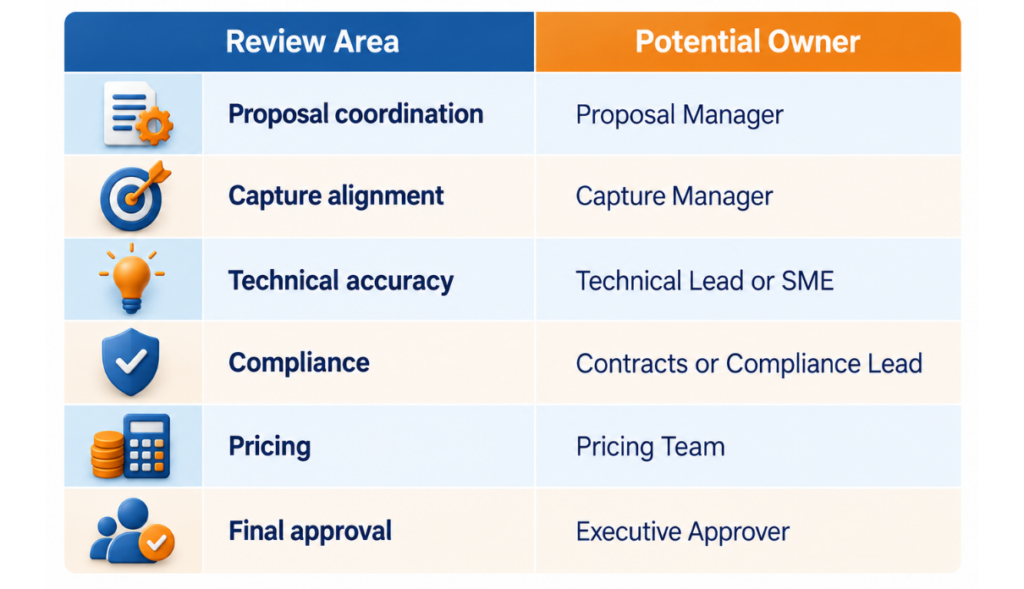
Smaller contractors may combine several responsibilities. What matters is that ownership remains clear and the required checks are completed.
It also helps to distinguish between three types of review:
Content review: Is the solution accurate, technically sound, and clearly presented?
Compliance review: Does the proposal follow the solicitation’s requirements?
Production review: Are the final files formatted, named, and prepared according to the submission instructions?
These reviews address different risks. Treating them as one task can leave important issues unresolved.
The Most Common Mistake: Treating Compliance as a Final-Day Task
A final checklist is valuable, but it should not be the first time your team reviews compliance.
When requirements are checked only at the end, problems such as missing attachments, conflicting staffing information, incomplete forms, and incorrect formatting may be discovered too late.
Some corrections can require substantial rewriting or coordination between multiple teams.
A final checklist is a safeguard, not a replacement for continuous compliance management.
The earlier your team identifies requirements and assigns ownership, the more manageable the final review becomes.
For a broader look at the proposal workflow, explore the government RFP response process.
When Should You Use Outside Proposal Support?
Internal teams may need additional proposal support when they are managing multiple bids, complex solicitation requirements, or tight submission timelines.
External support can help when your company has limited proposal capacity, needs additional compliance review resources, or requires structured coordination between technical subject matter experts and proposal personnel.
The appropriate level of support depends on your requirements, internal capabilities, and available time.
If your team needs help coordinating proposal development and final review, explore Contragenix Proposal Development Services.
Conclusion: Is Your Proposal Ready for Submission?
A completed proposal is not automatically a submission-ready proposal.
Before submitting, review the solicitation requirements, evaluation criteria, proposal volumes, required documents, pricing, and final file package.
The objective is to reduce avoidable compliance and submission errors while ensuring that your response accurately represents your company’s proposed solution.
Ask one final question:
Does the proposal meet the solicitation’s requirements, address the evaluation criteria, remain consistent across volumes, and follow the exact submission instructions?
If your team needs additional support with proposal development and compliance review, connect with Contragenix.