


Q1 looked productive. But did it actually convert?
Pipelines were full. Submissions were steady. The team stayed busy.
But for many contractors, wins didn’t follow.
That gap between effort and outcomes isn’t bad luck; it’s misalignment.
Reality Check
High activity ≠ high win rate
More submissions don’t improve your odds if qualification and alignment are weak. In high-density competitions, volume without strategy often reduces your overall win probability.
What Actually Impacted Your Win Rate in Q1
If Q1 felt harder than expected, it’s because the environment quietly shifted.
Award cycles slowed, pushing decisions further out and reducing the number of wins that could realistically close within the quarter. At the same time, competition intensified, with more vendors pursuing fewer, often consolidated opportunities.
In several sectors, LPTA made a return. That changed the equation; pricing began influencing outcomes earlier, leaving less room for technical differentiation to carry proposals.
Compliance expectations also tightened. Agencies are placing greater emphasis on responsiveness, formatting precision, and strict FAR alignment. What used to be minor gaps are now enough to take a proposal out of contention.
Most importantly, evaluation behavior has become more cautious. Agencies are prioritizing vendors that feel predictable and low risk. Strong solutions are not enough if they introduce uncertainty.
These shifts didn’t just make Q1 competitive.
They changed how decisions are made.
Why Effort Didn’t Convert
The issue wasn’t capability. It was how that capability was applied.
Many teams responded to a tougher market by increasing volume, more bids, more submissions, and more activity. But without a clear qualification strategy, that approach diluted focus instead of improving outcomes.
A consistent pattern emerged. Proposals were technically sound but not aligned with evaluation criteria. They explained what the contractor could do, but didn’t clearly show how that mapped to how the agency scores.
Past performance was often treated as a requirement, not a differentiator. Experience was included but not positioned to demonstrate relevance or reduce evaluator risk. Pricing decisions were addressed late, especially in LPTA scenarios where early alignment is critical.
There was also a disconnect between what was proposed and how the work would actually be delivered. Evaluators notice that, and in a risk-sensitive environment, even small doubts are enough to lose.
Effort created activity.
Alignment drives wins.
Busy vs Winning Contractors
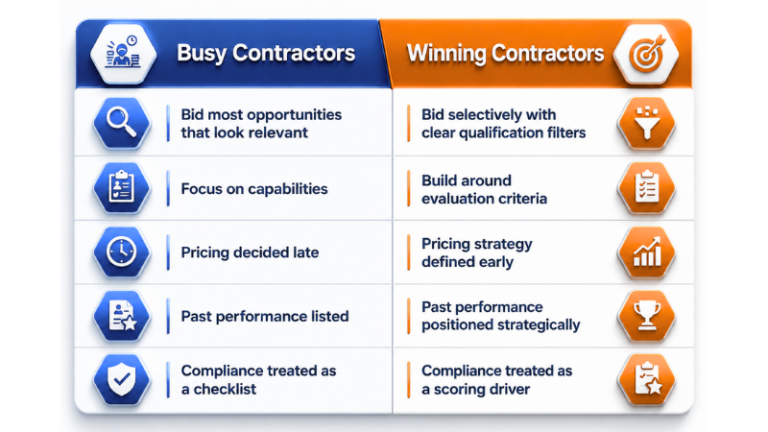
The difference wasn’t effort.
It was precision in decision-making.
Quick Case Insight
A mid-sized contractor doubled proposal volume in Q1 and didn’t win a single award.
In the previous quarter, with fewer bids, they had a strong win rate. The difference wasn’t capability or market conditions. It was discipline. As volume increased, qualifications dropped, and so did results.
Q2 Success Playbook
If Q1 didn’t convert, Q2 requires a different approach, not more effort, but better decisions.
Start by tightening your pipeline. Be clear about what you will not bid. Every pursuit should have a reason to win, not just a reason to try.
Set your pricing strategy early, especially in LPTA or cost-sensitive environments. Late adjustments rarely fix misalignment.
Strengthen compliance reviews beyond surface-level checks. Every requirement should be addressed clearly, directly, and in a way that aligns with how evaluators read proposals.
Rework how you present past performance. Focus on relevance, outcomes, and risk reduction, not just experience.
Align proposal and execution teams before submission. What you promise should reflect how the work will actually be delivered. That’s where credibility is built.
Finally, track patterns. Not how much you’re bidding, but why you’re winning or losing. Without that insight, improvement is guesswork.
Q2 is not about increasing activity.
It’s about increasing conversion.
The Shift Most Teams Are Missing
Federal contracting is tightening.
There are fewer opportunities, more competition, stricter compliance expectations, and a stronger preference for vendors who feel predictable in execution. In this environment, effort alone doesn’t differentiate you.
Alignment does.
Strategic Insight
Winning in federal contracting isn’t about doing more; it’s about doing the right opportunities, the right way.
That requires structure in how you qualify opportunities, alignment with evaluation criteria, and a consistent focus on reducing evaluator risk.
Final Thought
If your Q1 didn’t convert, that’s not just a result; it’s a warning.
Q2 will reward precision. Not activity.