

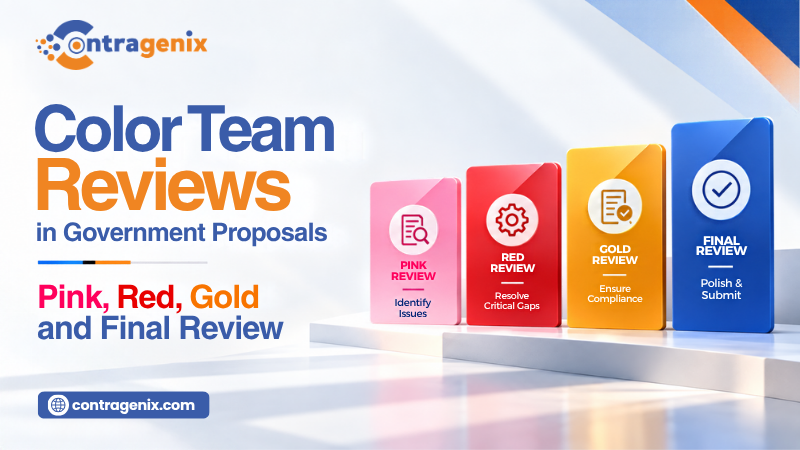
Color Team Reviews in Government Proposals: Pink, Red, Gold and Final Review
A federal proposal can look excellent to the people who wrote it and still have serious problems.
Section L may contain an instruction that was only partially answered. A response may address a technical requirement but miss what Section M says the government will evaluate. A win theme may appear in the executive summary and then disappear from the technical volume. A past performance claim may sound impressive without enough evidence behind it. Two volumes may even describe the solution differently.
These problems are difficult to spot when everyone has been staring at the same draft for weeks.
That is where color team reviews can help.
Color team reviews are structured internal reviews used by many federal contractors to examine a proposal from different perspectives before submission. Pink, Red, Gold, and final compliance reviews typically focus on different questions, from whether the proposal is heading in the right direction to whether the final package actually satisfies the solicitation. They are contractor-side proposal management practices, not universal federal government requirements. The solicitation and its instructions remain the controlling source for what must be submitted.
What Are Color Team Reviews?
Color team reviews are staged proposal reviews designed to catch problems at different points in the development process.
The exact colors, names, timing, and sequence vary between organizations. Some contractors use pink, red, and gold teams exactly as described here. Others combine stages or use different terminology.
The underlying idea is more important than the color.
A useful proposal review asks whether the team is answering the solicitation, addressing the stated evaluation criteria, presenting a credible solution, supporting its claims, and making the information easy for an evaluator to find and understand.
It also looks for something a proofreading pass cannot reliably catch: strategic disconnects.
A proposal can be grammatically perfect and still fail to explain why its approach addresses the government’s priorities. It can be compliant in appearance while leaving a reviewer unsure where a requirement was addressed. Color team reviews create deliberate points in the process where those issues can be challenged.
The common progression is Pink → Red → Gold → Final Compliance, although contractors may adapt that sequence to fit their proposal process.
Why Federal Proposal Teams Use Colour Reviews
The value of a color team proposal review comes from changing the perspective at different stages.
The person writing a technical section may know exactly what they intended to communicate. That familiarity can make it harder to recognize where an evaluator might become confused. A technical SME may focus heavily on whether the solution is technically sound while overlooking a page limitation. A capture manager may understand the customer extremely well but miss a formatting or compliance issue buried in another volume.
A structured review brings those different perspectives into the proposal before submission.
Timing matters, too. A structural problem discovered during early drafting may take hours to correct. The same problem discovered two days before submission can force major rewrites across multiple volumes.
The earlier a major proposal problem is discovered, the easier it generally is to address.
That does not mean color team reviews guarantee a contract award. They are a quality-control and decision-support mechanism. Their purpose is to improve the proposal before the government evaluates it.
Pink Team Review: Is the Proposal Going in the Right Direction?
The Pink Team is generally an early-stage review conducted while the proposal is still taking shape.
At this point, the team should be thinking about the architecture of the response rather than polishing individual sentences.
The review should examine whether the proposal has a sound response strategy, whether the outline supports the solicitation, whether the planned solution addresses the customer’s requirements, and whether the team has identified the evidence needed to support its claims.
Section L instructions and Section M evaluation factors deserve particular attention.
Consider a solicitation where Section M places significant emphasis on transition risk. If the developing proposal dedicates most of its planned content to staffing qualifications but gives little attention to transition, the problem is strategic. A Pink Team review has an opportunity to identify that mismatch before the team spends days refining the wrong material.
The same applies to win themes and differentiation. If the team says its approach reduces implementation risk, the proposal structure should give the writers a clear path to proving that claim.
The Pink Team question is straightforward:
Are we building the right proposal before we spend too much time polishing it?
This is not the stage for spending most of the review time fixing commas, sentence structure, or minor formatting issues. Those things matter later. At this stage, direction matters more.
Red Team Review: Would an Evaluator Be Convinced?
The Red Team is generally a more mature, evaluator-style review. This is where the proposal needs to be challenged from outside the perspective of the people who created it.
Instead of asking whether the team likes the proposal, reviewers should ask what a government evaluator would understand, question, score, or fail to find.
That distinction is critical.
A strong Red Team proposal review examines the response against the solicitation’s evaluation criteria. It looks at whether the proposal demonstrates customer understanding, whether the solution is credible, whether claimed strengths are supported by evidence, and whether the response clearly differentiates the contractor.
It should also expose weaknesses that the writing team may have become blind to.
For example, a proposal might state that its transition approach minimizes operational disruption. That sounds reasonable. But what demonstrates it? Is there a transition methodology? Are responsibilities defined? Are risks identified? Is there evidence from relevant past performance? Does the response explain how the approach addresses the government’s actual concern?
The Red Team should push beyond statements and look for proof.
It should also look at readability and consistency. If the management volume promises one staffing model while the technical volume describes another, an evaluator may be left with questions about how the solution would actually operate.
Where practical, reviewers who were not heavily involved in drafting a particular section can provide a useful outside perspective. They are less likely to fill in missing information from their own knowledge of the proposal.
The goal is not to make the proposal sound impressive to the internal team.
The goal is to determine whether the proposal communicates effectively to the evaluator who will actually read it.
Gold Team Review: Is the Proposal Ready for Final Approval?
The Gold Team generally occurs later, when the proposal is approaching its final form.
There is no single universal definition of a Gold Team, so organizations may use this stage differently. In many proposal environments, the focus shifts from detailed drafting concerns toward strategic alignment, unresolved issues, executive-level decisions, and overall readiness.
By this point, major Red Team findings should have been addressed or have a clear disposition.
The Gold Team may examine whether the final solution positioning remains aligned with the capture strategy, whether commitments are supportable, whether pricing and the technical approach remain consistent, and whether any significant risks are still unresolved.
This is not simply another Red Team.
The question has changed.
The team is no longer primarily asking, “What is wrong with this proposal?”
It is asking whether the proposal has progressed from a good draft to a package that is ready for final approval.
For contractors that do not use a formal Gold Team, these objectives may be handled through an executive review, leadership approval meeting, or another final decision process.
Final Compliance Review: The Last Check Before Submission
A proposal can be persuasive and still be noncompliant.
That is why the final compliance review should be treated differently from an editorial review or an evaluator-style review.
At this stage, the team needs to return to the actual solicitation and verify the submission requirements rather than relying on assumptions about what has been covered.
The review should confirm requirements such as Section L instructions, Section M evaluation criteria, page limits, required forms, attachments, signatures, certifications, representations, file formats, volume structure, naming conventions, pricing volumes, permitted hyperlinks, portal requirements, and the actual submission deadline.
The question is simple:
Can we submit this proposal exactly as the solicitation requires?
This is where a contractor’s federal RFP response process and proposal compliance discipline come together.
A final compliance check should also verify that comments from earlier reviews were actually incorporated. A comment marked “resolved” in a tracker does not automatically mean the underlying issue was fixed correctly in the proposal.
The final package needs to be checked, not assumed.
Who Should Participate in a Color Team Review?
The right review team depends on the proposal.
A complex technical proposal may require technical SMEs, a proposal manager, capture leadership, contracts, pricing, and compliance expertise. Another proposal may be small enough for several responsibilities to sit with the same people.
What matters is that each reviewer has a defined purpose.
A proposal review becomes inefficient when everyone comments on everything. One reviewer may focus on compliance while another evaluates technical credibility. An executive may concentrate on strategic positioning and commitments. A pricing lead may look for disconnects between the proposed solution and the cost structure.
The proposal manager should establish what each review is intended to accomplish before reviewers begin.
A room full of people giving unrelated comments is not necessarily a stronger review process. It can create comment overload, conflicting recommendations, and unnecessary rework.
The best reviews are deliberate.
Common Problems Color Team Reviews Identify
One common problem is a proposal that answers the requirement but misses the evaluation factor.
The writer may technically respond to the RFP, but the response does not demonstrate why the approach matters under the government’s stated evaluation criteria. A Red Team review can expose that gap.
Another problem is a win theme that appears once and disappears.
The executive summary may claim that the contractor provides a lower-risk transition, faster implementation, or a more mature technical approach. But if the rest of the proposal does not provide evidence for that position, the theme becomes a statement rather than a differentiator.
Evidence is another frequent issue.
A contractor may describe deep expertise, exceptional performance, or a highly effective methodology without providing enough relevant examples, metrics, past performance, or other support. Reviewers should challenge claims that sound strong but are difficult to verify from the proposal itself.
Compliance can also be assumed instead of demonstrated.
A writer may know that a requirement was addressed somewhere in the response. The evaluator should not have to know that. The answer needs to be clear and findable.
Consistency matters as well. The technical approach, management approach, staffing plan, past performance, and pricing should describe the same underlying solution. If they do not, the problem is larger than an editing error.
Finally, review comments that arrive too late can create their own risk. A major structural issue discovered immediately before submission leaves little time for rewriting, SME validation, formatting, and another compliance check.
Building a Strong Proposal Review Schedule
There is no universal number of days that should separate each review. Proposal schedules vary based on solicitation complexity, page count, team size, submission requirements, and available resources.
A better approach is to work backward from the submission deadline.
The logic is:
Submission deadline → final compliance → final production → Gold/approval → Red Team → Pink Team → drafting
Each review needs time not only for comments but for what happens afterward.
The team needs time to evaluate the feedback, make decisions, rewrite content, obtain SME validation, resolve compliance issues, format the final volumes, and verify that changes did not introduce new problems.
A review is not complete when reviewers submit their comments.
It is complete when the team has properly evaluated, resolved, incorporated, and verified those comments.
That distinction can make a major difference in compressed federal proposal schedules.
How Color Teams Fit Into the Federal Proposal Process
Color team reviews are one part of the broader proposal lifecycle.
A typical contractor-side process may move from Capture → RFP Release → Kickoff → Compliance Matrix → Drafting → Pink → Red → Gold → Final Compliance → Submission.
The exact workflow varies, but the principle remains the same: proposal reviews should occur at points where the team can still act on what the reviewers find.
This is why color teams should not be treated as isolated meetings. They work best when they are built into the larger federal RFP response process.
The solicitation remains the source of truth. Color teams are the contractor’s mechanism for testing whether the developing response is strategically sound, evaluator-focused, consistent, and submission-ready.
When Should Contractors Use Outside Proposal Support?
External proposal support can be useful when the internal team is too close to the content to provide an objective review.
It can also help when multiple volumes need coordination, compliance requirements are complex, deadlines compress the review schedule, or leadership wants an independent perspective before submission.
Outside reviewers do not replace the contractor’s subject-matter expertise. They add another perspective to the process.
For contractors managing high-stakes federal proposals, that distinction matters. The strongest review process brings together customer understanding, capture strategy, technical knowledge, compliance discipline, and an evaluator’s perspective without allowing any one perspective to dominate the entire proposal.
Contragenix supports federal contractors with proposal development, compliance, writing, reviews, and submission preparation. Learn more about federal proposal development services.
The Bottom Line
Color team reviews work best when every review has a specific job.
Pink should help the team determine whether it is building the right proposal. Red should challenge whether the proposal will communicate effectively to an evaluator. Gold should help determine whether the near-final proposal is ready for approval. Final compliance should verify that the submission meets the solicitation’s actual requirements.
The colors themselves are less important than the discipline behind them.
A proposal review should not be a ceremonial meeting held because the schedule says “Red Team.” It should be an opportunity to find problems while the team still has time to fix them.
For federal contractors, that means connecting strategy, compliance, evaluator perspective, technical content, and review discipline before the proposal reaches the submission portal.
That is what turns a collection of drafted volumes into a submission-ready proposal.