


A High Win Rate Can Hide a Weak Growth Strategy
A contractor can celebrate a strong win rate at the end of the quarter and still have a serious problem with its growth strategy.
The company may be winning contracts consistently, but those contracts might be too small to support its revenue targets. It may be securing work from the same agency year after year while making little progress toward expanding its customer base. It may be winning opportunities that stretch its delivery team, produce thin margins, or leave little room to pursue the next stage of growth.
None of those problems necessarily shows up in a win-rate report.
Win rate is an important measure of competitiveness. It can tell leadership whether the company is selecting opportunities carefully and whether its pursuit strategy is producing results. But winning contracts and building a healthy government contracting business are two different outcomes.
A company needs to do more than win. It needs to win the right work, at the right time, under conditions that support its long-term objectives.
That distinction is where a growth strategy begins.
The next challenge is competing for the actual work.
A federal task order proposal is the contractor’s response to an individual order opportunity issued under an existing contract vehicle. It must address the specific requirement, evaluation criteria, submission instructions, technical expectations, staffing needs, and pricing requirements established for that opportunity.
For contractors pursuing IDIQ task order proposals, success depends on treating every order as a distinct competition. The original vehicle proposal may establish relevant qualifications, but the task-order response must demonstrate why the company’s capabilities and proposed solution fit the work currently being solicited.
What Your Win Rate Actually Tells You
Win rate is commonly used to evaluate business development and proposal performance. Depending on how a contractor calculates it, the metric may represent awarded opportunities divided by submitted bids, wins divided by completed pursuits, or another internally defined measure.
The calculation matters because different methodologies can produce very different interpretations.
A contractor that withdraws from opportunities after identifying unfavorable conditions may report a different win rate from one that counts every pursuit entered into its pipeline. A company tracking task orders may also have a different picture from one measuring major contract awards.
A high win rate can indicate disciplined opportunity selection, strong customer relationships, competitive positioning, and effective proposal execution. Those are meaningful advantages, particularly for small businesses that cannot afford to pursue every solicitation that appears relevant.
But win rate does not tell leadership how much revenue those awards will generate, how profitable the work is, how long the contracts will last, or whether the business is developing new customers.
It measures an outcome within a defined set of pursuits. It does not measure the health of the entire business.
That distinction becomes important when leadership starts using win rate as evidence that its business development strategy is working.
The Problem with Measuring Wins in Isolation
Not every contract award moves a company closer to its growth objectives.
Imagine a federal contractor that wins several small assignments in a year. The awards are legitimate successes, and the company has a respectable win rate. However, the combined revenue from those contracts may not be sufficient to support its hiring plans, investment in new capabilities, or long-term revenue targets.
Now consider another contractor that wins fewer opportunities but secures a longer-term contract with a stronger revenue contribution, a reasonable delivery structure, and opportunities to develop relevant experience in a market it intends to enter.
The number of wins alone does not tell leadership which business development strategy is working better.
Contract value matters, but it should not be treated as the only measure of opportunity quality. A larger award may require substantial upfront investment, additional personnel, expensive compliance obligations, or operational commitments that reduce its attractiveness. A smaller contract may provide valuable past performance, establish a new customer relationship, or serve as a deliberate entry point into a federal market.
The real question is whether the award supports the company’s financial, operational, and strategic objectives.
If a contractor repeatedly wins work that keeps it busy but does little to improve its position, leadership needs to look beyond the celebration of award notices. The business may be performing well at pursuing contracts while making limited progress toward the company it intends to become.
A Full Pipeline Is Not Necessarily a Healthy Pipeline
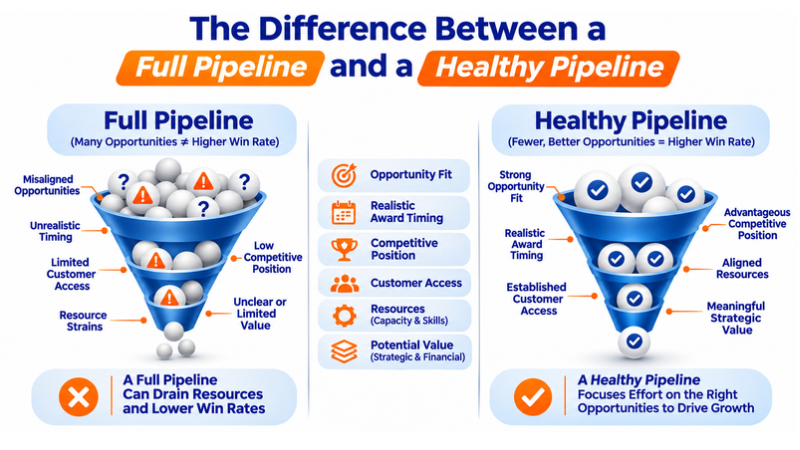
A pipeline full of opportunities can create the impression that future growth is secured. Yet pipeline volume is one of the easiest business development indicators to misinterpret.
The problem is not necessarily a shortage of opportunities. It may be the quality of the opportunities being tracked.
Some pursuits have an unclear funding path. Others have estimated award dates that keep moving, limited customer engagement, weak competitive positioning, or requirements that fall outside the contractor’s strongest capabilities. Opportunities may remain in the pipeline long after the business has any realistic reason to expect an award.
A large pipeline can therefore create confidence without providing a reliable picture of future revenue.
Contract pipeline management should involve more than tracking solicitation dates, estimated award values, and pursuit stages. Leadership needs to understand how credible each opportunity is, whether the company has a competitive reason to pursue it, and what resources it will require to move forward.
There is also a cost to pursuing opportunities that are unlikely to produce meaningful results. Capture time, proposal labor, pricing analysis, technical resources, management attention, and subcontractor coordination all consume capacity that could be directed toward better-qualified pursuits.
A business development team should not be rewarded simply for keeping the pipeline full. It should be building a pipeline that gives the company a realistic path toward its future objectives.
Sometimes that means pursuing fewer opportunities. Sometimes it means investing earlier in customer engagement, improving competitive intelligence, strengthening teaming relationships, or declining a solicitation that looks attractive on paper but offers little strategic value.
The quality of the pipeline matters far more than the confidence its size creates.
The statement of work or performance work statement establishes what the contractor is expected to deliver. Submission instructions establish how the response must be organized and delivered. Evaluation criteria explain the stated basis on which proposals will be assessed.
These elements should be reviewed together rather than independently.
A requirement that appears technically straightforward may involve demanding staffing qualifications, transition responsibilities, reporting obligations, security requirements, or delivery schedules. Missing one of these elements can create inconsistencies throughout the response.
Contractors should also review the applicable vehicle’s ordering procedures. FAR Part 16.505 addresses ordering under indefinite-delivery contracts, but the applicable contract terms and solicitation determine the specific process for a particular opportunity.
For contractors developing a response, a structured government proposal compliance checklist can help organize requirements and track whether the response addresses the instructions.
The objective is to understand the complete requirement before deciding how to compete.
Winning Work Your Business Cannot Deliver
Winning a contract is the beginning of a delivery obligation, not the end of a business development effort.
A contractor pursuing aggressive growth may overlook the resources required to execute new work. Staffing plans may assume personnel can be recruited quickly. Subcontractors may be expected to provide capabilities without sufficient availability. Existing managers may already be responsible for multiple projects, and the business may have limited experience handling a larger or more complex program.
These concerns do not necessarily mean the opportunity should be rejected. They mean the business needs to understand what winning will require before committing.
A contract that requires rapid mobilization, specialized personnel, substantial infrastructure, or significant management oversight may have consequences beyond its projected revenue. If the company cannot meet its obligations, the strain may affect performance, customer confidence, existing contracts, and future opportunities.
Growth should expand a contractor’s ability to deliver, not expose weaknesses that undermine the work it has already won.
For leadership, this means bringing operational considerations into business development decisions early enough to influence them. Capture and proposal teams should understand what the company can realistically support, where capability gaps exist, what investments may be necessary, and whether the anticipated contract economics justify those investments.
Winning work the business can execute successfully is a stronger measure of progress than winning work that simply adds another award to the quarterly report.
When Customer Concentration Becomes a Strategic Risk
A strong customer relationship can be one of a contractor’s greatest advantages.
Working repeatedly with the same agency may allow a business to understand its mission, develop relevant past performance, build trust, and identify opportunities that align with its capabilities. For a small contractor, concentrating resources on one customer or market may be a deliberate and sensible way to establish itself.
The risk emerges when the company becomes dependent on that relationship without recognizing how much of its future depends on it.
If a major contract ends, funding changes, priorities shift, or a recompete produces a different outcome, a contractor with significant customer concentration may have limited alternatives. The effects can extend beyond lost revenue. They may influence staffing, cash flow, hiring decisions, subcontractor commitments, and the company’s ability to invest in new pursuits.
Customer concentration is not automatically a strategic failure. It becomes a concern when leadership cannot explain its exposure or has no credible plan for managing it.
A contractor does not need to pursue every agency to reduce concentration risk. Entering a new market without understanding its buying environment, competition, contract vehicles, past performance requirements, and customer needs can create a different set of problems.
Diversification should be deliberate. The objective is not to spread the business across as many customers as possible. It is to build a revenue base that aligns with the company’s capabilities and provides a reasonable degree of resilience.
A high win rate within one customer environment may be a genuine competitive advantage. Leadership should still understand what happens to the business if that environment changes.
Recompetes, New Customers, and the Quality of Future Revenue
Federal contracting businesses often spend significant time protecting existing revenue. Recompetes matter. Retaining a contract can preserve employees, revenue, customer relationships, and operational continuity.
But protecting today’s revenue can become a distraction if it consumes the attention required to build tomorrow’s pipeline.
A contractor may have a strong current portfolio while several important contracts approach expiration. It may depend on successful recompetes to maintain its revenue base, leaving little room for growth if one or more awards are lost. Alternatively, the business may have a strong backlog but limited visibility into what will replace it.
The issue is not that recompetes are inherently risky or that every contractor needs to pursue new customers constantly. The issue is whether leadership understands how current revenue connects to future revenue.
A growth strategy should account for contract duration, renewal and recompete timelines, customer relationships, follow-on potential, and the time required to develop new opportunities. It should also consider whether the company is building capabilities and past performance that position it for opportunities beyond its existing portfolio.
New-customer development often takes time. Waiting until a contract is nearing expiration to begin pursuing another market can leave a business reacting to revenue pressure rather than making deliberate strategic decisions.
The strongest business development organizations are not simply trying to replace contracts as they expire. They are positioning the company for what comes next while managing the work it already has.
The Metrics Leaders Should Read Alongside Win Rate
Win rate becomes more useful when leadership considers it alongside the indicators that explain the company’s broader business development position.
Qualified pipeline value, for example, helps reveal whether the business has enough credible opportunities to support its future objectives. But the value of that pipeline should be considered alongside opportunity maturity, expected award timing, competitive positioning, and the likelihood that the company can realistically pursue and win the work.
Contract profitability adds another layer. A contract may generate substantial revenue without contributing the financial return leadership expected. Staffing costs, subcontractor expenses, execution requirements, pricing decisions, and the investment needed to deliver can influence whether an award is commercially worthwhile.
Customer concentration provides insight into revenue exposure. Recompete schedules help identify where current revenue may be vulnerable. New-customer acquisition indicates whether the business is expanding its relationships or relying primarily on existing ones. Delivery capacity helps determine whether the company can absorb additional work without compromising execution.
These indicators should not become another dashboard of numbers that leadership reviews without changing decisions. Their purpose is to help executives understand why the business is winning, what those wins are contributing, where future revenue may be vulnerable, and whether the company’s pursuit strategy is aligned with its capabilities.
A contractor with a modest win rate and a carefully qualified pipeline of strategically relevant opportunities may be in a stronger position than one with a higher win rate and limited visibility into future revenue.
The metrics are useful because of the decisions they inform, not because they look impressive in a report.
The Better Question Is Not How Many Contracts You Won
A high win rate deserves recognition. It may reflect a disciplined team, strong proposal execution, sound customer positioning, and the ability to compete effectively in the federal marketplace.
But leadership should not stop there.
The more important question is whether the opportunities the company pursues, and the contracts it wins, are building the business it intends to operate in the future.
Are the awards strengthening the company’s financial position? Are they helping establish new customer relationships or deepen strategically valuable ones? Are they developing capabilities the business can use again? Does the pipeline support future revenue, or is it primarily a collection of hopeful pursuits? Can the organization deliver the work without compromising existing commitments?
These are growth strategy questions. They cannot be answered by win rate alone.
For federal contractors evaluating their next stage of growth, the discipline begins before the solicitation arrives. It requires a clear understanding of which customers to pursue, what opportunities fit the business, where the company can compete credibly, and how each pursuit contributes to its longer-term position.
Contragenix supports government contractors with proposal development, capture and bid strategy, and government contracting support to help businesses approach federal opportunities with greater discipline and strategic alignment. If your team is evaluating its next opportunities or strengthening its pursuit strategy, explore Contragenix’s proposal development services.
Winning contracts is an important part of growth. Building a business that can sustain, deliver, and capitalize on those wins is what makes the growth strategy worth pursuing.