

Introduction
Have you ever had an interesting project stalled for months simply because your site plan was caught under a local stormwater management ordinance? If so, you’re certainly not alone. Real estate developers are increasingly finding out that water, not zoning, not financing, is the biggest obstacle to their project schedule.
The problem is that stormwater regulations aren’t made at the federal level just once. They are multi-layered. You have the federal permit, which is your baseline; on top of that, your state applies additional conditions, and finally, your locality adds yet another layer of conditions, which may even be different than what your neighboring town requires. Failure to spot all those layers during the design stage will mean having to redo designs, resubmit designs, and submit the construction stormwater permit application back to the reviewer’s desk several times.
This blog breaks down exactly what US real estate developers need to know about stormwater compliance from NPDES stormwater permit basics to detention ponds, low impact development, and the fees that show up on your closing statement. By the end, you will have a clear, practical framework for navigating stormwater regulations for developers . All technicalities covered.
The US Stormwater Management Ordinance Framework: Why Rules Change by ZIP Code

Each stormwater management ordinance in the country derives from the same federal legislation known as the Clean Water Act; however, it is precisely for this reason that the ordinances are so varied.
How the Clean Water Act Sets the Floor, Not the Ceiling
The Clean Water Act created the National Pollutant Discharge Elimination System (NPDES), which regulates stormwater discharges from construction sites, industrial activity, and municipal storm sewer systems. Most states are authorized to run their own version of the NPDES program, which means your state environmental agency not just the EPA is often the one issuing your paperwork. You can review the federal framework directly on the EPA’s NPDES Stormwater Program page.
The tricky part is that the federal and state guidelines just establish a minimum standard. The city, county, or watershed districts are allowed to impose additional requirements. A plan that is approved by the state may not be approved at the local level if it doesn’t satisfy additional local stormwater guidelines.
Why Local Stormwater Ordinance Requirements Vary So Much
The municipal governments craft their own ordinances depending upon history, sensitivity of the watershed, and capacity of the infrastructure. The ordinance will be vastly different in a coastal city fearing combined sewer overflows as compared to an inland suburb worried about flash flooding (as per FEMA). Therefore:
- Detention and retention sizing standards differ by jurisdiction
- Impervious surface thresholds that trigger review are not standardised
- Some municipalities require green infrastructure (LID); others simply require volume control
- Review timelines and fee schedules vary by department
The takeaway: never assume the ordinance from your last project applies to your next one, even if it is in the same state. Always start with a pre-application meeting at the local level before you finalize your site plan.
Stormwater Permits Every Real Estate Developer Must Secure
In addition to the permits needed for development projects, several other permits may be required prior to any movement of dirt. Being aware of the necessary permits will keep your project schedule on track.
NPDES Stormwater Permit: The Federal Backbone
The NPDES stormwater discharge permit is the overarching permit that you need whenever your project discharges stormwater into the waters of the US. This permit is issued by your state environmental agency and not by the EPA itself.
MS4 Permit: What It Means When You Build in a Regulated City
If your project sits inside a city or county with a regulated Municipal Separate Storm Sewer System, the local government itself holds an MS4 permit. That permit obligates the municipality to control pollutants entering its storm sewers which is exactly why your development must meet local stormwater management plan requirements before you connect to, or discharge into, that system. In practice, this is the permit layer that produces most of your local site plan conditions.
Construction Stormwater Permit Thresholds
Indeed, almost all the states adhere to this principle, whereby the issuance of construction stormwater permit must take place after one acre or more of land is disturbed. In some localities, the level of disturbance can be below an acre, hence the need to check the level of disturbance within the locality first.
SWPPP: Turning Your Construction Stormwater Permit into an Action Plan
The Stormwater Pollution Prevention Plan (SWPPP) is the operational plan associated with the stormwater permit required for your project. It includes information about which erosion and sediment controls will be installed at the job site, who will perform inspections, and how the stabilization of the job site will take place after construction is completed. The plan should reflect the actual installation on-site; discrepancies are among the quickest methods to receive a stop work order.
Building a Stormwater Management Plan That Passes Site Plan Review
A sound stormwater management plan will be your one document that gets you to the approval stage for your project. Do it correctly, and everything else flows easily afterwards.
Core Elements of a Stormwater Management Plan
Most jurisdictions expect a stormwater management plan to include:
- Existing and proposed drainage patterns
- Pre- and post-development runoff calculations/modelling
- Selected BMPs and their sizing calculations
- An operations and maintenance plan for permanent facilities
- Erosion and sediment control measures for the construction phase
Impervious Surface Requirements: The Number That Drives Your Design
Requirements for impervious surface may be the only thing which is going to determine how much detention or retention you need on your property. All roof tops, driveways, parking areas, and even compacted gravel areas may go towards your impervious surface area requirements under most ordinances. Because the amount of water and its flow rate vary directly with the impervious surface area, reducing paved surface area may help reduce detention/ retention/ LID facility size.
What Reviewers Look for During Site Plan Stormwater Review
Municipal reviewers tend to flag the same issues again during site plan stormwater review:
- Undersized detention or retention volume compared to the ordinance's design storm
- Missing or incomplete pre-development versus post-development comparisons
- BMPs placed in locations that conflict with utilities or easements
- No clear long-term maintenance responsibility named in the plan
Catching these issues internally, before submission, is far cheaper than a second review cycle.
Detention, Retention, and BMP Requirements Explained
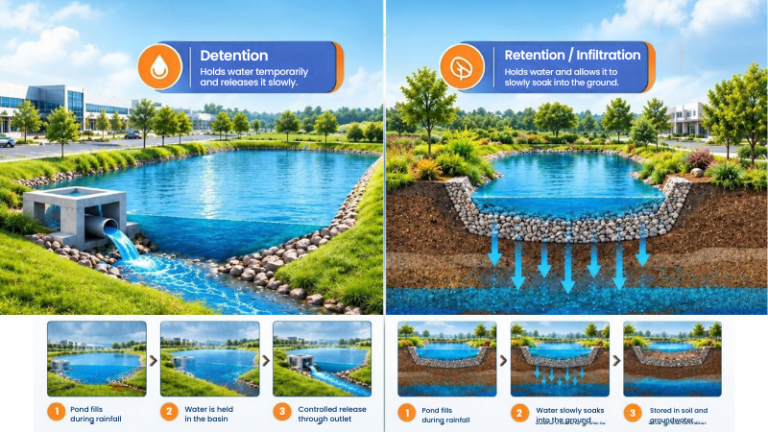
This is where most local stormwater ordinance requirements get technical and where developers often need their engineer (PE) to translate jargon into plain decisions.
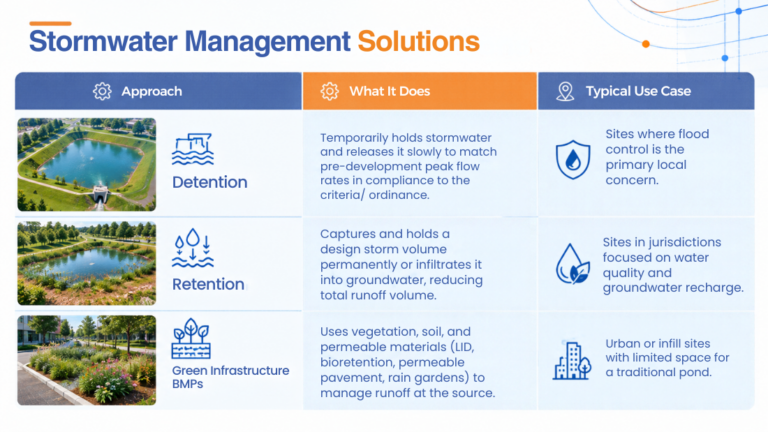
Stormwater Detention Requirements
Stormwater detention requirements generally focus on rate control keeping the peak discharge from your developed site at or below the rate that existed before construction, for a specific design storm (commonly a 2-year, 5-year, 10-year and/or a 25-year event, though this varies locally and in compliance to the criteria/ ordinance).
Stormwater Retention Pond Requirements
Whereas stormwater retention pond regulations change the emphasis from the rate of discharge to the amount of water stored in the pond, where the pond holds a particular volume of water that corresponds to a certain percentile of rain event defined by the local regulations.
Matching Stormwater BMP Options to Your Site
Selecting an appropriate stormwater BMP involves several factors such as soil characteristics, available land area, maintenance capability, and the ordinance of your locality. An infill site located in a downtown location with limited open area would be inappropriate for the installation of a wet pond but could well be a good choice for underground or bioretention methods. A suburban area with more land might benefit from the conventional detention pond approach.
Low Impact Development and Post-Construction Stormwater Management
Regulators across the country are steadily shifting away from “pipe it all to a pond” thinking and toward managing water closer to where it falls.
LID Techniques Gaining Ground with Developers
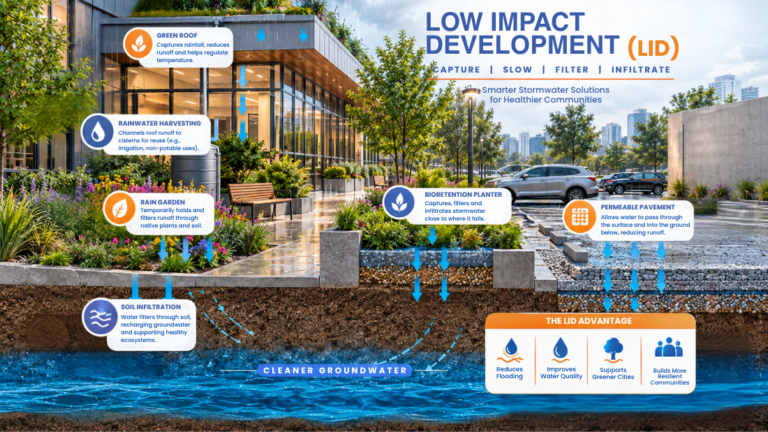
Low impact development (LID) treats stormwater management as a design feature rather than an afterthought. Common LID techniques include:
- Bioretention and rain gardens — vegetated areas that filter and slow runoff
- Permeable pavement — lets water soak through parking areas instead of running off
- Green roofs — absorb rainfall before it ever reaches the ground
- Rainwater harvesting — captures roof runoff for irrigation or non-potable reuse
Many municipalities now offer credit toward your required stormwater volume when you incorporate LID, which can shrink the footprint needed for a traditional pond and free up developable land. The EPA’s green infrastructure resources are a useful starting point for understanding how these practices are evaluated.
LID Techniques Gaining Ground with Developers
Post-construction stormwater management does not end when the certificate of occupancy is issued. Most ordinances require:
- A recorded operations and maintenance (O&M) agreement tied to the property
- Periodic inspection and maintenance of BMPs, ponds, or LID features
- Reporting to the local jurisdiction on request
Failing to maintain these systems can trigger code enforcement action well after your project has sold or leased out so make sure the maintenance obligation, and who holds it (developer, HOA, or property manager), is clearly documented before you close out the project.
Stormwater Utility Fees and Erosion and Sediment Control Permits
Two items catch developers off guard more than almost anything else in the stormwater process:
- Ongoing fees and
- Construction-phase erosion control.
How a Stormwater Utility Fee Is Usually Calculated
A growing number of municipalities charge a stormwater utility fee, billed similarly to a water or sewer bill, to fund the maintenance of public drainage infrastructure. This fee is typically based on the amount of impervious surface on a parcel more rooftop and pavement generally mean a higher fee. Because this is a recurring operating cost, not a one-time permit charge, it is worth factoring into your pro–forma early rather than discovering it after stabilization.
Erosion and Sediment Control Permit Requirements During Construction
An erosion and sediment control permit controls how your construction site will handle any loose soils and sediments until you have installed your BMPs. Common requirements are:
- Silt fencing, check-dams and sediment barriers around the site perimeter
- Stabilised construction entrances to prevent tracking mud onto public roads
- Temporary seeding or mulching on disturbed slopes
- Regular self-inspections, especially after rain events
This permit is frequently reviewed alongside your construction stormwater permit and SWPPP, and inspectors will check for it during routine site visits.
A Practical Compliance Checklist for Navigating Stormwater Regulations for Developers
Use this as an early-stage gut check before your engineering team finalizes drawings:
Treat stormwater compliance as a design input from day one, not a box to check right before submission, and you will avoid most costly delays.
- Confirm every layer of jurisdiction — federal, state, and local — that applies to your site
- Request a pre-application meeting with the local stormwater review department
- Calculate your impervious surface total early, since it drives most sizing requirements
- Decide on detention, retention, or LID based on site constraints and local ordinance preference
- Draft your SWPPP alongside your site plan, not as an afterthought
- Confirm the local construction stormwater permit threshold, since some jurisdictions go below one acre
- Budget for a stormwater utility fee as a recurring post-construction cost
- Name a long-term maintenance party for all permanent BMPs before closing out approvals
Planning a development project?
Stormwater requirements can affect grading, drainage, site layout, BMP selection, and approval timelines. Getting these considerations into the design early can help reduce costly revisions later.
Let Contragenix AEC Design & Support help you navigate the technical side of your project from site and civil design support to stormwater-related planning, design, modelling and documentation.
Conclusion
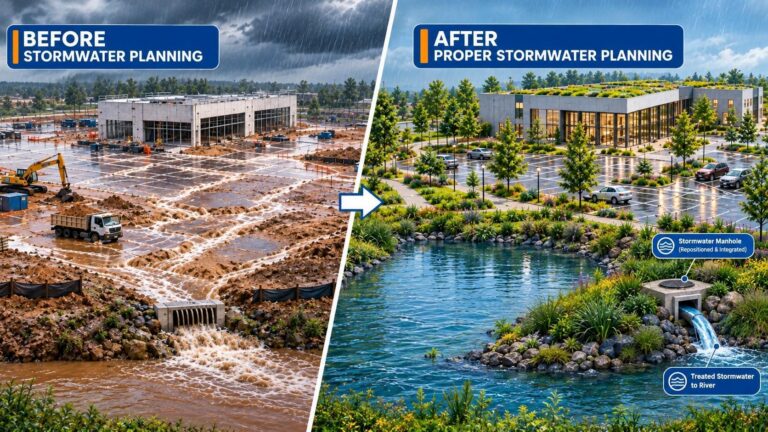
Stormwater management ordinances are here to stay, and in most of the country, they will become even more stringent over time. However, developers who have a firm grasp on the NPDES stormwater permit requirements, as well as the additional layers of state and local ordinance, will be able to make the process a consistent element of their predevelopment process. Plan the stormwater management system up front; choose the appropriate balance of detention, retention, and low impact development techniques to fit your site; establish a clear plan for maintenance, and you’ll find your next project breezing through the site plan stormwater review process.
Many infrastructure owners land on a hybrid model: a small internal team that owns the BIM execution plan and data standards, paired with outsourced BIM modeling services for high-volume CAD to BIM conversion or scan-to-BIM capture work.
It is like what some transport organizations have been doing in their phased approach. For instance, the Ministry of Transportation in Ontario aims to integrate the digital twins into all contracts by 2034 in a stepwise manner, not in an instant switch-over.
Scale Your AEC Projects with Expert Design Support
Whether you’re managing multiple projects or facing resource constraints, our experienced engineering professionals seamlessly integrate with your team to provide accurate design, drafting, BIM coordination, and technical documentation, keeping your projects on schedule and within budget.