

Federal Proposal Management: How to Build a Proposal Team That Actually Wins
An RFP drops, and suddenly everyone is moving.
The Proposal Manager is chasing SME inputs. The technical team is interpreting requirements. Contracts has questions about the solicitation. Pricing needs staffing assumptions. Writers are waiting for content, while leadership wants to know whether the proposal is on track.
The problem may not be the quality of the people involved. It may be the way the proposal is being managed.
Federal proposal management is what keeps the people, requirements, deadlines, content, pricing, reviews, and submission activities moving together. A strong proposal team does not simply produce good content. It operates from a coordinated process where responsibilities are clear, dependencies are visible, and compliance is managed from kickoff through submission.
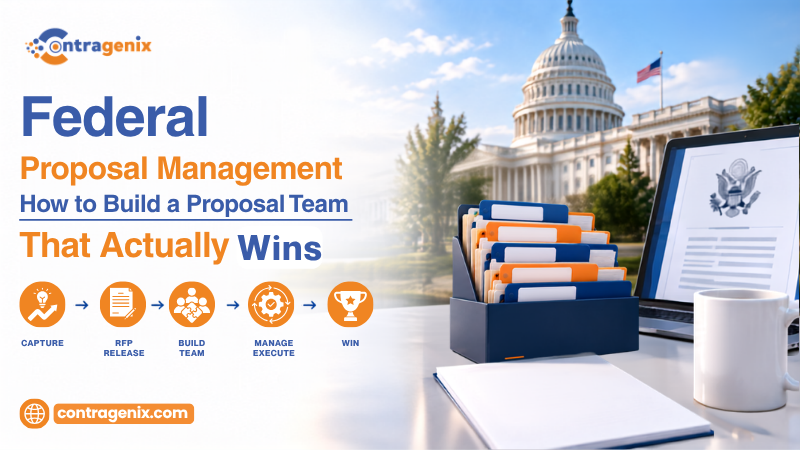
The basic progression looks like this:
Capture → RFP Release → Kickoff → Roles & Responsibilities → Compliance → Schedule → Writing → Pricing → Reviews → Final Production → Submission
When those pieces are coordinated properly, the proposal becomes much easier to control. When they are not, even a technically strong response can become a last-minute scramble.
What Is Federal Proposal Management?
Federal proposal management is the coordination of the people, requirements, content, schedule, reviews, pricing, compliance activities, and submission tasks required to produce a competitive government proposal.
The Proposal Manager typically serves as the operational coordinator. That does not mean the Proposal Manager writes every section, develops the technical solution, owns pricing, or makes every capture decision.
Instead, the Proposal Manager keeps the response moving and makes sure the different parts of the proposal connect.
That distinction matters.
Capture management focuses heavily on positioning the opportunity, understanding the customer, shaping the pursuit, and developing a win strategy. Business development focuses on identifying and developing opportunities. Proposal writing focuses on creating persuasive response content. Proposal development encompasses the broader work required to build the actual response.
Proposal management connects these activities during the response process.
For a small contractor, one person may wear several of these hats. That is common. What matters is that ownership remains clear even when the organization is small.
What Does a Federal Proposal Management Process Look Like?
Effective proposal management often begins before the RFP is released.
During the pre-RFP stage, teams may already be monitoring anticipated requirements, coordinating with capture, considering teaming arrangements, assessing staffing needs, and preparing information that will be needed once the solicitation arrives.
The objective is not to write the proposal before there is an RFP. It is to reduce avoidable reaction time.
RFP Release and Kickoff
Once the solicitation is released, the proposal manager helps turn the RFP into an executable internal plan.
The team needs to understand what the government is asking for, how the response must be structured, what information is required, and when each piece needs to be completed.
The kickoff should establish the proposal schedule, responsibilities, communication process, major dependencies, and immediate actions. It is also the point where the team begins identifying questions, ambiguities, and requirements that may need clarification.
A proposal calendar should work backward from the actual submission deadline—not simply copy the government’s deadline into an internal tracker.
Compliance and Responsibility Mapping
The compliance matrix becomes one of the team’s most useful management tools when it is actually used throughout development.
It can connect requirements to proposal sections, owners, page or word limitations, deliverables, SMEs, and other dependencies. Instead of leaving compliance until final production, the team can use the matrix to track whether each requirement has been addressed as the response develops.
This is particularly important when one requirement affects several parts of the proposal.
A technical commitment might influence staffing. Staffing can affect pricing. Pricing assumptions can affect the technical narrative. A resume may need to support the same qualifications described elsewhere.
Good proposal management makes those connections visible early.
Writing and Content Development
Once responsibilities are established, the proposal manager coordinates the development of the actual response.
This includes managing outlines and assignments, collecting SME input, tracking drafts, coordinating past performance and resumes, managing graphics and supporting evidence, and controlling versions.
The goal is not simply to make sure every section has a writer. The goal is to make sure writers have what they need to produce a response that addresses the solicitation and evaluation criteria.
That often means identifying missing information before it becomes a deadline problem.
A technical SME who misses one internal deadline may not seem like a major issue. But if that input feeds three proposal sections, a graphic, a resume, and a pricing assumption, the delay can spread quickly.
Pricing and Contracts Coordination
Technical and pricing teams cannot operate in separate lanes.
The proposed solution may depend on labor categories, staffing levels, quantities, schedules, subcontracting assumptions, travel, materials, or other cost considerations. Changes in one area can create consequences in another.
For example, if the technical approach changes the level of effort required to perform the work, pricing may need to change with it. If pricing assumptions change, the technical response may need to reflect those assumptions accurately.
Federal proposal management provides the coordination point between these functions so the final response does not contain disconnected commitments.
Reviews and Final Submission
Structured reviews give the team opportunities to evaluate the proposal before the final deadline.
Organizations use different review terminology and processes, but stages such as Pink Team, Red Team, and Gold Team are commonly used to assess different aspects of proposal development.
The most valuable reviews are not simply proofreading exercises. Reviewers should evaluate the proposal against the solicitation and evaluation criteria.
They should ask:
- Does the response answer the requirement?
- Does it address what the government says it will evaluate?
- Is the proposed approach credible?
- Is supporting evidence clear?
- Can the evaluator easily find the answer?
After substantive reviews, the team still has final production work to complete: compliance checks, formatting, file validation, naming conventions, approvals, and submission verification.
The government deadline should not be the team’s production deadline.
Who Should Be on a Federal Proposal Team?
A federal proposal team does not need to be large to be effective. It needs clear ownership.
Proposal Manager
The Proposal Manager coordinates the response operation. This includes the schedule, assignments, meetings, compliance tracking, content flow, reviews, and final readiness.
Their role is less about owning every answer and more about making sure the right people deliver the right answers at the right time.
Capture Manager
The Capture Manager brings the broader pursuit strategy into the proposal process. They help connect customer understanding, competitive positioning, teaming, solution development, and win strategy to the response.
Technical Lead or Solution Architect
The Technical Lead helps ensure that the proposed solution is technically sound, feasible, and aligned with the customer’s requirements.
Proposal Writers
Writers translate technical information and solution strategy into clear, compliant proposal content. They should not have to invent technical details simply because SME inputs were poorly coordinated.
Subject Matter Experts
SMEs provide the specialized knowledge behind the response. Their contribution can be critical, but their availability must be managed because they are often balancing proposal work with delivery responsibilities.
Pricing and Finance
Pricing and finance develop the cost side of the proposal and help ensure that staffing, labor, quantities, assumptions, and other financial elements align with the proposed solution.
Contracts
Contracts professionals help interpret solicitation terms, contractual requirements, clauses, and other issues that may affect the response.
Executive Leadership
Leadership provides strategic direction, approvals, resources, and final decision-making. Their involvement should be intentional rather than turning every proposal decision into an executive escalation.
For smaller contractors, several of these responsibilities may belong to the same person. That makes a defined operating structure even more important.
How to Build a Proposal Team That Actually Works
The strongest proposal teams are built around ownership, realistic deadlines, visible dependencies, centralized information, and objective review.
Every important requirement should have an owner. When something becomes “everyone’s responsibility,” it can quickly become nobody’s responsibility.
The same principle applies to deadlines. If the government submission is due Friday at 5:00 p.m., the internal team should not be planning to finish the proposal Friday afternoon. Internal milestones need to leave room for substantive reviews, revisions, compliance checks, formatting, approvals, and unexpected problems.
Dependencies should also be visible.
A delayed SME input may affect more than one section. A change to the technical solution may affect pricing, staffing, resumes, graphics, and past performance. A strong Proposal Manager identifies those relationships rather than treating each section as an isolated assignment.
The team also needs a single source of truth for proposal files, drafts, requirements, and versions. Searching through email threads for the latest document is not a proposal management system.
Most importantly, reviews should be objective.
A reviewer should not rewrite a section simply because they would have used different wording. The better question is whether the response answers the requirement, supports the evaluation criteria, provides credible evidence, and makes the answer easy for the evaluator to identify.
That shift—from personal preference to evaluator-focused review—can significantly improve the quality of proposal feedback.
Federal Proposal Management Best Practices
Strong proposal management starts early, but it does not mean creating unnecessary process.
The most effective teams establish milestones that reflect the actual work required, assign ownership early, and continuously track compliance rather than treating the compliance matrix as a final checklist.
SMEs should be involved early enough to influence the response rather than being asked to approve a nearly finished narrative. Technical and pricing decisions should be coordinated as the solution develops. Review stages should be scheduled early enough that the team can act on what reviewers find.
Version control also matters more than it may appear. When multiple people are editing different versions of the same section, the team can lose time reconciling changes or, worse, submit outdated content.
Finally, every proposal should create institutional knowledge. After submission, teams can capture what worked, what caused delays, which requirements created confusion, and where the process broke down. That information can improve the next proposal instead of disappearing when the current deadline passes.
Common Federal Proposal Management Mistakes
One common mistake is allowing the Proposal Manager to become the bottleneck.
If every decision, edit, question, and follow-up must pass through one person, the Proposal Manager can spend more time chasing work than managing the proposal.
Another problem is bringing SMEs in too late. Writers may develop assumptions that later have to be completely rewritten once technical experts review the content.
Teams also get into trouble when they begin writing before fully understanding the solicitation. A polished response can still miss the mark if it does not address the requirements and evaluation criteria.
A compliance matrix can create a false sense of security when it exists only as a document. If nobody uses it to track actual response development, unresolved requirements can remain hidden until the final review.
Late reviews create another serious operational risk. A Red Team conducted hours before submission does not leave much time to fix major weaknesses.
Pricing and technical disconnects are equally dangerous. A proposal cannot credibly promise one staffing model while pricing reflects another.
And perhaps the simplest mistake is failing to establish who owns final submission. Submission should never depend on an assumption that “someone will send it.”
How Section L and Section M Fit Into Proposal Management
Section L and Section M should influence the proposal management process from the beginning.
Generally, Section L provides instructions on what and how the contractor must submit, while Section M explains how the government will evaluate the proposal.
That distinction affects assignments, compliance tracking, outlines, reviews, and the team’s definition of a complete response.
The proposal should be managed against both—not simply written first and checked against them later.
For a deeper look at how these sections shape proposal development, see Contragenix’s resource on Section L and Section M.
When Should Contractors Use Outside Proposal Support?
Not every contractor needs a large permanent proposal organization.
Outside support can make sense when an internal team is overloaded, several pursuits are running at the same time, an opportunity requires more proposal capacity than the company currently has, or technical SMEs need experienced proposal support to turn their knowledge into a compliant response.
It can also be useful when a proposal requires additional compliance management, structured reviews, editing, formatting, or production support.
For smaller and mid-sized GovCon businesses, external support can provide experienced proposal professionals without requiring the company to build a large permanent team.
When the gap is capacity, process, or proposal execution, proposal development services can provide additional support across the response lifecycle.
Contractors looking to strengthen their content should also review their government proposal format and make sure the structure supports both compliance and evaluator readability.
Conclusion
A strong federal proposal is not simply a collection of good writing and technical content.
It is the result of a coordinated process in which the right people know what they own, requirements are tracked, dependencies are managed, technical and pricing decisions remain connected, reviews happen early enough to matter, and final submission is controlled.
That is the real value of federal proposal management. It gives the proposal team an operating structure that keeps the response moving toward a compliant, credible, and competitive submission.
When internal capacity or process becomes the constraint, Contragenix can support the response through its proposal development services.