

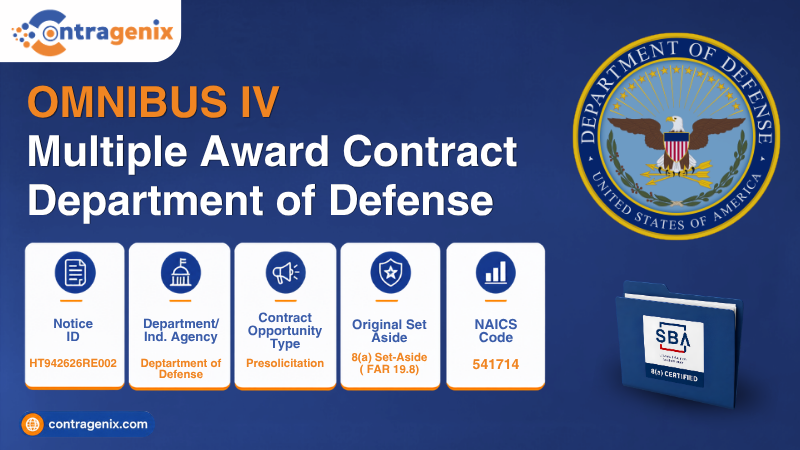
OMNIBUS IV On-Ramp 2026: What 8(a) Contractors Need to Know
The OMNIBUS IV on ramp is moving toward a critical stage for 8(a) federal contractors.
On August 17, 2026, the Defense Health Agency Contracting Activity (DHACA) updated its pre-solicitation notice and extended the anticipated release of the formal solicitation to late September 2026. The planned on-ramp is intended to add new 8(a) small-business contractors to the existing Department of Defense OMNIBUS IV multiple-award IDIQ supporting military medical research and development.
For contractors that fit the requirement, this is the time to understand the vehicle, assess their positioning, and prepare for the RFP.
Official opportunity: On-Ramp for the Department of Defense OMNIBUS IV Multiple-Award Contract
What Is the OMNIBUS IV On-Ramp?
The OMNIBUS IV on-ramp is a planned opportunity for new contractors to join an established DoD multiple-award, indefinite-delivery, indefinite-quantity (IDIQ) contract vehicle.
DHACA intends to expand the pool of eligible contractors supporting ongoing and future military medical research and development requirements. The existing OMNIBUS IV vehicle was awarded in 2022 and has an ordering period that extends through June 2032, including its option ordering period.
The distinction between the existing vehicle and the on-ramp matters.
The $10 billion figure associated with OMNIBUS IV is the cumulative ceiling of the existing IDIQ. It is not $10 billion in newly available funding being released through this on-ramp.
What makes the on-ramp significant is the opportunity to become a contract holder on a vehicle that is already being used for task-order requirements.
What Do We Know About the 2026 OMNIBUS IV On-Ramp?
The latest pre-solicitation provides several important signals for contractors.
The anticipated RFP is now expected in late September 2026. The solicitation is planned as an 8(a) set-aside, and the government anticipates making multiple new awards.
The existing OMNIBUS IV vehicle has a $10 billion cumulative ceiling. According to the August 17 update, more than $630 million in task-order value has been awarded across 55 task orders, including future unexercised option periods. Thirty-six task orders have been awarded to small businesses. The government also reports that competitive task-order activity has increased across recent fiscal years.
These numbers should be read correctly.
They do not represent guaranteed revenue for new awardees. They demonstrate that OMNIBUS IV is an active contract vehicle with an established history of task-order activity.
That makes the on-ramp worth evaluating as part of an 8(a) contractor’s capture strategy.
Who Is Eligible for the OMNIBUS IV On-Ramp?
The planned solicitation is intended for small businesses certified under the SBA 8(a) Program. The government anticipates multiple new awards, with new awardees becoming eligible to compete for task orders under the existing vehicle.
But eligibility and competitiveness are two different questions.
An 8(a) certification may make a contractor eligible to pursue the opportunity. It does not automatically establish that the company has the right technical capabilities, past performance, personnel, or positioning to compete effectively.
Before the RFP arrives, contractors should be asking:
Where does our company fit within OMNIBUS IV?
Which capabilities can we prove?
Which past performance supports our position?
What makes our company relevant to the government’s medical R&D requirements?
Those questions belong in the capture process—not after proposal development has already started.
What Work Does OMNIBUS IV Cover?
The scope of OMNIBUS IV is broad and is organized into four market segments:
- Research and Development
- Research and Development Support Services
- Regulatory Processes
- Translational Science Support and Services
The vehicle covers a wide range of health-related research and development activities. Identified program areas include medical simulation technologies, infectious diseases, military health, performance and recovery, joint battlefield healthcare, radiation health effects, clinical and rehabilitative medicine, chemical and biological readiness, genomics and omics-based activities, and emerging science and technology.
The scope also includes areas such as research involving human subjects, investigational products, regulatory requirements, technology transfer, evidence-based solution development, implementation, and evaluation.
For contractors, the breadth of the vehicle creates a strategic challenge: being broadly capable is not the same as being clearly positioned.
A strong pursuit should identify the market segment and capability areas where the company’s experience is most credible.
How Should 8(a) Contractors Prepare Before the RFP?
The pre-solicitation period is an opportunity to do the work that becomes harder once the proposal clock starts.
Identify your strongest market-segment fit
Map your actual capabilities to the OMNIBUS IV segments. Focus on where you can demonstrate meaningful relevance rather than trying to claim the entire scope.
Build your evidence
Gather relevant contracts, customers, outcomes, technical accomplishments, and past-performance examples. A capability statement is stronger when it is supported by evidence.
Define your differentiators
Ask what your company brings that another qualified 8(a) contractor may not. Differentiation should be specific, defensible, and relevant to the mission.
Organize proposal content
Corporate experience, key personnel information, technical material, past performance, and supporting documentation should be accessible before the RFP arrives.
Establish compliance process
Once the solicitation is released, the proposal team will need to map requirements, instructions, evaluation criteria, and submission requirements. A structured government RFP response process can help keep that work organized.
Prepare for rapid execution
The objective is not to write the entire proposal before the RFP exists. It is to eliminate avoidable preparation work so the team can focus on the actual solicitation once released.
Monitor the official sources
Interested contractors are responsible for monitoring SAM.gov and the PIEE Solicitation Module for the solicitation and amendments. The formal proposal is expected to be submitted through the applicable PIEE process.
Why Should Contractors Prepare Before the RFP?
Waiting for the formal solicitation may feel like the logical move. After all, the government has not released the final requirements yet.
But preparation does not require guessing what the RFP will say.
Contractors can prepare the pieces that are unlikely to become easier under deadline pressure: identifying relevant experience, organizing past performance, assessing market-segment fit, developing differentiators, aligning key personnel, and establishing a proposal team.
That is the difference between starting preparation and starting from scratch.
Pre-RFP preparation does not guarantee an award. It creates a stronger starting position when the actual solicitation arrives.
How Can Contragenix Help With OMNIBUS IV Preparation?
Contragenix helps federal contractors turn emerging opportunities into structured capture and proposal strategies.
For an OMNIBUS IV pursuit, that can include opportunity analysis, capture strategy, capability positioning, past-performance positioning, compliance mapping, proposal development, technical writing, proposal management, and proposal reviews.
The goal is not to promise a contract award. It is to help an eligible contractor understand where it fits, build the evidence behind that position, and prepare to respond effectively when the formal RFP is released.
If OMNIBUS IV is on your 2026 capture calendar, the time to build your proposal foundation is before the RFP arrives.
Prepare to compete. Position to win.
Looking to win a spot on OMNIBUS IV?
Don’t wait for the solicitation to start preparing. Connect with Contragenix to evaluate your positioning, identify gaps, develop your capture strategy, and build a proposal approach designed for the opportunity.