

GSA MAS Refresh 33: Key Changes Contractors Need to Know in 2026
Last Updated: August 2026
On August 12, 2026, the General Services Administration’s Federal Acquisition Service issued an advance notice outlining planned changes for GSA Multiple Award Schedule (MAS) Solicitation 47QSMD20R0001. GSA anticipates issuing MAS Refresh 33 in September 2026, followed by a mass modification.
That timing matters, but so does the status of the announcement.
For existing GSA Schedule contractors, however, the most important point is the status of the announcement: Refresh 33 is not final.
The proposed changes touch supply-chain security, FASt Lane eligibility, product substitutions, SCLS wage determinations, several SINs, Travel SIN documentation, and other MAS solicitation provisions. The practical question is not simply “What did GSA announce?”
It is:
Which of these changes could affect my Schedule, my offerings, or my next GSA submission?
What Is GSA MAS Refresh 33?
GSA MAS Refresh 33 is a planned update to GSA Multiple Award Schedule Solicitation 47QSMD20R0001. GSA currently anticipates issuing the refresh in September 2026, with proposed changes covering areas including supply-chain security, FASt Lane eligibility, product substitutions, SCLS wage determinations, and specific MAS SINs.
The important distinction is between the advance notice, the final solicitation refresh, and the subsequent mass modification.
The August 12 notice is not itself the final set of Schedule requirements. GSA describes the material as a high-level description of significant changes planned for the upcoming refresh and mass modification and directs contractors to the final versions for the final requirements.
Contractors should therefore use the current notice to identify potential exposure and prepare internally, while relying on the final solicitation and mass modification for the requirements that ultimately take effect.
Who Should Pay the Most Attention to MAS Refresh 33?
The proposed changes will not affect every GSA Schedule contractor in the same way.
Contractors that should prioritize a review include:
- Contractors operating under the affected SINs
- Product contractors that manage substitutions or changing product lines
- Contractors subject to applicable supply-chain security requirements
- Contractors performing services subject to SCLS
- Companies preparing new MAS offers
- Contractors under SIN 531 or SIN 561510
- Companies that may potentially benefit from expanded FASt Lane eligibility
- Proposal teams responsible for maintaining SOWs, pricing templates, and Schedule submission materials
- Contractors outside these areas may have little or no immediate operational impact. The purpose of an early review is therefore not to assume that every provision applies to every contractor, but to identify where the proposed changes intersect with your existing Schedule or future business plans.
What Are the Major Planned Changes in GSA MAS Refresh 33?
The following framework translates the proposed changes into the areas contractors should review now:
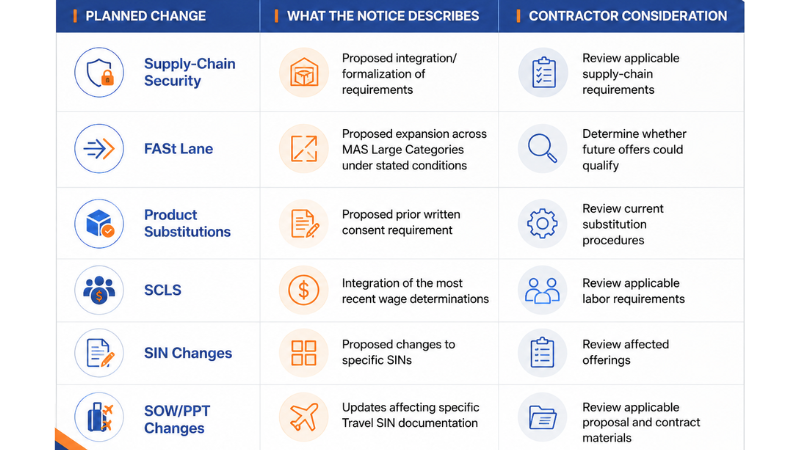
The impact will not be uniform. A contractor operating under an affected SIN may have a very different review list from a contractor whose Schedule offerings are outside those areas.
Supply-Chain Security Requirements
One of the broader proposed changes concerns supply-chain security.
The notice describes proposed changes involving GSAR Part 540, including 552.540-70 and 552.540-71, as part of an effort to formally integrate existing supply-chain requirements into the GSA acquisition supplement. The notice connects this work with GSA’s broader RGO initiative to evaluate and reimagine its acquisition system.
The important point for contractors is that this is not simply another SIN-description update. It concerns how supply-chain requirements are incorporated into the MAS framework.
What This Could Mean for Contractors
For contractors, the practical response is to determine whether supply-chain requirements already relevant to their products, services, vendors, or fulfillment processes could intersect with the final MAS language.
That does not mean every Schedule contractor should assume a new compliance obligation is already effective.
The current notice is a proposed-change document. Contractors should review their applicable requirements now and then compare them against the final refresh when issued.
FASt Lane Eligibility Could Expand Across MAS Categories
FASt Lane is another area worth watching closely.
The proposed change would expand FASt Lane eligibility across the MAS solicitation and its Large Categories under specified conditions. The proposal centers on situations involving a validated federal requirement, agency sponsorship or documented customer demand, and verifiable, compelling customer needs.
There are important limitations.
Startup Springboard would remain limited to approved FASt Lane participants, while FASt Lane modification processes would remain limited to the IT Category. The proposed non-IT eligibility concerns offers, including requirements around pending submissions.
So the wrong takeaway is:
“FASt Lane is now available to everyone.”
The better takeaway is:
The proposal would expand FASt Lane eligibility across MAS categories, but it does not make every offeror automatically eligible.
For companies preparing future Schedule offers, this could become strategically relevant. But eligibility should be evaluated against the final language and the specific circumstances of the offer—not assumed from the advance notice.
Product Substitutions Could Require Prior Written Consent
The proposed product-substitution language deserves attention from contractors whose Schedule business involves products that may change over time.
Under the proposed language described in the notice, substitutions would require prior written buyer consent. Authorized substitutions would also need to be listed on the MAS contract, subject to the proposed pricing conditions.
For contractors, the operational question is straightforward:
How are you currently managing products, substitutions, pricing, and contract listings?
If your business frequently replaces products because of availability, manufacturer changes, or other commercial considerations, this is an area worth reviewing before the final refresh.
Again, these are proposed changes—not requirements that should be treated as already effective.
Updated SCLS Wage Determinations
The proposed refresh would also incorporate the most recent Service Contract Labor Standards (SCLS) wage determinations.
Contractors performing services subject to SCLS should pay attention to the final language and applicable wage determinations when the refresh is issued.
The current advance notice does not establish specific wage rates in the material summarized here, so contractors should not infer particular rates or new obligations from the announcement alone.
Contractors should also avoid interpreting the proposed wage-determination update as meaning that every MAS contractor is newly subject to SCLS. The relevant question is whether the contractor’s existing services are subject to SCLS and which wage determinations apply.
GSA MAS Refresh 33 SIN and Category Changes
The SIN-specific changes are where the refresh becomes particularly relevant to contractors with affected offerings.
The proposed changes identified in the notice include SIN 238160, SIN 532490P, SIN 238910, SIN 531, and SIN 561510.
Contractors operating under these SINs should compare their current Schedule offerings and supporting contract materials against the proposed language, then repeat the review when the final SIN descriptions are issued.
SIN 238160 — Roofing Products and Services Solutions
The proposed revision would clarify the scope of SIN 238160 around roofing products and associated materials, installation, site preparation, and different combinations of products and services.
The proposed description addresses:
- Did we address every stated evaluation factor?
- Did we address the relevant subfactors?
- Is important evidence easy to find?
- Are significant claims supported?
- Does each major claim connect to evidence?
- Are our strongest differentiators visible?
- Are relevant past-performance examples clearly tied to the requirement?
- Have we addressed credible performance risks?
- Have we followed the proposal instructions?
- Does the response align with the stated evaluation criteria?
- Can an evaluator understand our value without hunting for it?
One notable point is that the proposed description places standalone roofing services within scope.
For contractors under this SIN, the final wording should be compared against the products and services currently represented on the Schedule.
SIN 532490P — Pre-Engineered/Prefabricated Buildings and Structures
The proposed changes to SIN 532490P address a broader range of temporary and prefabricated structures, including:
- Pre-engineered structures
- Prefabricated structures
- Portable/mobile structures
- Modular structures
- Temporary facilities
- Temporary living quarters
- Turnkey temporary facility solutions
- Have we addressed credible performance risks?
- Base camp facilities
- Operational support
The notice also proposes formalizing turnkey base camp facilities and related operational support services, such as laundry and housekeeping, when directly connected to leased or rented temporary structures.
There is an important boundary around food-related services. Meals, dining facility operations, and food services should not be treated as automatically included simply because other operational support services are addressed.
Contractors in this space should therefore review the final SIN language carefully rather than relying on broad interpretations of “turnkey.”
4PL and SIN 238910 Changes
The proposed 4PL clarification addresses bottled water and the distinction between food and beverage scope.
The notice indicates that food and beverages remain outside the MAS program, while bottled water may be included under the unique requirements of the 4PL SIN.
For SIN 238910, the proposed changes address ancillary services, incidental products, equipment rentals, and direct support provided in conjunction with Schedule services.
The proposed note indicates that incidental products must be separately priced and directly support Installation and Site Preparation Services.
That distinction matters when contractors evaluate whether an incidental product or related offering actually belongs within the scope of a Schedule service.
SIN 531 — Employee Relocation
The proposed SIN 531 updates include revised Statement of Work guidance involving:
- Move management requirements
- Updated audit and payment standards
- FMR 102-118
Contractors operating under this SIN should compare their current service delivery and proposal materials against the final SOW requirements when issued.
SIN 561510 — Travel Agent Services
The proposed SIN 561510 updates are broader and include changes to:
- Statement of Work requirements
- Price Proposal Template
- Transactional Data Reporting
- VIP remote/hybrid provisions
- Service-level agreements
- Explanatory codes
- New codes C6 and C7
- eOffers-related provisions
The notice specifically identifies changes to the Travel Agent Services SOW and Price Proposal Template, including Transactional Data Reporting and VIP remote/hybrid provisions.
For contractors under this SIN, this is a good reason to review both contract documentation and proposal-production processes, not just the Schedule contract itself.
How Could MAS Refresh 33 Affect GSA Schedule Contractors?
The answer depends on what you sell, which SINs you hold, and whether you are maintaining an existing Schedule or preparing a new offer.
Existing GSA Schedule Contractors
Existing contractors should begin with a simple exposure review:
- What MAS Large Categories and SINs do you currently hold?
- Which of those appear in the proposed changes?
- Do your current offerings align with the proposed descriptions?
- Do supply-chain considerations apply to your business?
- Are SCLS requirements relevant to your services?
- Do product substitutions form part of your normal contract-management process?
- Will any current proposal or SOW materials need attention if the final language changes?
This does not mean every existing contractor will need to modify its Schedule.
The purpose of the review is to determine whether there is an actual point of exposure before the final refresh and mass modification arrive.
If a change affects how you respond to federal requirements, your broader government RFP response process may also need to be considered alongside your Schedule-management process.
Companies Preparing a New GSA Offer
Companies preparing a GSA offer have an additional consideration: timing.
If your offer is being developed while Refresh 33 moves from advance notice to final solicitation, the final solicitation will control.
That means teams should avoid building an offer around assumptions taken exclusively from the August advance notice. Instead, track the final solicitation and verify the applicable SIN, solicitation instructions, SOWs, templates, and other requirements before submission.
Contractors in Affected SINs
Contractors operating under 238160, 532490P, 238910, 531, or 561510 should pay particular attention to the final language.
But even within an affected SIN, impact can differ depending on the contractor’s actual offering.
A SIN appearing in the refresh does not automatically mean every contractor under that SIN will experience the same operational or compliance impact.
What Should GSA Contractors Do Before MAS Refresh 33?
The most useful response to an advance notice is not panic. It is a structured review.
Map your current schedule.
Document your current MAS Large Categories, SINs, offerings, and relevant contract documentation.
Include current SOWs, pricing templates, reporting procedures, product listings, and other materials that could be affected by a SIN or solicitation change.
Identify direct exposure
Compare your current offerings against the SINs and provisions identified in the proposed Refresh 33 changes.
Review supply-chain considerations
If your products or services involve supply-chain requirements, identify the relevant processes and documentation you already maintain.
Identify the internal owner of those processes so any final requirement can be assessed quickly.
Evaluate FASTLane relevance
If your company expects to pursue future schedule offers, determine whether the proposed expansion could create an opportunity under the final eligibility requirements.
Review product-substitution procedures
If your business frequently changes products or product configurations, examine how substitutions are currently handled.
Pay particular attention to customer approval, pricing, documentation, and how approved substitutions are reflected on the schedule.
Check SCLS exposure
For applicable service offerings, identify the wage determinations and labor requirements that may need review when the final refresh is issued.
Review affected Travel SIN materials
Contractors under SIN 531 or SIN 561510 should review applicable SOWs, templates, reporting requirements, and related proposal materials.
Monitor the final solicitation
Do not stop at the advance notice. The final solicitation refresh is the document that should drive the next compliance and offer review.
Review the mass modification
Once issued, evaluate the mass modification against your existing schedule and determine what action, if any, is required.
MAS Refresh 33 vs. the Final Solicitation vs. the Mass Modification
This distinction is easy to overlook and critical to getting the analysis right.
Advance notice / draft
GSA communicates proposed changes and gives interested parties an opportunity to review and comment. The current notice explicitly identifies itself as a notification of a planned refresh or mass modification and states that the attached material is a draft.
↓
Final solicitation refresh
GSA issues the final Refresh 33. This is where contractors should look for the requirements that survived the draft stage and any changes made after review.
↓
Mass modification
The modification stage addresses the contractual implementation of applicable changes for existing Schedule contractors.
The August 2026 notice should therefore be treated as a preparation document, not as the final contract requirement.
GSA MAS Refresh 33 – FAQs
What is GSA MAS Refresh 33?
GSA MAS Refresh 33 is a planned update to Multiple Award Schedule Solicitation 47QSMD20R0001. GSA anticipates issuing it in September 2026. The current announcement is an advance notice describing proposed changes, not the final refresh.
When is MAS Refresh 33 expected?
GSA anticipates issuing Refresh 33 in September 2026. The final issuance should be monitored before contractors make decisions based on the proposed language.
What changes are included in MAS Refresh 33?
The proposed changes include supply-chain security, FASt Lane eligibility, product substitutions, SCLS wage determinations, specific SIN changes, Travel SIN SOW and template updates, and other solicitation provisions.
Does Refresh 33 expand FASt Lane eligibility?
The proposal would expand FASt Lane eligibility across MAS Large Categories under specified conditions. It does not mean every offeror automatically qualifies.
Does MAS Refresh 33 affect all GSA Schedule contractors?
Not necessarily. The proposed changes cover multiple areas, but the practical impact depends on a contractor’s Schedule, SINs, offerings, and applicable requirements.
Are GSA SINs changing under Refresh 33?
The advance notice identifies proposed changes to several SINs, including 238160, 532490P, 238910, 531, and 561510. Contractors should review the final descriptions before determining their impact.
Will GSA issue a mass modification?
The advance notice identifies an upcoming mass modification associated with the planned refresh. Existing contractors should review the final modification when GSA issues it.
What should contractors do before MAS Refresh 33?
Review your current SINs, offerings, supply-chain considerations, SCLS exposure, product-substitution processes, and applicable SOWs. Then compare those areas against the final Refresh 33 and mass modification.
The Bottom Line for Contractors
GSA MAS Refresh 33 is planned, not final.
That distinction should drive how contractors respond to the August 2026 announcement.
There is enough in the proposed changes to justify a review—particularly for contractors affected by the identified SINs, supply-chain provisions, SCLS requirements, product substitutions, FASt Lane eligibility, and Travel documentation.
But there is no reason to treat every proposed provision as an immediate new requirement.
The smarter approach is to map the proposed changes against your own Schedule, SINs, offerings, proposal processes, and compliance responsibilities now, then revisit that analysis when GSA issues the final September refresh and subsequent mass modification.
If you need help assessing how a GSA solicitation update could affect your Schedule, Contragenix helps federal contractors review GSA requirements and prepare compliant submissions for government opportunities.
Source: U.S. General Services Administration, Federal Acquisition Service — Significant Changes for the GSA Multiple Award Schedule (MAS) Solicitation.
Important: This article is based on the August 12, 2026, advance notice. The proposed language should not be treated as the final MAS Refresh 33 requirements. Contractors should review GSA’s final solicitation refresh and mass modification when issued.
Looking to Secure a GSA Schedule Contract?
The GSA Schedule process involves complex documentation, pricing negotiations, and compliance requirements. Contragenix helps businesses streamline the process with strategic support for GSA Schedule preparation, proposal development, and government contracting growth.