

Introduction
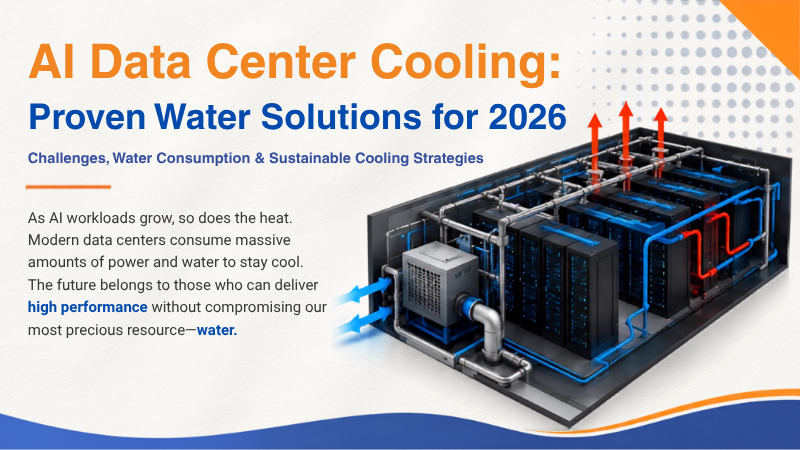
AI data center cooling has evolved from an engineering challenge into one of the most critical sustainability issues of the AI era. As AI models become larger and more compute-intensive, can today’s cooling systems manage the increasing heat without depleting valuable water resources?
The rapid growth of Generative AI, large language models (LLMs), and high-performance computing (HPC) is driving unprecedented demand for computing capacity. Each new generation of AI servers packs more GPUs into every rack, generating significantly more heat than traditional IT infrastructure.
Without an effective cooling system, AI data centers face overheating, reduced performance, and shorter equipment lifespans.
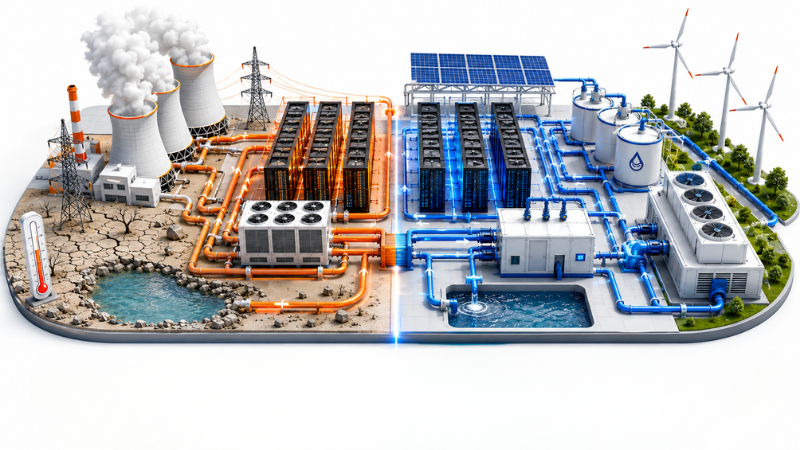
At the same time, many cooling technologies rely heavily on water. Evaporative cooling systems, cooling towers, and chilled-water infrastructure can consume millions of gallons of water annually, particularly in hyperscale data centers. With the increasing strictness of environmental laws and companies’ sustainability initiatives, reducing AI data center water consumption has become a necessity.
Fortunately, the sector has seen a fast pace of development. Liquid cooling for chips directly, immersion cooling, closed loop cooling systems, AI-based thermal management, and water-efficient infrastructure designs have transformed the data center architecture.
In this blog, you’ll learn:
- Why AI workloads require unprecedented levels of cooling
- Major factors contributing to high water consumption in data centers
- Benefits and drawbacks of different AI server cooling techniques
- Methods to improve thermal efficiency in your data center
- Futuristic cooling technologies for AI infrastructure
Whether you’re a data centre owner, engineer, architect, infrastructure consultant, or business leader planning future AI facilities, understanding these cooling strategies will help you design systems that are more efficient, resilient, and environmentally responsible.
Why AI Data Center Cooling Is Becoming a Global Challenge
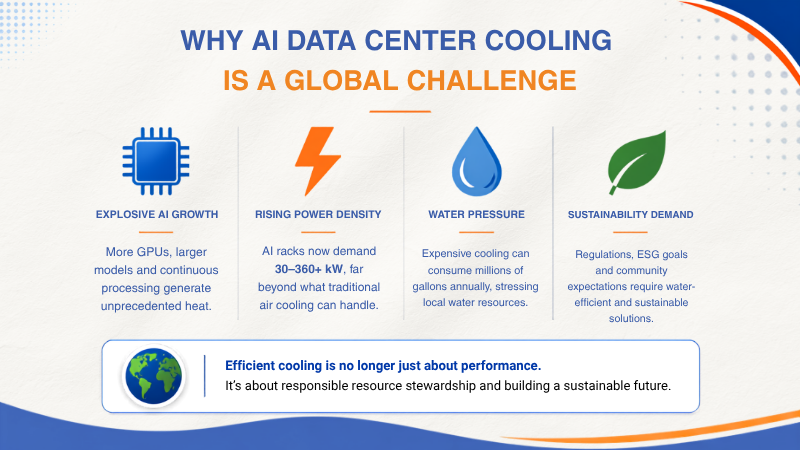
Artificial intelligence is changing almost every industry from healthcare and finance to manufacturing and autonomous vehicles. Behind every AI application are powerful data centres processing enormous amounts of information around the clock.
The downside of higher AI computing performance is simple: more power generates more heat.
Typical corporate servers used only modest amounts of electricity, so traditional air-cooling methods could easily maintain safe temperature levels. This is not the case with modern-day AI infrastructure, which generates significantly more heat.
The Rise of High-Density AI Infrastructure Cooling
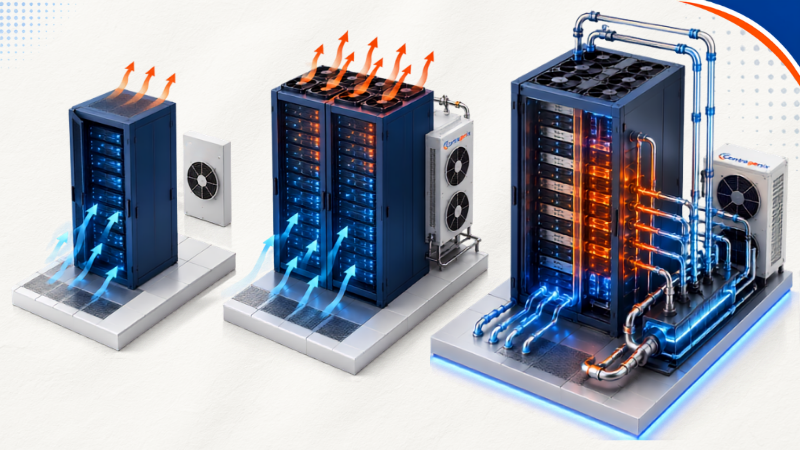
Contemporary AI servers may have multiple high-performance GPUs operating continuously during training and inference. These systems demand:
- More electrical power
- Higher rack density
- Continuous processing
- Improved thermal management
- Better cooling infrastructures
As rack power increases, dissipating heat with air alone becomes more challenging.
Typical Rack Density Evolution
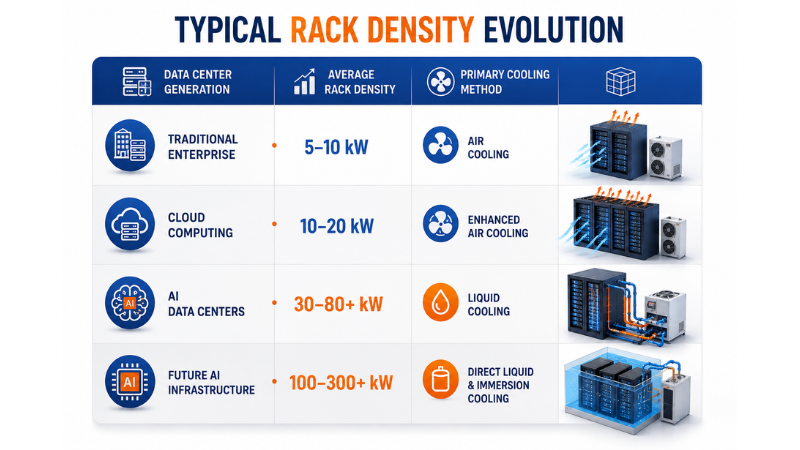
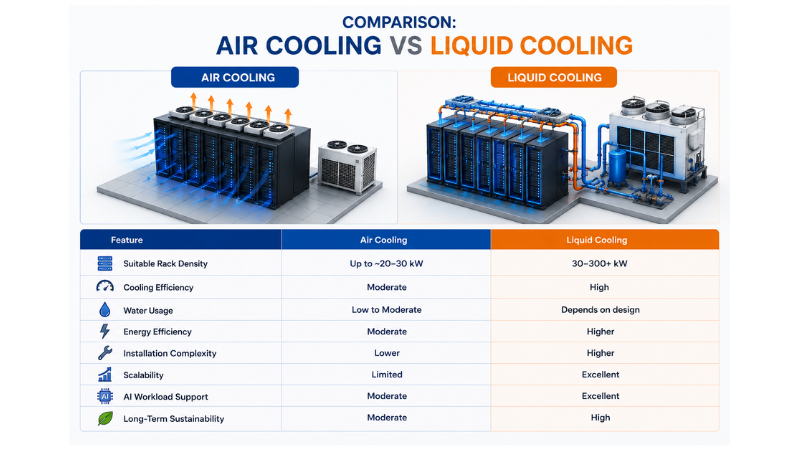
The transition toward higher rack densities is one of the main reasons liquid cooling for AI data centers is gaining widespread adoption.
Why AI Servers Produce More Heat
AI workloads differ significantly from traditional enterprise applications.
Tasks such as:
- Large Language Model (LLM) training
- Image generation
- Scientific simulations
- Drug discovery
- Machine learning inference
- Financial modelling
often keep GPUs operating near full capacity for extended periods. Nearly all of the electrical energy consumed by these processors is ultimately converted into heat, making efficient thermal management essential.
Without effective AI server cooling solutions, organisations may experience:
- Performance throttling
- Unexpected shutdowns
- Increased hardware failures
- Higher energy costs
- Reduced equipment lifespan
Why Water Plays Such an Important Role
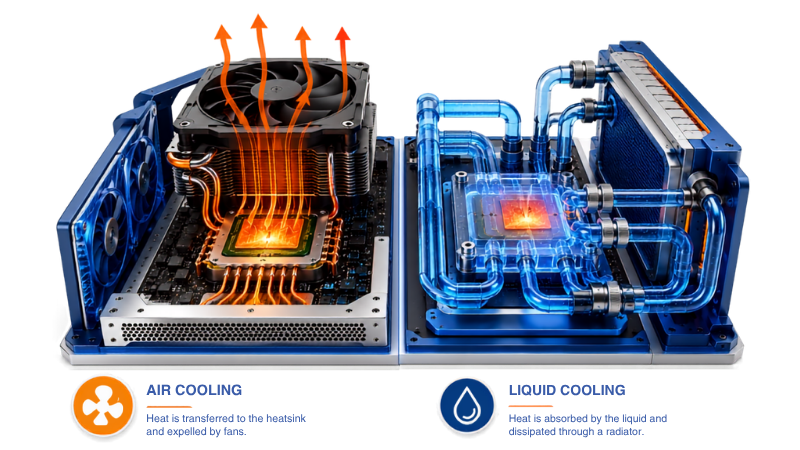
Water is one of the most effective heat-transfer media available.
Compared with air, water transfers heat far more efficiently while requiring a much smaller volume to remove the same amount of thermal energy. This superior heat-transfer capability makes water-based cooling systems the preferred choice for high-density AI infrastructure.
Common applications include:
- Chilled water loops
- Cooling towers
- Direct liquid cooling
- Rear-door heat exchangers
- Coolant distribution units (CDUs)
These technologies improve cooling efficiency but also introduce new considerations around data center water usage, water availability, maintenance, and sustainability.
Understanding Water Usage in AI Data Centers
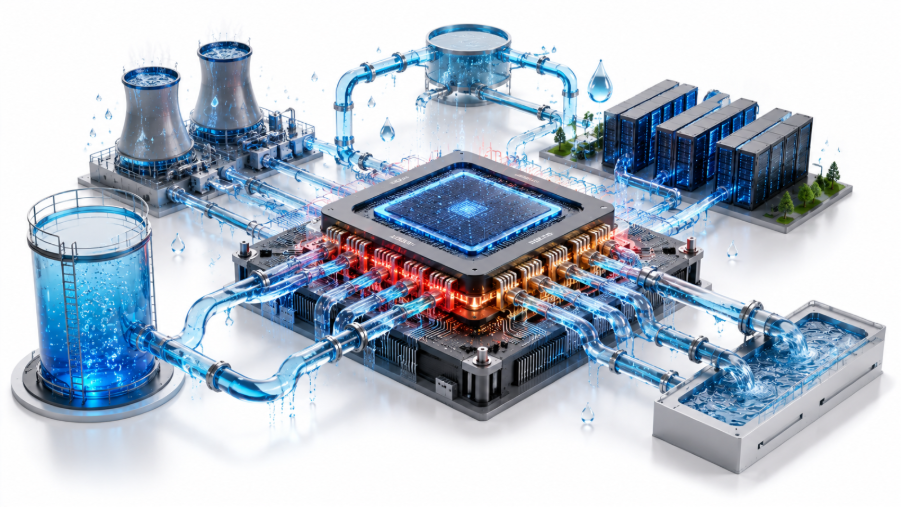
Water plays a central role in many modern cooling systems, yet its use varies considerably depending on the cooling technology employed.
Understanding where water is consumed is the first step toward improving efficiency.
How Water Is Used in Data Centers
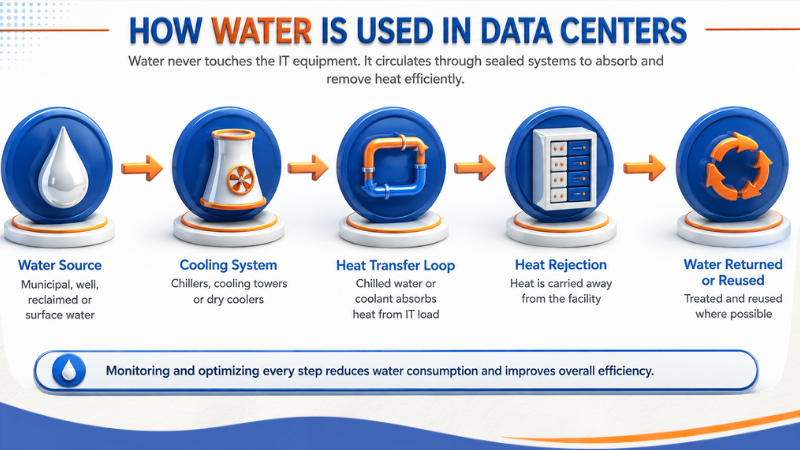
Contrary to a common misconception, servers are not directly exposed to water. Instead, water circulates through sealed cooling systems that absorb and remove heat from the computing equipment.
A typical water-cooled data centre may include:
- Chilled-water piping
- Cooling towers
- Heat exchangers
- Pumps
- Pumps
- Condensers
- Closed-loop circulation systems
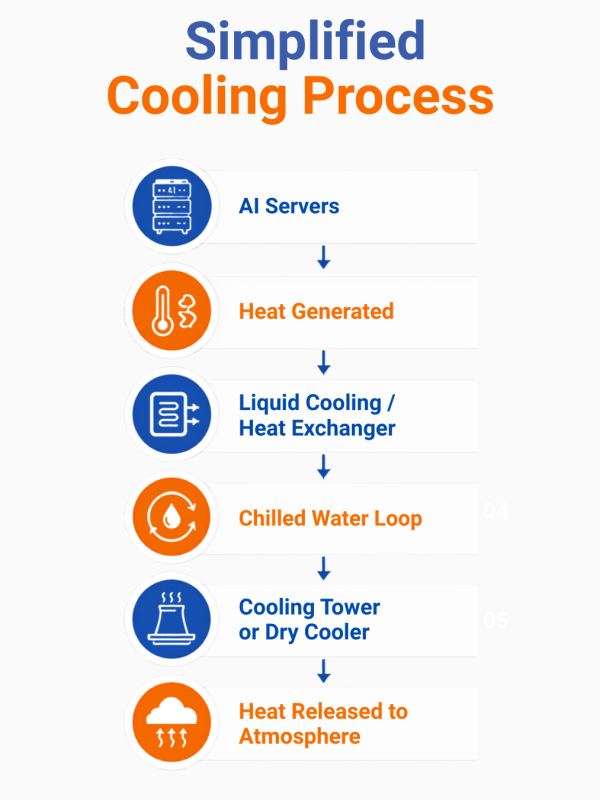
The heat generated by servers is transferred into the cooling water and then rejected to the outside environment
Simplified Cooling Process
What Is Water Usage Effectiveness (WUE)?
While many organisations focus on Power Usage Effectiveness (PUE), another important metric is Water Usage Effectiveness (WUE).
WUE measures the amount of water consumed to support a data centre’s IT operations.
A lower WUE generally indicates a more water-efficient facility.
Common factors influencing WUE include:
- Climate conditions
- Cooling technology
- Outdoor temperature
- Facility design
- AI workload density
- Cooling tower efficiency
Monitoring WUE helps operators identify opportunities to reduce water consumption while maintaining reliable cooling performance.
Why Water Consumption Is Increasing
Several industry trends are contributing to higher AI data center water consumption:
- 1. Increased Computing Power Density A higher number of GPUs per rack produces more heat.
- 2. More Advanced AI Models Running an advanced AI model may take weeks, hence the increased need for cooling.
- 3. Expansion of Hyperscale Facilities Global demand for AI services is driving rapid construction of large-scale data centres.
- 4. Rising Ambient Temperatures Facilities in warmer climates require more intensive cooling, which can increase water use in evaporative systems.
- 5. Continuous Availability Requirements Mission-critical AI applications often operate 24/7, leaving little room to reduce cooling loads.
Why Sustainability Is Driving Innovation
Water scarcity is becoming a growing concern across many regions of the world. As a result, organizations are rethinking how they design, operate, and optimize cooling systems.
Some of the main goals of sustainability include:
- Reduced water usage
- More water reuse
- Improved thermal performance
- Reduced costs
- Environmental compliance
- Business resilience
These priorities are accelerating investment in sustainable data center cooling technologies, including closed-loop systems, advanced liquid cooling, and alternative heat rejection methods.
The Biggest Water Problems in AI Data Center Cooling
As AI infrastructure expands, water management is emerging as one of the industry’s most complex engineering challenges. While water-based cooling systems provide excellent thermal performance, they also introduce operational, environmental, and economic risks that must be carefully managed.
1. High Water Consumption
Most cooling systems in use depend on evaporation for heat dissipation. While effective, evaporation consumes water indefinitely, requiring a constant supply to replace the losses.
For large-scale AI-based data centres that operate 24/7, this can lead to high water consumption rates, especially in areas where freshwater availability is a challenge.
Some of the effects include:
- Higher operational costs
- High dependence on local water sources
- Reporting sustainability issues
- Community opposition in water-scarce areas
2. Water Scarcity and Climate Risk
Water availability is becoming less predictable due to changing weather patterns, population growth, and competing industrial demands.
Facilities located in drought-prone regions may face:
- Water restrictions
- Higher utility costs
- Operational limitations
- Greater pressure to adopt water-efficient cooling strategies
As a result, site selection and cooling system design increasingly consider long-term water resilience alongside energy performance.
3. Scaling Cooling Infrastructure for High-Density AI Racks
The rapid adoption of AI is driving rack densities far beyond what traditional data centres were designed to handle. While conventional enterprise racks typically operate between 5–10 kW, modern AI racks can exceed 100 kW, with some next-generation deployments targeting 300 kW or more.
This shift presents several engineering challenges:
- Existing air-cooling systems struggle to remove heat efficiently.
- Cooling equipment may require costly upgrades or replacement.
- Higher cooling demand increases energy and water consumption.
- Mechanical systems become more complex to design and maintain.
As AI workloads continue to grow, designing scalable cooling infrastructure from the outset is becoming essential.
4. Water Quality and System Reliability
Cooling systems depend on clean and well-treated water to function effectively. Inadequate water treatment results in:
- Scaling of pipes and heat exchangers
- Corrosion of cooling system components
- Bacterial and algal growth
- Decreased heat transfer efficiency
- High maintenance costs
Water treatment and maintenance are vital to keeping the system running and ensuring longevity of the equipment.
5. Balancing Energy Efficiency and Water Efficiency
One of the biggest engineering challenges is balancing Power Usage Effectiveness (PUE) and Water Usage Effectiveness (WUE).
For example:
- Evaporative cooling often reduces energy consumption but increases water use.
- Dry cooling significantly reduces water use but may require more electricity in hot climates.
- Hybrid cooling systems attempt to optimise both metrics depending on weather conditions.
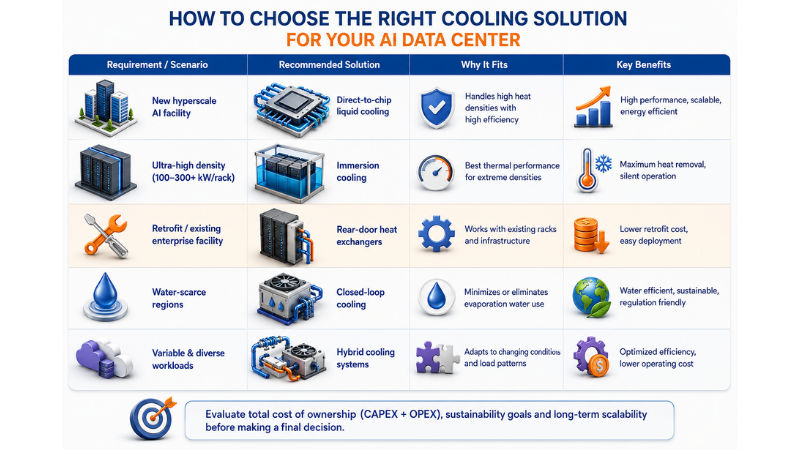
Selecting the right cooling strategy depends on climate, workload, sustainability goals, and operational priorities.
Modern AI Data Center Cooling Solutions
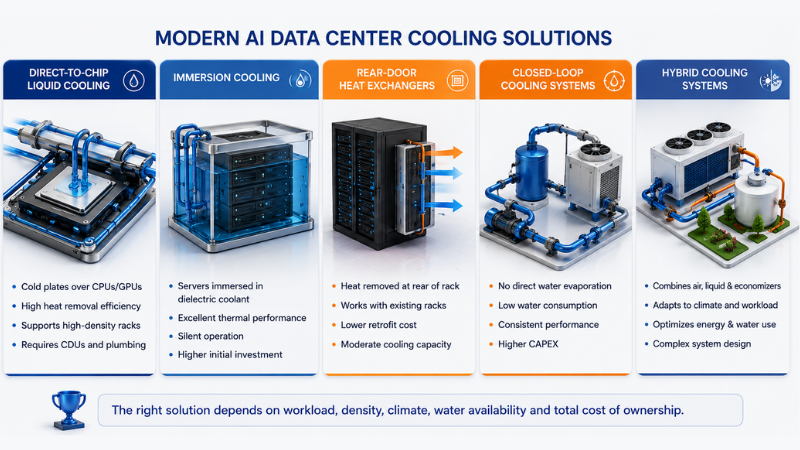
The limitations of traditional air cooling have accelerated the development of advanced cooling technologies capable of supporting high-density AI workloads.
1. Direct-to-Chip Liquid Cooling
Direct-to-chip liquid cooling uses cold plates attached directly to CPUs and GPUs, allowing liquid coolant to remove heat at its source with exceptional efficiency.
Advantages
- Effective heat removal from the source
- High rack density support
- Improved server performance
- Reduced operating temperatures
This technology is becoming one of the preferred AI server cooling solutions for large-scale AI deployments.
2. Immersion Cooling
Immersion cooling can significantly reduce water consumption, depending on the facility’s heat rejection system.
Advantages
- High cooling efficiency
- Very little water usage in many cases
- Reduced mechanical complexity
- Lower noise levels
- Extended hardware lifespan
Although still an emerging technology, immersion cooling is gaining traction for extremely high-density computing environments.
3. Closed-Loop Cooling Systems
A closed-loop cooling system significantly reduces water consumption by recirculating coolant, although small water losses may occur during maintenance .
Advantages
- Low freshwater use
- Environmentally friendly
- Improved reliability
- Better control over water quality
- Suitable for water-stressed regions
Many organisations are adopting closed-loop systems as part of their sustainability strategies.
4. Rear-Door Heat Exchangers
Rear-door heat exchangers capture heat as it exits the server rack.
Advantages are:
- Greater cooling capacity
- Lower room temperature
- Compatibility with the current data centers
- Relief to the air conditioning system in the facilities
They provide a practical upgrade path for facilities transitioning from traditional air cooling.
5. Hybrid Cooling Systems
Hybrid Cooling Systems Hybrid cooling uses several methods of cooling systems such as air cooling, liquid cooling, and economizers. This provides flexibility in choosing the cooling system depending upon workload and environment.
How to Choose the Right Cooling Solution for Your AI Data Center
Comparison: Air Cooling vs Liquid Cooling
Predictive design isn’t a plug-and-play upgrade, and it’s worth being realistic about where firms typically run into friction.
Emerging Technologies Transforming AI Infrastructure Cooling
The future of AI infrastructure cooling extends beyond traditional methods. Several innovations are reshaping the industry.
Artificial Intelligence for Thermal Management
Ironically, AI is also helping manage AI data centres.
AI-powered monitoring systems can:
- Predict heat patterns
- Optimise airflow
- Adjust cooling equipment automatically
- Detect failures early
- Reduce unnecessary energy and water use
This proactive approach improves operational efficiency and reduces costs.
Digital Twins
Digital twins create virtual models of physical data centres, allowing engineers to:
- Simulate thermal performance
- Test cooling strategies before deployment
- Optimise equipment placement
- Improve capacity planning
This reduces design risks and supports informed decision-making.
Advanced Coolant Technologies
Researchers continue to develop new coolants that:
- Improved heat transfer efficiency
- Decreased need for maintenance
- Increased system reliability
- Enabling increased computing density
It is anticipated that these advancements will help enhance the performance of the cooling process.
Best Practices for Sustainable Data Center Cooling
Organizations can greatly enhance their cooling efficiency and sustainability through adopting well-tested engineering best practices.
Recommended Best Practices
- Facility design must be done using anticipated increases in AI workload.
- Constant monitoring of PUE and WUE is important.
- Develop predictive maintenance systems.
- Closed-loop cooling systems should be used wherever possible.
- Treated water reuse should be done when allowed by law.
- Hot-aisle and cold-aisle containment must be employed for better airflow management.
- AI-based monitoring systems must be employed.
- Legacy system upgrades must be undertaken before capacity issues arise.
- Water quality testing must be conducted regularly.
- Cooling systems must be selected according to regional climatic factors
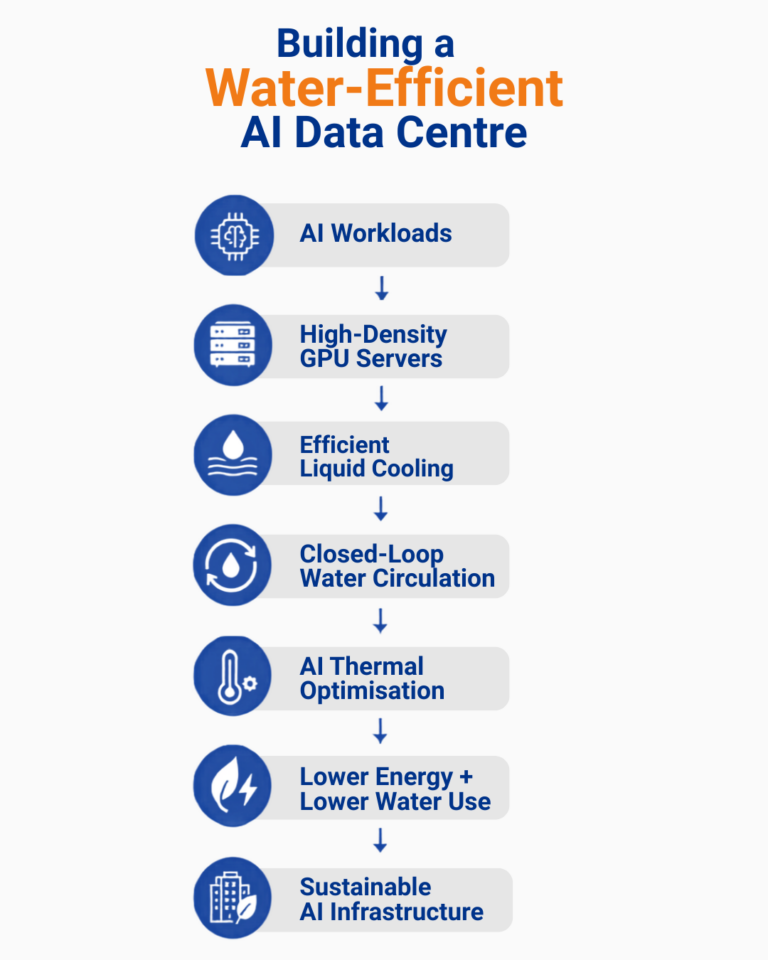
Building a Water-Efficient AI Data Centre
The Future of AI Data Center Cooling
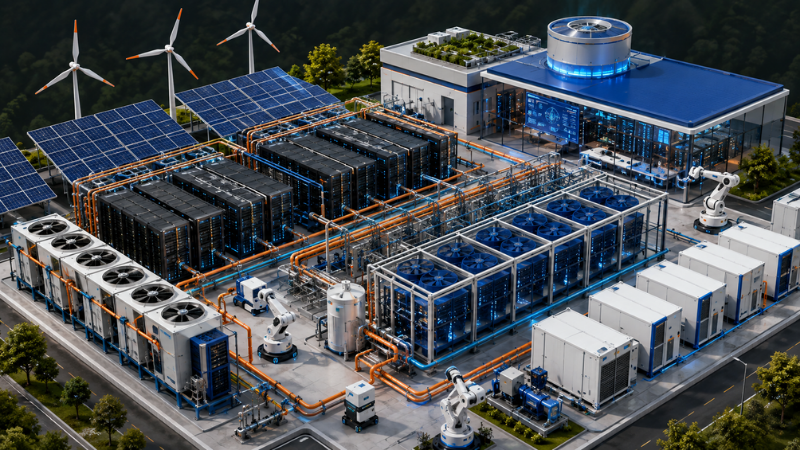
AI adoption is expected to continue accelerating across industries, increasing demand for reliable, high-performance computing infrastructure.
Future data centres are likely to focus on:
- Ultra-high-density rack designs
- Direct liquid cooling as a standard solution
- Increased use of immersion cooling
- Greater automation through AI
- Waterless and minimal water-cooling solutions
- Cooling systems powered by renewable energy sources
- Modular design data centres
Organizations which adopt sustainable cooling systems now will be well prepared for any future AI demands.
How AEC Design Expertise Supports Modern AI Data Centres
The creation of energy-efficient AI data centers goes beyond choosing the correct cooling system. It also involves integrating all areas of architecture, structural engineering, mechanical systems, electrical systems, and civil design.
Experienced AEC design and support teams can help organisations:
- Facilities must be designed to accommodate dense AI hardware.
- Ensure HVAC, plumbing and mechanical systems can achieve advanced cooling.
- Design BIM models to enhance cooperation between professionals from different fields.
- Layouts must be optimised with respect to air flow, maintenance access, and expandability.
By integrating engineering expertise early in the design process, organisations can reduce project risks, improve constructability, and create data centres prepared for evolving AI demands.
From Cooling Strategy to Build-Ready Design
Selecting the right cooling technology is only one part of designing a high-performance AI data center. Transforming that strategy into a reliable, build-ready facility requires experienced AEC engineering professionals. Contragenix LLC provides comprehensive AEC Design and Support Services to help engineering firms transform complex infrastructure concepts into build-ready designs.
Conclusion
AI is transforming digital infrastructure and fundamentally changing how modern data centers are designed, cooled, and operated. As computing densities increase, traditional cooling methods alone are no longer sufficient to meet performance, efficiency, and sustainability requirements.
Modern solutions including direct-to-chip liquid cooling, closed-loop cooling technology, immersion cooling, and AI-driven thermal management offer realistic means of handling increasing heat loads in an efficient manner while minimizing water use in data centers.
Meanwhile, efficient deployment of AI infrastructure initiatives relies on proper engineering, design, and planning. Organizations that invest in sustainable cooling strategies today will be better positioned to support future AI growth while reducing operating costs and environmental impact
.
FAQs
1. Why do AI data centres require more cooling than traditional data centres?
AI data centers feature powerful GPUs with high energy consumption and high heat generation, and thus they require innovative cooling technologies.
2. What is AI data center cooling?
AI data center cooling includes different systems and solutions for heat removal from AI computing infrastructure.
3. Why do some data centres consume large amounts of water?
Most of them use evaporative cooling and cooling towers based on using water for heat removal.
4. What is direct-to-chip liquid cooling?
In direct-to-chip liquid cooling technology, cooling liquid moves through cold plates installed on processors, which makes it much more effective than air cooling.
5. What is immersion cooling?
This is the process of submerging servers into special non-conductive liquid that takes away heat generated by electronic devices.
6. How can organisations reduce data centre water consumption?
Approaches include using closed loop cooling technology, better water treatment, recycling treated water when possible, improving airflow and using AI-based cooling controls.
7. What is Water Usage Effectiveness (WUE)?
WUE is a metric that measures the amount of water used to support data centre IT operations, helping organisations assess and improve water efficiency.
8. Is liquid cooling replacing air cooling?
Not completely. Although some places use both methods, liquid cooling has become more popular for high-density AI systems.
Scale Your AEC Projects with Expert Design Support
Whether you’re managing multiple projects or facing resource constraints, our experienced engineering professionals seamlessly integrate with your team to provide accurate design, drafting, BIM coordination, and technical documentation, keeping your projects on schedule and within budget.